


The association between indwelling urinary catheter use in the elderly and urinary tract infection in acute care
- PMID: 17038177
- PMCID: PMC1618836
- DOI: 10.1186/1471-2318-6-15
The association between indwelling urinary catheter use in the elderly and urinary tract infection in acute care
Abstract
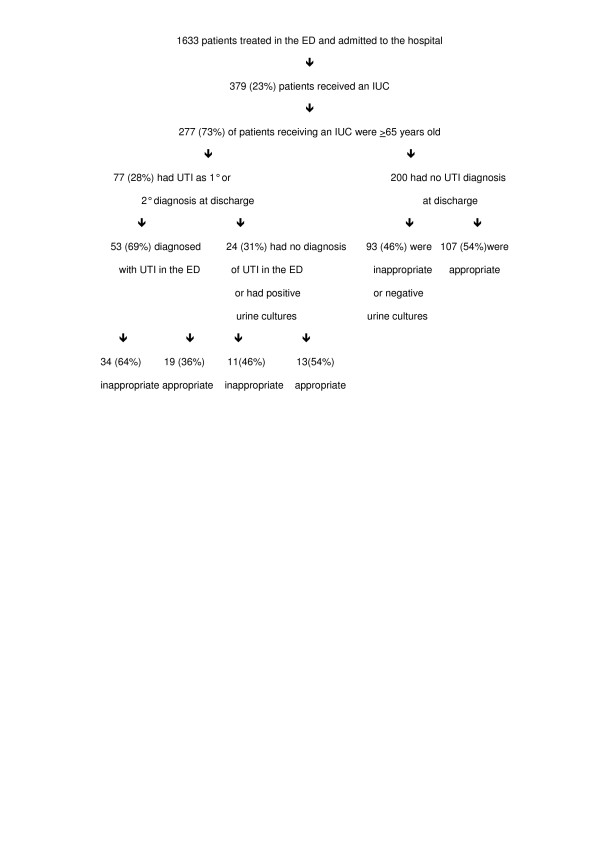
Background: The use of indwelling urinary catheters (IUCs) is thought to be the most significant risk factor for developing nosocomial urinary tract infections (UTIs). However, it is unclear how many elderly patients have preexisting bacteriuria prior to IUC placement. The purpose of this study was to determine 1) the frequency and appropriateness of IUC use in the Emergency Department (ED) in elderly patients admitted to our acute care hospital, 2) the percentage of elderly patients with an IUC who were discharged from the hospital with a diagnosis of UTI, 3) the percentage of patients with IUCs who were diagnosed and treated for UTI in the ED or who had admission bacteriuria > or =105 organisms/ml indicating preexisting UTI, and 4) the percentage of patients with no indication of UTI on admission who had inappropriately placed IUCs and subsequently were diagnosed with a UTI.
Methods: Retrospective chart review. Chi square used to test significance of differences in proportions.
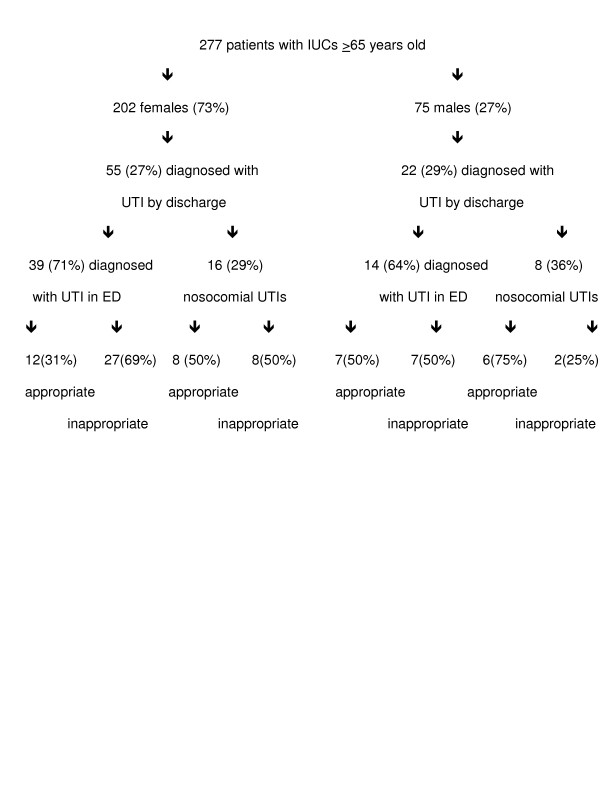
Results: Seventy three percent of patients who received an IUC in the ED were elderly (> or =65 years old). During the study period, 277 elderly patients received an IUC prior to admission. Of these, 77 (28%) were diagnosed with UTI during their hospitalization. Fifty three (69%) of those diagnosed with a UTI by discharge either had the UTI diagnosed in the ED or had bacteriuria > or =105 organisms/ml prior to IUC placement. Of the 24 elderly patients who developed a catheter-associated UTI (i.e., 9% of the elderly population who received an IUC), 11 of the IUCs were placed inappropriately. Thus, 4% of elderly patients with no indication of UTI on admission who received an inappropriate IUC in the ED had a primary or secondary diagnosis of UTI by discharge. The overall rate of nosocomial UTI due to an inappropriately placed IUC was the same in males and females.
Conclusion: This study indicates that the strong association between IUC use and UTI may be partly explained by the high prevalence of preexisting UTI prior to IUC placement. Further prospective studies are needed to clarify the true risk vs benefit ratio for IUC use in acutely ill elderly patients.
Figures
References
-
- Wong ES. Guideline for prevention of catheter-associated urinary tract infections. CDC. http://www.cdc.gov/ncidod/dhqp/gl_catheter_assoc.html - PubMed
-
- Nickel JC. Catheter-associated urinary tract infection:new perspectives on problems. Canadian Journal of Infect Control. 1991;6:38–42. - PubMed
-
- Gardam MA, Amihod B, Orenstein P, Consolacion N, Miller M. Overutilization of indwelling urinary catheters and the development of nosocomial urinary tract infections. Clinical Performance and Quality Health Care. 1998;6:99–102. - PubMed
Publication types
MeSH terms
LinkOut - more resources
Full Text Sources
Medical
