. 2006 Dec 15;577(Pt 3):857-68.
doi: 10.1113/jphysiol.2006.120493. Epub 2006 Oct 12.

Histaminergic and glycinergic modulation of GABA release in the vestibular nuclei of normal and labyrinthectomised rats

Affiliations

Histaminergic and glycinergic modulation of GABA release in the vestibular nuclei of normal and labyrinthectomised rats

Filip Bergquist et al. J Physiol. .

Abstract

Vestibular compensation (the behavioural recovery that follows unilateral vestibular de-afferentation), is facilitated by histamine, and is associated with increased central histamine release and alterations in histamine H(3) receptor expression in the vestibular nuclei. However, little is known of the effects of histamine on neurotransmission in the vestibular nuclei, and the mechanisms by which histamine may influence compensation are unclear. Here we examined the modulatory effects of histaminergic agents on the release of amino acid neurotransmitters in slices of the medial vestibular nucleus (MVN) prepared from normal and labyrinthectomised rats. The release of GABA, but not glutamate, glycine or aspartate, was robustly and reproducibly evoked by a high-K(+) stimulus applied to normal MVN slices. Histamine inhibited the evoked release of GABA, both through a direct action on presynaptic H(3) receptors (presumably located on GABAergic terminals), and through a novel, indirect pathway that involved the increased release of glycine by activation of postsynaptic H(1)/H(2) receptors (presumably on glycinergic neurons). After unilateral labyrinthectomy (UL), the direct H(3) receptor-mediated inhibition of GABA release was profoundly downregulated in both ipsi-lesional and contra-lesional MVNs. This effect appeared within 25 h post-UL and persisted for at least 3 weeks post-UL. In addition, at 25 h post-UL the indirect glycinergic pathway caused a marked suppression of GABA release in the contra-lesional but not ipsi-lesional MVN, which was overcome by strychnine. Stimulation of histamine H(3) receptors at 25 h post-UL restored contra-lesional GABA release to normal, suggesting that acutely after UL H(3) receptors may strongly modulate glycinergic and GABAergic neurotransmission in the MVN. These findings are the first to demonstrate the modulatory actions of the histaminergic system on neurotransmission in the vestibular nuclei, and the changes that occur during vestibular system plasticity. During vestibular compensation, histaminergic modulation of glycine and GABA release may contribute to the rebalancing of neural activity in the vestibular nuclei of the lesioned and intact sides.


Figures
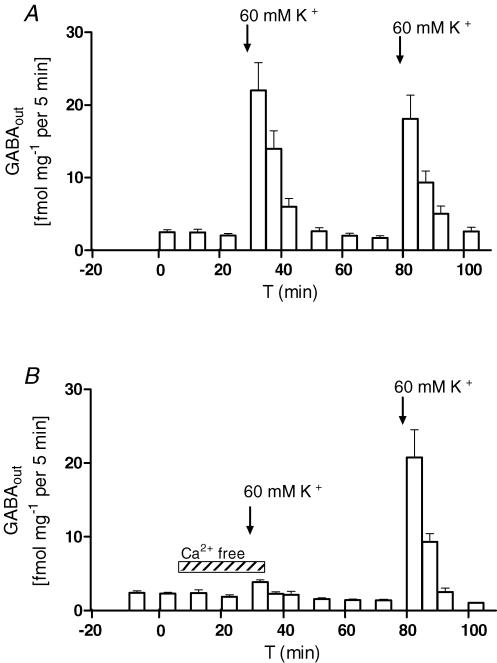
Figure 1
Figure 1. K+-evoked GABA release is Ca2+ dependent
A, GABA release (GABAout, mean ±s.e.m.) in normal aCSF, and in response to two 4 min stimuli with 60 mm K+ aCSF (arrows indicate start of stimuli), n = 10. B, calcium dependency of baseline and K+-evoked GABA overflow, n = 7. Calcium-depleted conditions are indicated by the hatched horizontal bar and the arrows indicate start of K+ stimuli.
Figure 2
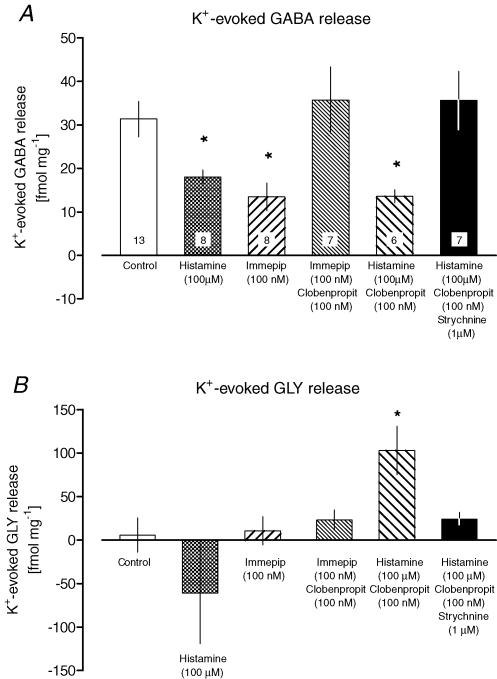
Figure 2. Histaminergic modulation of evoked GABA and glycine release
A, histaminergic modulation of K+-evoked GABA release (accumulated release, fmol mg−1, mean ±s.e.m.). The agonists histamine and immepip were only present during the 4 min-long 60 mm K+ stimulus. The antagonists clobenpropit and strychnine were introduced 20 min before the K+ stimulus. One-way ANOVA (F = 4.85, d.f. = 5, P = 0.0013) was followed by Sidak–Holm adjusted t tests. *P < 0.05 compared to control. Each experiment was repeated in 6–13 slices, as indicated in the bars. B, histaminergic modulation of K+-evoked glycine (GLY) release. Bars show the GLY release in response to the 4 min-long 60 mm K+ stimulus, mean ±s.e.m., during treatment with histaminergic drugs and strychnine as described in A. One way ANOVA (F = 2.73, d.f. = 5, P = 0.0313) was followed by Sidak-Holm adjusted t tests. *P < 0.05 compared to control. Data obtained from the same slices as in A (n = 6–13, see A).
Figure 3
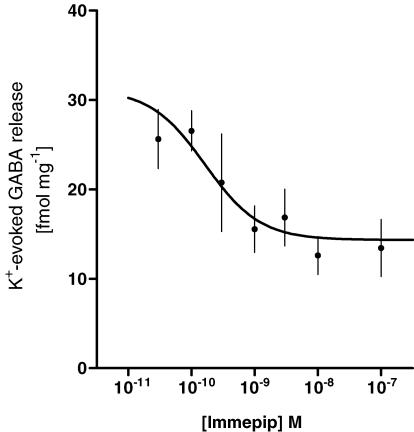
Figure 3. Dose-dependent inhibition of evoked GABA release by immepip
The inhibitory effect of the H3 agonist immepip on K+-evoked GABA release was investigated in an accumulated dose–response, where increasing doses of immepip were presented in two successive K+ stimuli before confirming the viability of the slice with a third stimulus. Non-linear regression, sigmoidal dose–response with top restraint <31.2 fmol mg−1 (which was the mean response of stimulus 1 and 2 in control experiments). R2= 0.3328, n = 3–9 for each tested concentration.
Figure 4
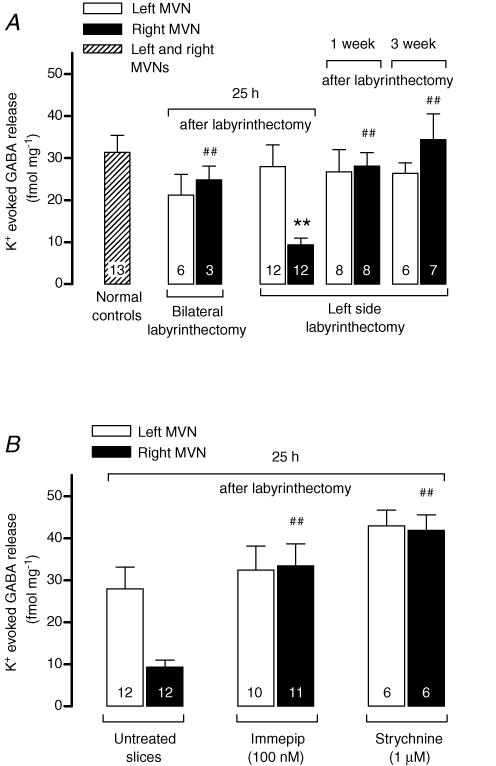
Figure 4. K+-evoked GABA release (mean ±s.e.m) from vestibular slices of labyrinthectomised animals
The number of slices included in each group is indicated inside the bars. The effects of labyrinthectomies (A) and of drug treatments of slices from 25 h post-UL animals (B) were analysed together by one-way ANOVA (P = 0.0003, F = 3.472, d.f. = 12) followed by Sidak–Holm corrected t tests. **P < 0.01 compared to normal controls, ##P < 0.01 compared to untreated contra-lesional slices prepared 25 h after UL. For clarity the untreated 25 h post-UL slices are shown in B as well as in A.
Figure 5
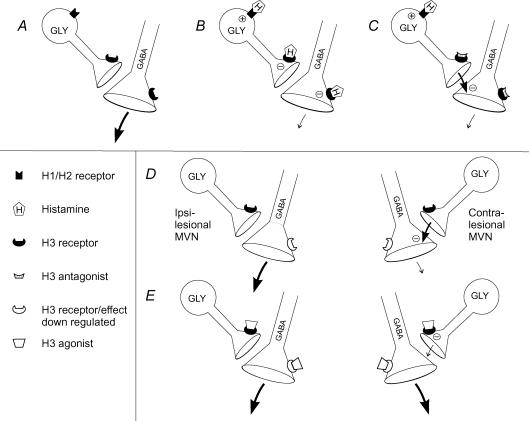
Figure 5. Proposed circuitry for histaminergic modulation of GABA release in the medial vestibular nucleus (MVN)
A, B and C, the inhibitory effects of histamine on GABA release from normal MVN slices. A, K+-evoked GABA release in untreated MVN slices. B, histamine inhibits GABA release directly by activation of H3 receptors on GABAergic terminals, but has a balanced effect on glycinergic neurons (GLY) due to activation of both H1/H2 and H3 receptors. C, in the presence of an H3 antagonist, histamine inhibits GABA release indirectly via H1/H2-mediated stimulation of GLY neurons. D and E, H3 receptor-mediated modulation of GABA release in the ipsi- and contra-lesional MVNs 25 h after unilateral labyrinthectomy. D, the suppression of contra-lesional GABA release together with normalisation of GABA release following treatment with strychnine (see Figure 4), indicates that glycinergic transmission is amplified in contra-lesional slices 25 h after unilateral labyrinthectomy. E, direct H3-mediated inhibition of GABA release is downmodulated, but the GABA release from the contra-lesional MVN is restored by H3-agonist treatment. The latter phenomenon can be mediated by inhibition of glycine release via activation of H3 receptors with normal sensitivity.

References

    1. Airaksinen MS, Panula P. The histaminergic system in the guinea pig central nervous system: an immunocytochemical mapping study using an antiserum against histamine. J Comp Neurol. 1988;273:163–186. - PubMed
    1. Alves-Rodrigues A, Lemstra S, Vollinga RC, Menge WM, Timmerman H, Leurs R. Pharmacological analysis of immepip and imetit homologues. Further evidence for histamine H3 receptor heterogeneity? Behav Brain Res. 2001;124:121–127. - PubMed
    1. Arias-Montano JA, Floran B, Garcia M, Aceves J, Young JM. Histamine H3 receptor-mediated inhibition of depolarization-induced, dopamine D1 receptor-dependent release of [3H]-gamma-aminobutryic acid from rat striatal slices. Br J Pharmacol. 2001;133:165–171. - PMC - PubMed
    1. Arrang JM, Garbarg M, Schwartz JC. Auto-inhibition of brain histamine release mediated by a novel class (H3) of histamine receptor. Nature. 1983;302:832–837. - PubMed
    1. Barmack NH. Central vestibular system: vestibular nuclei and posterior cerebellum. Brain Res Bull. 2003;60:511–541. - PubMed

Publication types

MeSH terms

LinkOut - more resources