


Purinergic 2 receptor blockade prevents the responses of group IV afferents to post-contraction circulatory occlusion
- PMID: 17038431
- PMCID: PMC2075108
- DOI: 10.1113/jphysiol.2006.119271
Purinergic 2 receptor blockade prevents the responses of group IV afferents to post-contraction circulatory occlusion
Abstract
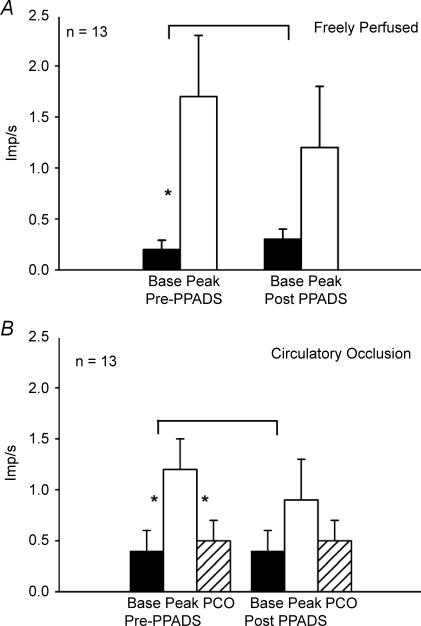
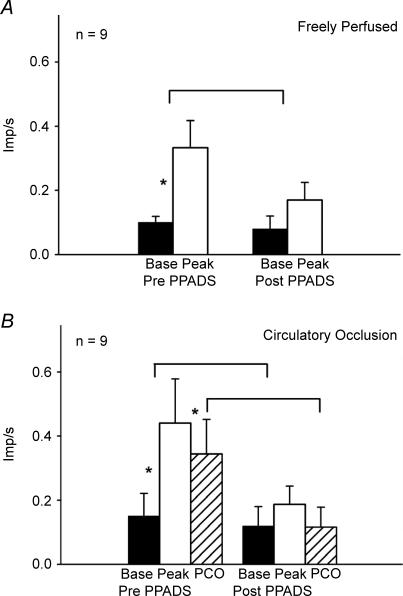
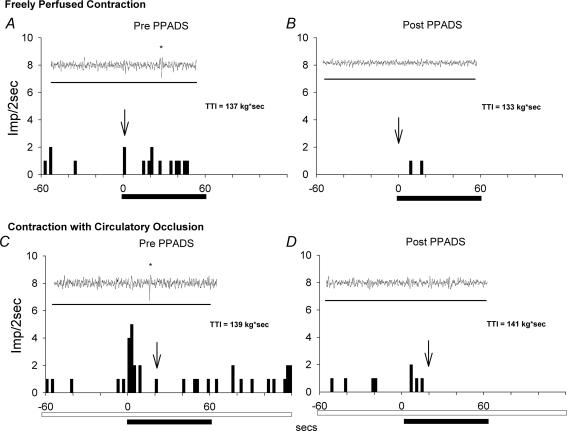
ATP, by activating purinergic 2 (P2) receptors on group III and IV afferents, is thought to evoke the metabolic component of the exercise pressor reflex. Previously we have shown that injection of PPADS, a P2 receptor antagonist, into the arterial supply of skeletal muscle of decerebrated cats attenuated the responses of group III and IV afferents to static contraction while the muscles were freely perfused. We have now tested the hypothesis that injection of PPADS (10 mg kg(-1)) attenuated the responses of group III (n = 13) and group IV afferents (n = 9) to post-contraction circulatory occlusion. In the present study, we found that PPADS attenuated the group III afferent responses to static contraction during circulatory occlusion (P < 0.05). Likewise, PPADS abolished the group IV afferent responses to static contraction during occlusion (P = 0.001). During a 1 minute period of post-contraction circulatory occlusion, four of the 13 group III afferents and eight of the nine group IV afferents maintained their increased discharge. A Fischer's exact probability test revealed that more group IV afferents than group III afferents were stimulated by post-contraction circulatory occlusion (P < 0.02). In addition, the nine group IV afferents increased their mean discharge rate over baseline levels during the post-contraction circulatory occlusion period, whereas the 13 group III afferents did not (P < 0.05). PPADS abolished this post-contraction increase in discharge by the group IV afferents (P < 0.05). Our findings suggest that P2 receptors on group IV afferents play a role in evoking the metabolic component of the exercise pressor reflex.
Figures
Comment in
-
Autonomic/metabolic interactions modulating the exercise pressor reflex: the purinergic hypothesis.J Physiol. 2007 Jan 1;578(Pt 1):5-6. doi: 10.1113/jphysiol.2006.124552. Epub 2006 Nov 16. J Physiol. 2007. PMID: 17110407 Free PMC article. No abstract available.
References
-
- Adreani CM, Kaufman MP. Effect of arterial occlusion on responses of group III and IV afferents to dynamic exercise. J Appl Physiol. 1998;84:1827–1833. - PubMed
-
- Bivalacqua TJ, Champion HC, Shah MK, De Witt BJ, Inscho EW, Kadowitz PJ. Comparative responses to α,β-methylene-ATP in cat pulmonary, mesenteric, and hindquarter vascular beds. J Appl Physiol. 2002;93:1287–1295. - PubMed
-
- Bonde-Petersen F, Rowell LB, Murray RG, Blomqvist GG, White R, Karlsson E, Campbell W, Mitchell JH. Role of cardiac output in the pressor responses to graded muscle ischemia in man. J Appl Physiol. 1978;45:574–580. - PubMed
-
- Buckwalter JB, Hamann JJ, Clifford PS. Vasoconstriction in active skeletal muscles: a potential role for P2X purinergic receptors? J Appl Physiol. 2003;95:953–959. - PubMed
Publication types
MeSH terms
Substances
Grants and funding
LinkOut - more resources
Full Text Sources
Miscellaneous
