


Outcome of occupational asthma after cessation of exposure: a systematic review
- PMID: 17040933
- PMCID: PMC2111252
- DOI: 10.1136/thx.2006.061952
Outcome of occupational asthma after cessation of exposure: a systematic review
Abstract
Background: Patients with occupational asthma, and their medical advisers, need valid information about the prognosis of their disease.
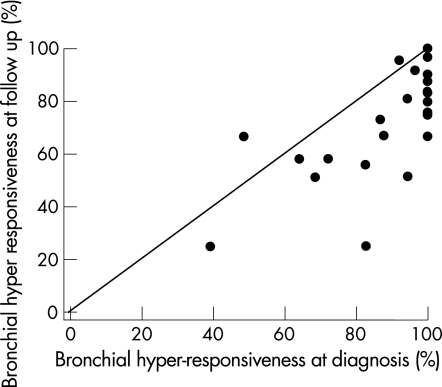
Methods: A systematic review of the published literature on the symptomatic and functional outcomes of occupational asthma was carried out after avoidance of exposure to the causative agent. Through a full search of electronic and bibliographic sources, original studies documenting complete recovery from asthma (n = 39,1681 patients) or improvement in non-specific bronchial hyper-responsiveness (NSBHR; n = 28,695 patients) were identified. The median duration of follow-up was 31 (range 6-240) months for studies of symptomatic recovery and 37 (6-240) months for studies of NSBHR. Most studies were of patients recruited from special clinics.
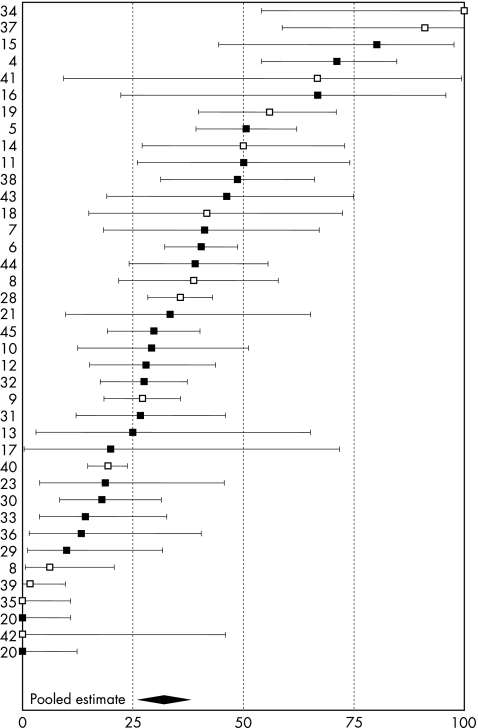
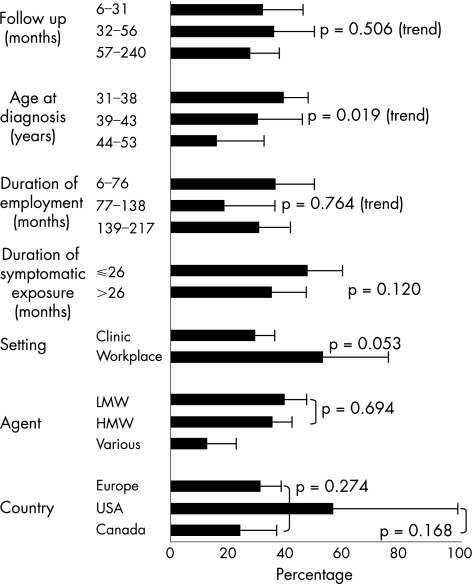
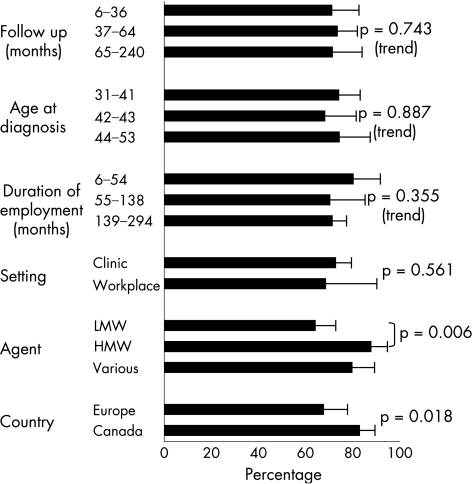
Results: Reported rates of symptomatic recovery varied from 0% to 100%, with a pooled estimate of 32% (95% CI 26% to 38%). These rates were lower with increasing age (p = 0.019) and among clinic based populations (p = 0.053). Patients with the shortest durations of exposure (< or =76 months) had the highest rate of recovery (36%; 95% CI 25% to 50%), but the effect was not linear. The pooled prevalence of persistent NSBHR at follow-up was 73% (95% CI 66% to 79%). This figure was higher among patients whose disease was due to high-molecular-weight agents (p = 0.006) and, less clearly, those from clinic-based populations (p = 0.561). In between-study comparisons, no clear patterns of improvement relating to total duration of exposure or follow-up were found. From within-study comparisons there was some evidence that a shorter duration of symptoms was associated with a higher rate of symptomatic recovery.
Conclusion: The available data on the prognosis of occupational asthma are insufficiently consistent to allow confident advice to be given to patients with the disease. Clinicians and epidemiologists with an interest in this disease should consider a collaborative and carefully standardised study of the prognosis of occupational asthma.
Conflict of interest statement
Competing interests: None.
References
-
- Chan‐Yeung M. Occupational asthma. Clin Rev Allergy 19864251–266. - PubMed
-
- Meyer W C. Prognosis of occupational bronchial asthma after change of occupation and elimination of antigen. Münch Med Wochenschr 1977119363–366. - PubMed
-
- Chan‐Yeung M. Fate of occupational asthma. A follow‐up study of patients with occupational asthma due to western red Cedar (Thuja plicata). Am Rev Respir Dis 19771161023–1029. - PubMed
