


doi: 10.1128/JVI.01030-06.
Novel envelope determinants for CCR3 use by human immunodeficiency virus
Affiliations
- PMID: 17041228
- PMCID: PMC1641764
- DOI: 10.1128/JVI.01030-06
Item in Clipboard
Novel envelope determinants for CCR3 use by human immunodeficiency virus
J Virol.
2006 Nov.
Abstract
Human immunodeficiency virus type 1 can generally use CCR3 and CCR5 for cell entry. We show that envelopes with novel phenotypes arise during "coreceptor switch": one loses the ability to use CCR3 (R5-only phenotype), and another gains use of CXCR4 in addition to CCR5 and CCR3 (R3/R5/X4-using phenotype). The envelope determinants for CCR3 use mapped to three amino acids. One, N356 in conserved region 3, is a potential glycosylation site and has not previously been associated with coreceptor use. The other two, R440 and N448 in conserved region 4, are proximal to but distinct from residues already identified as being important for CCR5 binding.
Figures
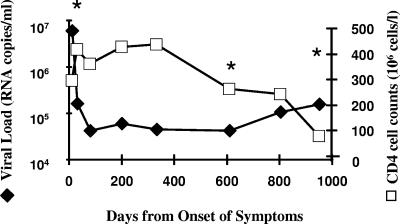
Virus load and CD4 cell counts over time. The patient's virus load (Chiron [Emeryville, Calif.] 3.0) (closed symbols) and CD4 cell numbers (open symbols) are plotted against the time in days from onset of symptoms characteristic of acute HIV infection. The time points from which HIV Envs were cloned are indicated with asterisks.
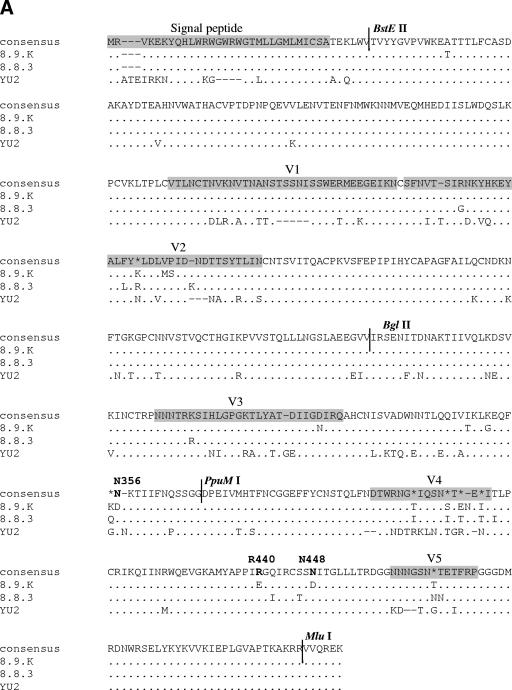
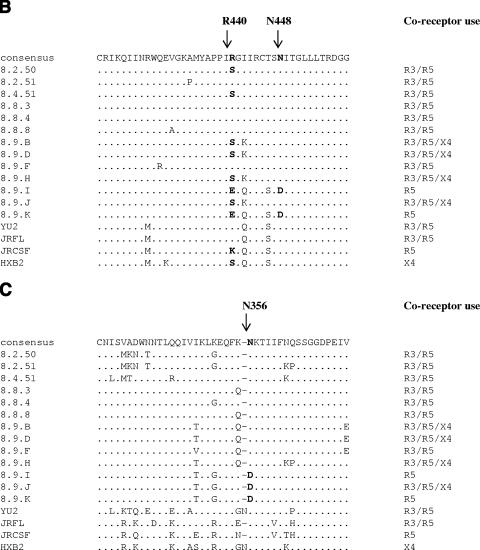
Env alignments. (A) Amino acid alignments (generated using ClustalW [http://www.ebi.ac.uk/clustralw ]) of the R5-only-using Env 8.9.K (GenBank accession number DQ645384), the most closely related R3/R5-using Env 8.8.3 (GenBank accession number DQ425072), and the prototypical R3/R5-using Env YU2 (GenBank accession number M93258). The asterisks indicate lack of consensus between the three Envs. The dots indicate residues identical to those in the consensus sequence, and the dashes indicate gaps. The signal peptide and the gp120 variable loops are shaded gray. The locations of the sites for the restriction enzymes BglII, BstEII, MluI, and PpuMI used for the sequence swapping are also indicated. Residues subjected to site-directed mutagenesis are in boldface. (B) Alignments of a section of the C4 regions of all patient Envs (GenBank accession numbers AY295233, AY295235, AY295237, DQ425072 to -4, and DQ64378 to -84) and Envs YU2, JRFL, JRCSF, and HXB2 (GenBank accession numbers M93258, AY669728, M38429, and K03455, respectively). The dots indicate residues identical to those in the consensus sequence, and the dashes indicate gaps. The determinants for CCR3 use are in boldface. (C) Alignments of a section of the C3 Env regions (see description of panel B).
Env alignments. (A) Amino acid alignments (generated using ClustalW [http://www.ebi.ac.uk/clustralw ]) of the R5-only-using Env 8.9.K (GenBank accession number DQ645384), the most closely related R3/R5-using Env 8.8.3 (GenBank accession number DQ425072), and the prototypical R3/R5-using Env YU2 (GenBank accession number M93258). The asterisks indicate lack of consensus between the three Envs. The dots indicate residues identical to those in the consensus sequence, and the dashes indicate gaps. The signal peptide and the gp120 variable loops are shaded gray. The locations of the sites for the restriction enzymes BglII, BstEII, MluI, and PpuMI used for the sequence swapping are also indicated. Residues subjected to site-directed mutagenesis are in boldface. (B) Alignments of a section of the C4 regions of all patient Envs (GenBank accession numbers AY295233, AY295235, AY295237, DQ425072 to -4, and DQ64378 to -84) and Envs YU2, JRFL, JRCSF, and HXB2 (GenBank accession numbers M93258, AY669728, M38429, and K03455, respectively). The dots indicate residues identical to those in the consensus sequence, and the dashes indicate gaps. The determinants for CCR3 use are in boldface. (C) Alignments of a section of the C3 Env regions (see description of panel B).
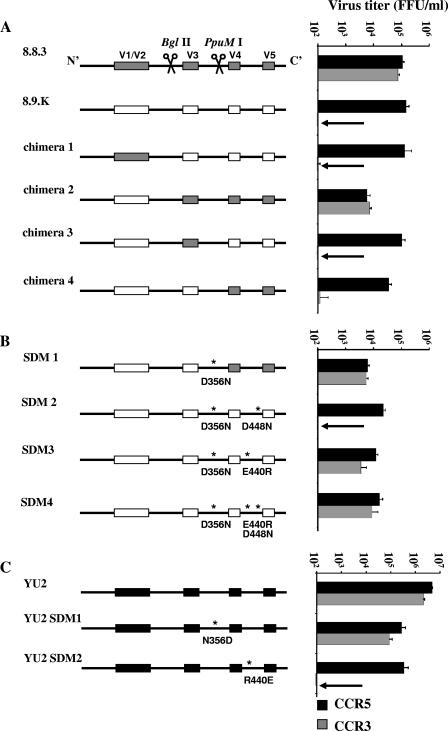
Mapping of CCR3 determinants. (A) Sections of the env gene were swapped between env 8.8.3 (gray boxes) and env 8.9.K (white boxes) by restriction enzyme digestion with BglII and/or PpuMI. Only chimera 2 (8.9.K-BglII-8.8.3) was able to infect NP2/CD4/CCR3 cells efficiently. (B) Amino acid substitutions, indicated with asterisks, were introduced into chimera 4 (SDM1) and env 8.9.K (SDM2, -3, and -4) by site-directed mutagenesis. Mutation of D356 to N in combination with mutation of E440 to R was sufficient to transform the R5-only-using Env 8.9.K to an efficient R3 user (SDM3). The titer of SDM3 on R3 cells was ∼30% of that on R5 cells. Additional mutation of D448 to N (SDM4) increased the virus titer on CCR3 cells to ∼60% of the titer on CCR5 cells. (C) Mutation of amino acids N356 in YU2 to aspartic acid (D) did not affect CCR3 use by YU2. However, mutation of R440 in YU2 to glutamic acid (E) resulted in an almost-complete abolition of CCR3 use (from 40% to less than 0.1% of the titer on R5 cells).
References
-
- Aasa-Chapman, M. M. I., K. Aubin, I. Williams, and A. McKnight. 2006. Primary CCR5 only using HIV-1 isolates does not accurately represent the in vivo replicating quasi-species. Virology 351:489-496. - PubMed
-
- Aasa-Chapman, M. M. I., A. Hayman, P. Newton, D. Cornforth, I. Williams, P. Borrow, P. Balfe, and A. McKnight. 2004. Development of the antibody response in acute HIV-1 infection. AIDS 18:371-381. - PubMed
-
- Fiore, J. R., G. Buccoliero, P. Pezzotti, G. Rezza, A. Saracino, G. Pastore, E. M. Fenyo, and G. Angarano. 1999. HIV-1 disease progression in women: role of the viral phenotype of the HIV-positive steady partner. AIDS 13:1801-1802. - PubMed
Publication types
MeSH terms
Substances
Grants and funding
LinkOut - more resources
Full Text Sources
Medical
Molecular Biology Databases
