


Sublethal concentrations of the aminoglycoside amikacin interfere with cell division without affecting chromosome dynamics
- PMID: 17043119
- PMCID: PMC1797645
- DOI: 10.1128/AAC.00892-06
Sublethal concentrations of the aminoglycoside amikacin interfere with cell division without affecting chromosome dynamics
Abstract
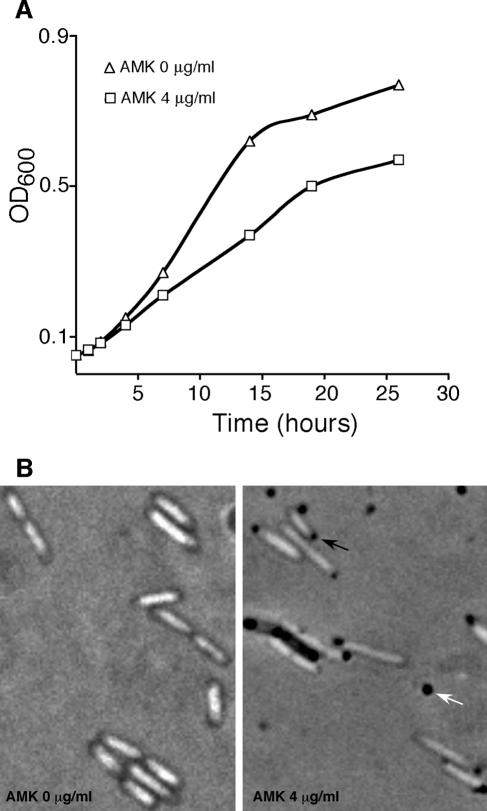
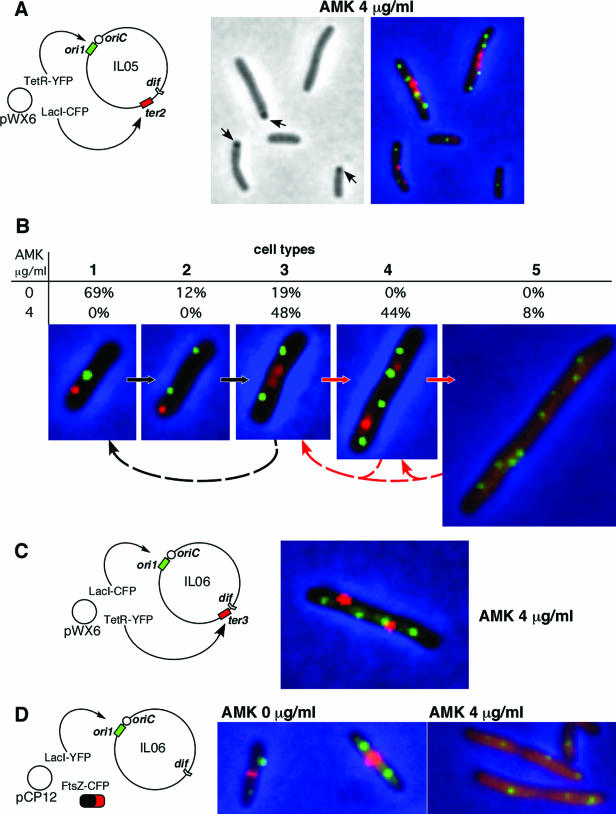
Aminoglycosides bind to the 16S rRNA at the tRNA acceptor site (A site) and disturb protein synthesis by inducing codon misreading. We investigated Escherichia coli cell elongation and division, as well as the dynamics of chromosome replication and segregation, in the presence of sublethal concentrations of amikacin (AMK). The fates of the chromosome ori and ter loci were monitored by visualization by using derivatives of LacI and TetR fused to fluorescent proteins in E. coli strains that carry operator arrays at the appropriate locations. The results showed that cultures containing sublethal concentrations of AMK contained abnormally elongated cells. The chromosomes in these cells were properly located, suggesting that the dynamics of replication and segregation were normal. FtsZ, an essential protein in the process of cell division, was studied by using an ectopic FtsZ-cyan fluorescent protein fusion. Consistent with a defect in cell division, we revealed that the Z ring failed to properly assemble in these elongated cells.
Figures
References
-
- Bi, E., and J. Lutkenhaus. 1991. FtsZ ring structure associated with division in Escherichia coli. Nature 354:161-164. - PubMed
-
- Fourmy, D., M. I. Recht, S. C. Blanchard, and J. D. Puglisi. 1996. Structure of the A site of Escherichia coli 16S ribosomal RNA complexed with an aminoglycoside antibiotic. Science 274:1367-1371. - PubMed
-
- Fourmy, D., M. I. Recht, and J. D. Puglisi. 1998. Binding of neomycin-class aminoglycoside antibiotics to the A-site of 16 S rRNA. J. Mol. Biol. 277:347-362. - PubMed
Publication types
MeSH terms
Substances
Grants and funding
LinkOut - more resources
Full Text Sources
Miscellaneous
