Cross talk between activation and slow inactivation gates of Shaker potassium channels
- PMID: 17043151
- PMCID: PMC2151579
- DOI: 10.1085/jgp.200609644
Cross talk between activation and slow inactivation gates of Shaker potassium channels
Abstract
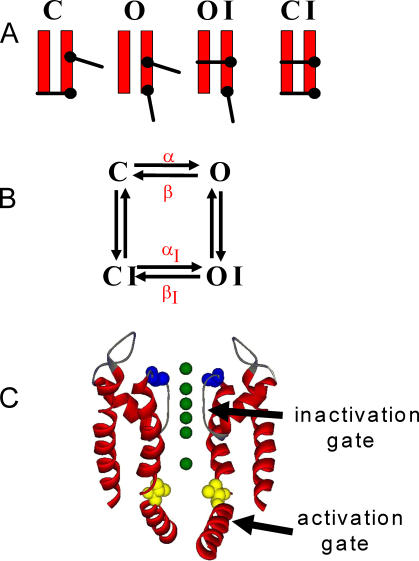
This study addresses the energetic coupling between the activation and slow inactivation gates of Shaker potassium channels. To track the status of the activation gate in inactivated channels that are nonconducting, we used two functional assays: the accessibility of a cysteine residue engineered into the protein lining the pore cavity (V474C) and the liberation by depolarization of a Cs(+) ion trapped behind the closed activation gate. We determined that the rate of activation gate movement depends on the state of the inactivation gate. A closed inactivation gate favors faster opening and slower closing of the activation gate. We also show that hyperpolarization closes the activation gate long before a channel recovers from inactivation. Because activation and slow inactivation are ubiquitous gating processes in potassium channels, the cross talk between them is likely to be a fundamental factor in controlling ion flux across membranes.
Figures


References
-
- Ashcroft, F.M. 2000. Ion Channels and Disease: Channelopathies. Academic Press, San Diego. 481 pp.
-
- Baukrowitz, T., and G. Yellen. 1995. Modulation of K+ current by frequency and external [K+]: a tale of two inactivation mechanisms. Neuron. 15:951–960. - PubMed
-
- Bezanilla, F. 2000. The voltage sensor in voltage-dependent ion channels. Physiol. Rev. 80:555–592. - PubMed
-
- Cordero-Morales, J.F., L.G. Cuello, Y. Zhao, V. Jogini, D.M. Cortes, B. Roux, and E. Perozo. 2006. Molecular determinants of gating at the potassium-channel selectivity filter. Nat. Struct. Mol. Biol. 13:311–318. - PubMed