. 2006 Oct 17:5:45.
doi: 10.1186/1476-4598-5-45.

Resveratrol interferes with AKT activity and triggers apoptosis in human uterine cancer cells

Affiliations

Resveratrol interferes with AKT activity and triggers apoptosis in human uterine cancer cells

Emilie Sexton et al. Mol Cancer. .

Abstract

Background: Endometrial cancer is the fourth most prominent cancer among all feminine cancers in the Western world. Resveratrol, a natural anti-oxidant found in red wine emerging as a novel anticancer agent, exerts antiproliferative and pro-apoptotic activity in various cancer cell types, but its effect on uterine cancer cells is poorly understood. At the molecular level, resveratrol has been reported to inhibit cyclooxygenase (COX) expression and/or activity; in endometrial cancer cells, COX-2 is overexpressed and confers cellular resistance to apoptosis. The aim of the present study was to determine if resveratrol could exert anti-proliferative and pro-apoptotic activity over uterine cancer cells upon inhibition of COX-2 expression and/or activity. Six different human uterine cancer cell lines were used as a model (HeLa, Hec-1A, KLE, RL95-2, Ishikawa and EN-1078D).

Results and discussion: High-dose of resveratrol triggered apoptosis in five out of six uterine cancer cell lines, as judged from Hoechst nuclear staining and effector caspase cleavage. In accordance, uterine cancer cell proliferation was decreased. Resveratrol also reduced cellular levels of the phosphorylated/active form of anti-apoptotic kinase AKT. Endogenous COX-2 protein levels were decreased, concomitant with a decrease in production of COX metabolites PGE2 and PGF2alpha, in each uterine cancer cell line expressing detectable levels of COX-1 and/or COX-2 in presence of resveratrol. Although COX expression was identified as a target of resveratrol in uterine cancer cells, inhibition of COX activity or exogenously added PGE2 did not modulate the effect of resveratrol on cellular proliferation.

Conclusion: High-dose of resveratrol exerts tumoricidal activity over uterine cancer cells and regulates COX expression. In these cells, resveratrol would not directly target COX activity, but possibly other enzymes involved in prostaglandin synthesis that act downstream of the COXs.


Figures
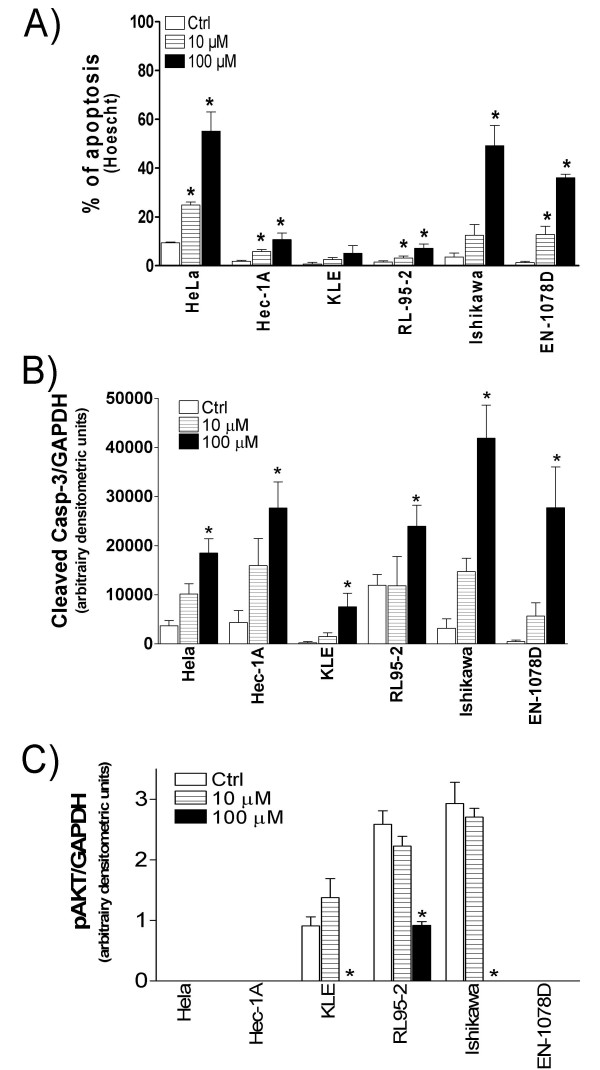
Figure 1
Figure 1
Effect of resveratrol (0 (control or Ctrl), 10 and 100 μM) on apoptosis induction in HeLa, HEC-1A, KLE, RL95-2, Ishikawa and EN-1078D cell lines, after a period of 48 hours. A) Hoescht nuclear staining was performed, and apoptotic cells were counted under a microscope. Results, presented as a percentage of apoptotic cells to the total cell count, are mean +/- SEM of three independent experiments. B) Cleavage/activation of caspases-3 was monitored by Western blot. GAPDH was used as a loading control; results are mean +/- SEM of three independent experiments. C) The effect of resveratrol of the levels of pAKT was determined by western blot analysis. GAPDH was used as a loading control. Results are mean +/- SEM of at least two independent experiments. *p < 0.05 compared to control cells (Ctrl).
Figure 2
Figure 2
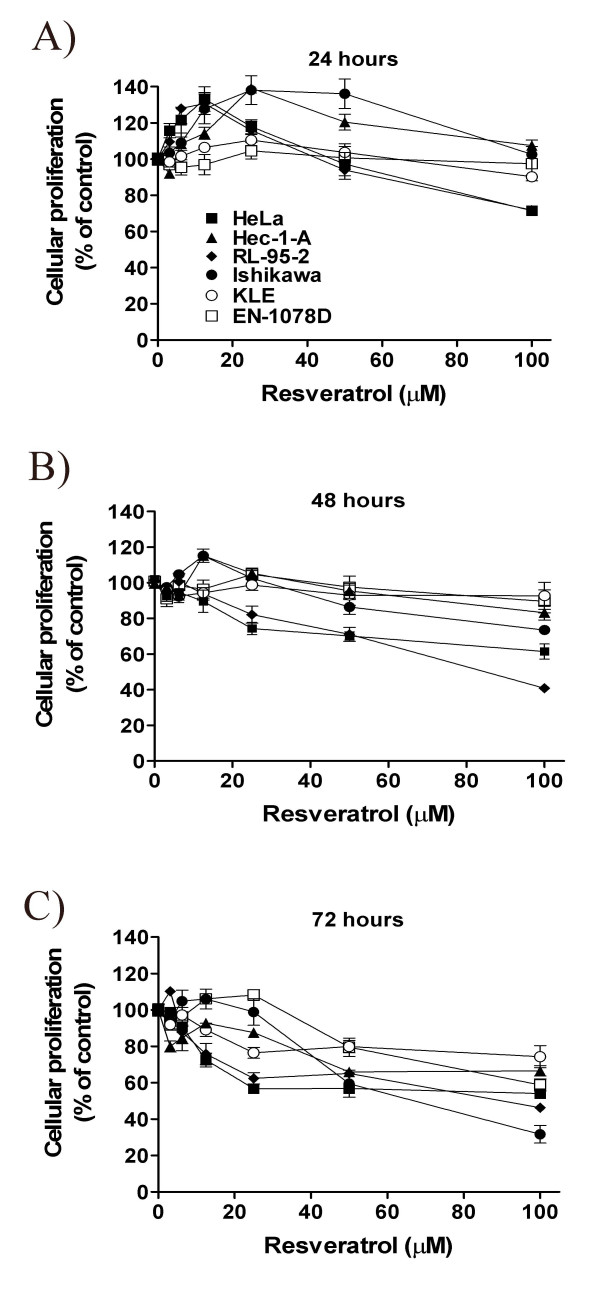
The effect of resveratrol (0 (control or Ctrl), 3.125, 6.25, 12, 25, 50 and 100 μM) on cellular proliferation in HeLa (■), HEC-1A (▲), RL95-2 (◆), Ishikawa (●), KLE (○) and EN-1078D (□) cells for a period of A) 24 hours, B) 48 hours and C) 72 hours was determined by MTT proliferation assay. Results, which are presented as a percentage of proliferation of treated cells compared to control (untreated) cells, are mean +/- SEM of three independent experiments, each performed in duplicates.
Figure 3
Figure 3
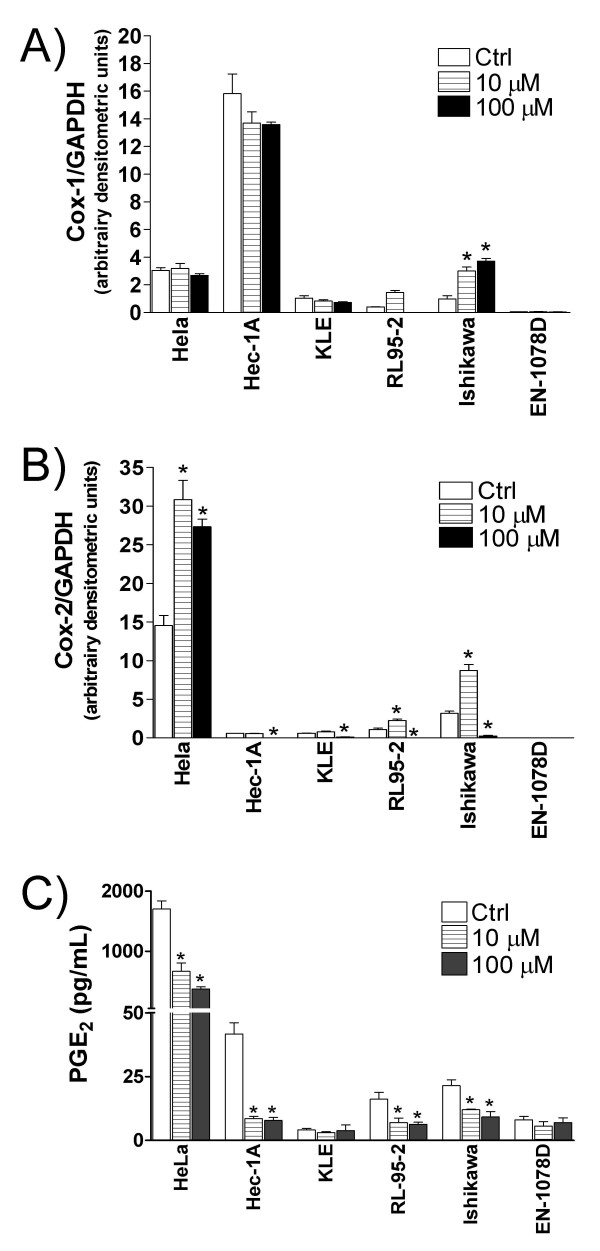
The effect of resveratrol of the levels of A) COX-1 and B) COX-2 was determined by western blot analysis. GAPDH was used as a loading control. Results are mean +/- SEM of at least two independent experiments. *p < 0.05 compared to control. C) The effect of a 48h-treatment with resveratrol (0, 10 and 100 μM) on PGE2 production by HeLa, HEC-1A, KLE, RL95-2, Ishikawa and EN-1078D cell lines was determined using EIA assay. Data represent the mean ± SEM of 4 independent experiments. *p < 0.05 compared to control (Ctrl).
Figure 4
Figure 4
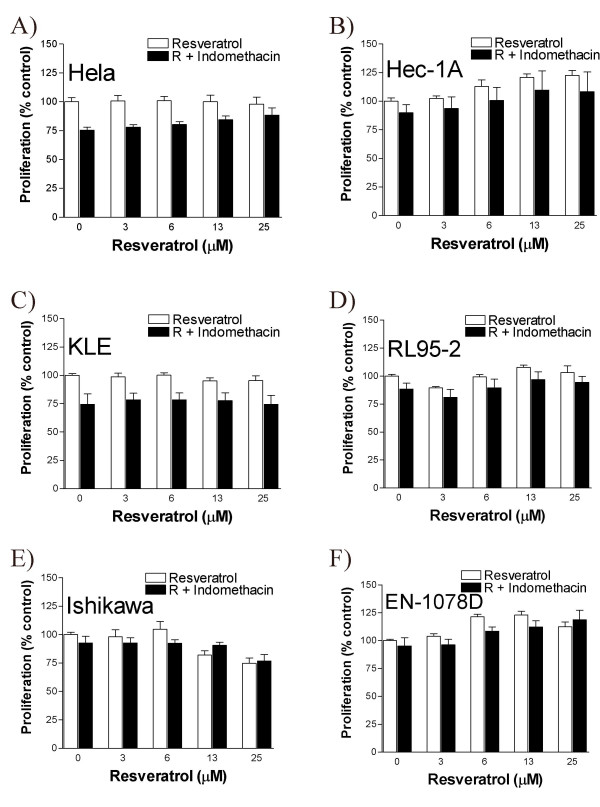
Effect of resveratrol (0, 3.125, 6.25, 12, 25, 50 and 100 μM), in the presence or absence of 5 μM indomethacin for a period of 48 hours, on cellular proliferation in A) HeLa, B) HEC-1A, C) KLE, D) RL95-2, E) Ishikawa and F) EN-1078D cells as determined by the MTT proliferation assay. Data represent the mean ± SEM of 6 independent experiments.
Figure 5
Figure 5
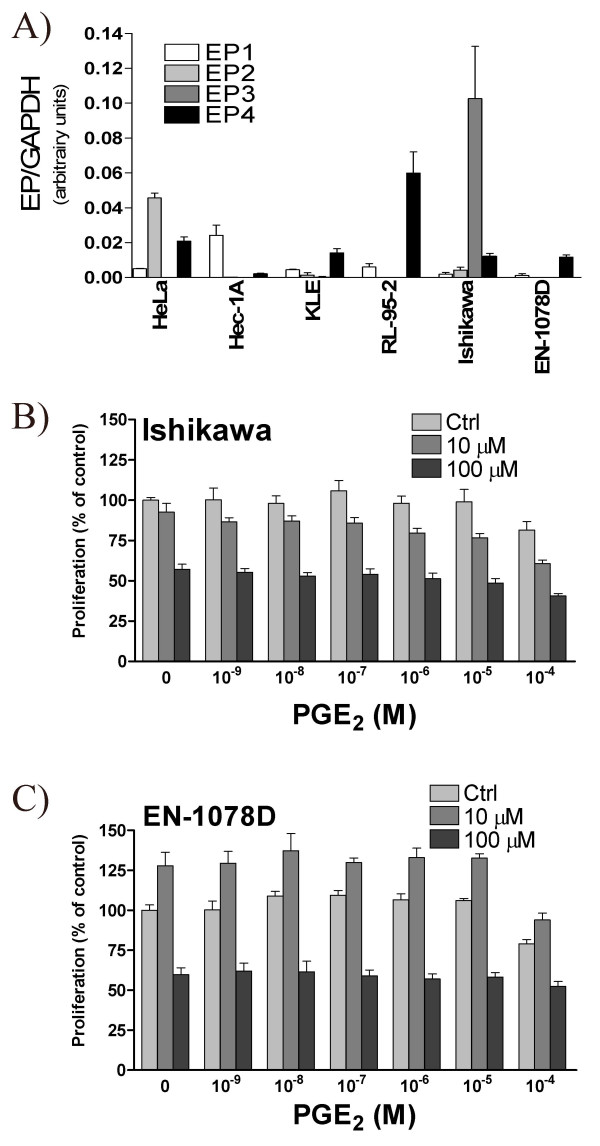
A) The levels of EP1 to EP4 receptors mRNA were determined in HeLa, HEC-1A, KLE, RL95-2, Ishikawa and EN-1078D cell lines by quantitative real-time PCR. GAPDH was used as control to correct for loading. Data represent mean ± SEM of 3 independent experiments. B) The effect of PGE2 (0, 10-9, 10-8, 10-7, 10-6, 10-5 and 10-4 M), in the presence or absence of 10 or 100 μM resveratrol, was evaluated on cellular proliferation in B) Ishikawa and C) EN-1078D cells, for a period of 48 hours, using the MTT proliferation assay. Data represent the mean ± SEM of 6 independent experiments. Ctrl: untreated control.

References

    1. Celotti E, Ferrarini R, Zironi R, Conte LS. Resveratrol content of some wines obtained from dried Valpolicella grapes: Recioto and Amarone. J Chromatogr A. 1996;730:47–52. doi: 10.1016/0021-9673(95)00962-0. - DOI - PubMed
    1. Faustino RS, Sobrattee S, Edel AL, Pierce GN. Comparative analysis of the phenolic content of selected Chilean, Canadian and American Merlot red wines. Mol Cell Biochem. 2003;249:11–19. doi: 10.1023/A:1024745513314. - DOI - PubMed
    1. Fauconneau B, Waffo-Teguo P, Huguet F, Barrier L, Decendit A, Merillon JM. Comparative study of radical scavenger and antioxidant properties of phenolic compounds from Vitis vinifera cell cultures using in vitro tests. Life Sci. 1997;61:2103–2110. doi: 10.1016/S0024-3205(97)00883-7. - DOI - PubMed
    1. Jang M, Cai L, Udeani GO, Slowing KV, Thomas CF, Beecher CW, Fong HH, Farnsworth NR, Kinghorn AD, Mehta RG, Moon RC, Pezzuto JM. Cancer chemopreventive activity of resveratrol, a natural product derived from grapes. Science. 1997;275:218–220. doi: 10.1126/science.275.5297.218. - DOI - PubMed
    1. Mgbonyebi OP, Russo J, Russo IH. Antiproliferative effect of synthetic resveratrol on human breast epithelial cells. Int J Oncol. 1998;12:865–869. - PubMed

Publication types