


De novo asymmetric syntheses of SL0101 and its analogues via a palladium-catalyzed glycosylation
- PMID: 17048865
- PMCID: PMC2529254
- DOI: 10.1021/ol062076r
De novo asymmetric syntheses of SL0101 and its analogues via a palladium-catalyzed glycosylation
Abstract
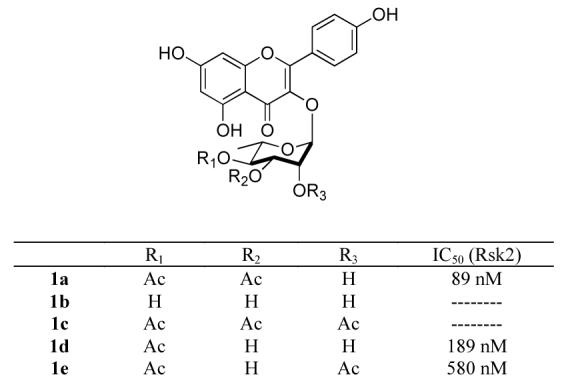
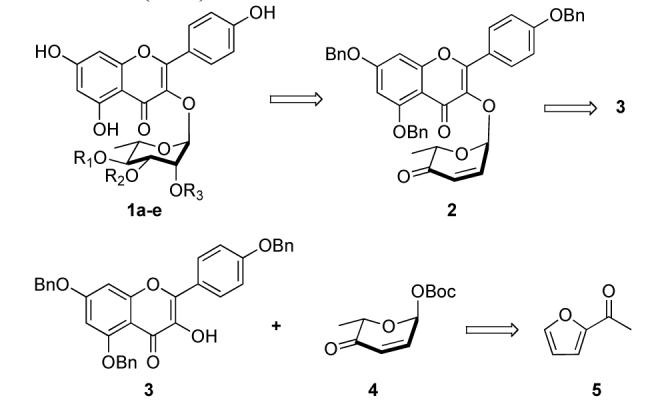
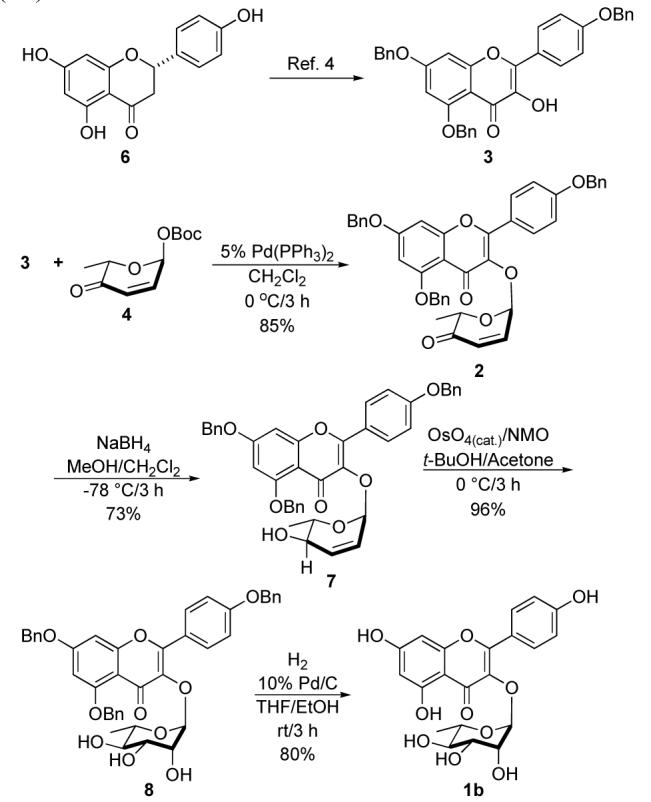
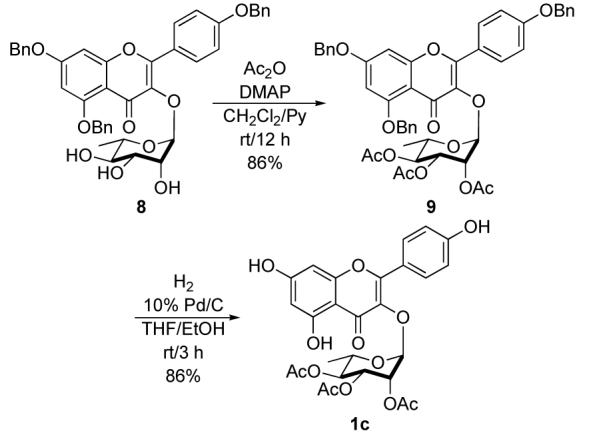
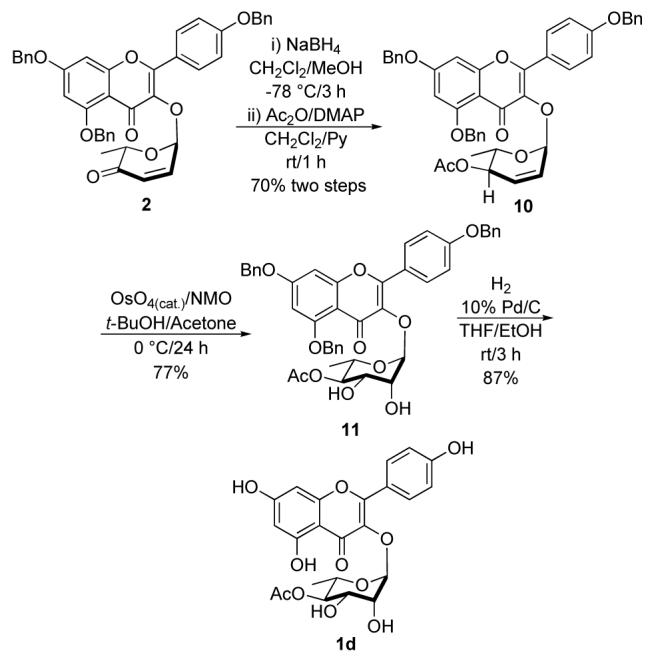
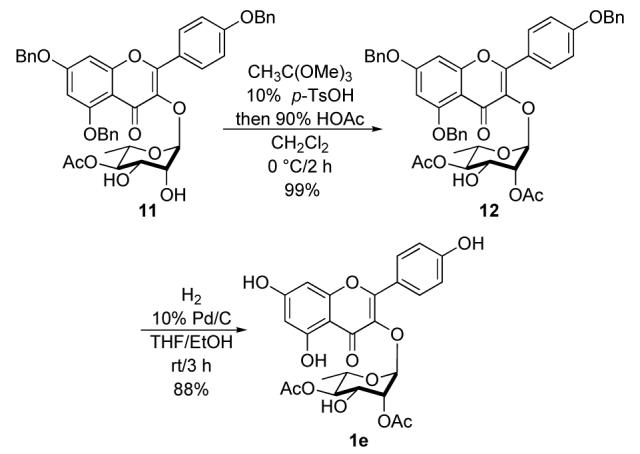
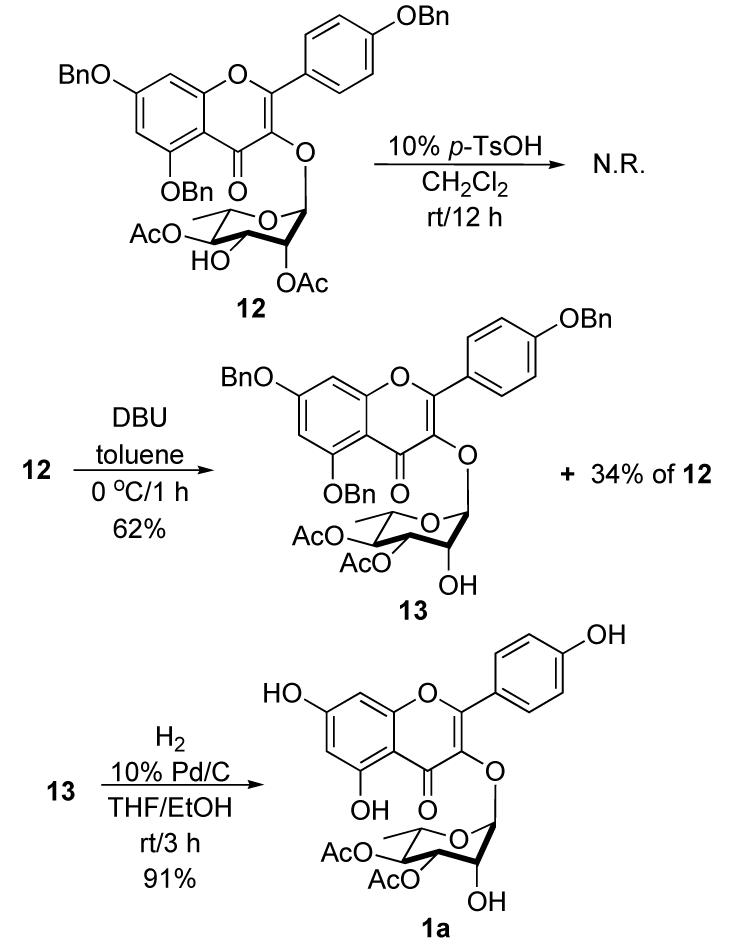
The enantioselective syntheses of naturally occurring kaempferol glycoside SL0101 (1a) and its analogues 1b-e, as well as their enantiomers, have been achieved in 7-10 steps. The routes rely upon a diastereoselective palladium-catalyzed glycosylation, ketone reduction, and dihydroxylation to introduce the rhamno-stereochemistry. The asymmetry of the sugar moiety of these kaempferol glycosides was derived from Noyori reduction of an acylfuran. An acetyl group shift from an axial (C-2) to equatorial position (C-3) under basic conditions was also described. [reaction: see text]
Figures
References
-
-
For the isolation of 1a-b see ref. 1b and:Matthes HWD, Luu B, Ourisson G. Phytochem. 1980;19:2643–2650.For 1b, see:Kaouadji M. Phytochem. 1990;29:2295–2297. For 1b and 1d, see:Masuda T, Jitoe A, Kato S, Nakatani N, Phytochem. 1991;30:2391–2392. For 1a and 1e, see:Nakatani N, Jitoe A, Masuda T. Agric. Biol. Chem. 1991;55:455–460. For 1c see:Usia T, Iwata H, Hiratsuka A, Watabe T, Kadota S, Tezuka Y. J. Nat. Prod. 2004;67:1079–1083. For 1b, see: Deng J-Z, Marshall R, Jones SH, Johnson RK, Hecht SM. J. Nat. Prod. 2002;65:1930–1932.
-
-
- Maloney DJ, Hecht SM. Org. Lett. 2005;7:1097–1099. - PubMed
Publication types
MeSH terms
Substances
Grants and funding
LinkOut - more resources
Full Text Sources
Other Literature Sources
Miscellaneous
