Review
. 2006 Dec;97(12):1291-7.
doi: 10.1111/j.1349-7006.2006.00341.x.

Present role and future prospects of positron emission tomography in clinical oncology

Affiliations
Review

Present role and future prospects of positron emission tomography in clinical oncology

Noboru Oriuchi et al. Cancer Sci. 2006 Dec.

Abstract

Positron emission tomography (PET) has emerged as a significant molecular imaging technique in clinical oncology and cancer research. PET with (18)F-fluorodeoxyglucose ((18)F-FDG) demonstrates elevated glucose consumption by tumor cells, and is used clinically for the accurate staging and restaging of cancer, planning of radiotherapy, and predicting response or lack of response in the early stages of treatment. Combined PET and computed tomography (PET-CT) provides both functional and morphological information of the disease to allow accurate diagnosis of cancer. PET with new radiotracers such as protein synthesis markers and proliferation markers, as well as hypoxia and receptor-binding agents, will offer patient-specific images in order to yield tailored diagnostic and prognostic information.


Figures
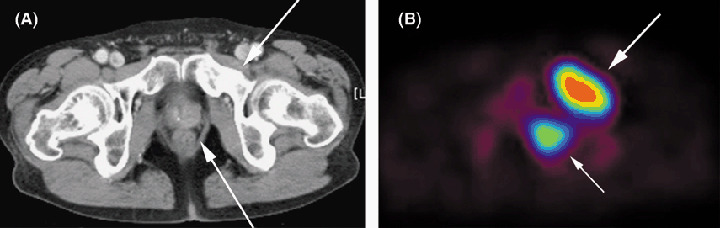
Figure 1
Figure 1
Detection of prostate cancer by positron emission tomography (PET) with 11C‐choline. A man with prostate cancer and bone metastasis underwent PET with 11C‐choline. (A) Computed tomography (CT) shows swelling of the left lobe (arrow) and osteoblastic appearance of the left pubic bone (arrow). (B) PET shows markedly increased uptake of 11C‐choline in both the primary prostate cancer lesion and bone metastasis (arrows). As PET with 18F‐FDG is not suitable for the diagnosis of prostate cancer due to excretion of the 8F‐FDG into urine, PET with 11C‐choline is thought to be useful for the detection of tumors adjacent to the urinary tract.
Figure 2
Figure 2
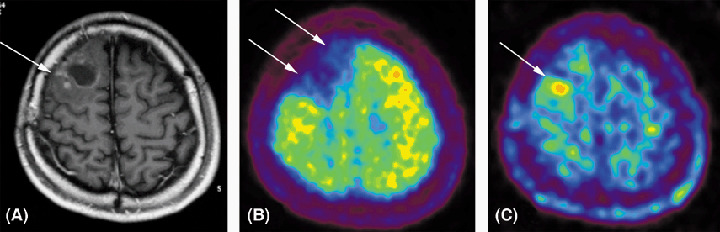
Detection of recurrent glioblastoma by positron emission tomography (PET) with 18F‐fluoro‐α‐methyltyrosine (FAMT). A woman with glioblastoma in the right frontal lobe underwent resection of tumor and adjuvant chemoradiation. (A) After 8 months, magnetic resonance imaging showed gadolinium‐enhancement around the area of resection (arrow). (B) PET with 18F‐FDG showed decreased uptake of 18F‐FDG in the area as compared with normal brain parenchyma (arrows). (C) PET with FAMT shows increased uptake at the posterolateral portion (arrow) indicating recurrence of glioblastoma.
Figure 3
Figure 3
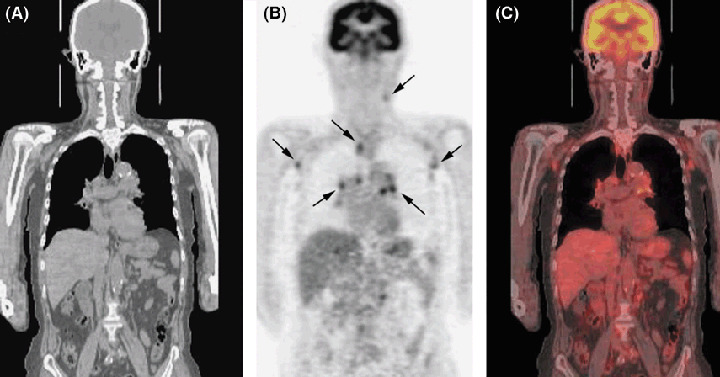
Detection of recurrent lymphoma by positron emission tomography‐computed tomography (PET‐CT) with 18F‐FDG. A 73‐year‐old man with peripheral T‐cell lymphoma in the left cervix underwent six courses of chemotherapy with THP‐COP. After 2 years, cervical CT demonstrated recurrence at a left cervical lymph node. PET‐CT was performed for restaging. (A) CT, (B) PET and (C) coronal view on PET‐CT show increased uptake of 18F‐FDG in multiple lymph nodes <1 cm (arrows).
Figure 4
Figure 4
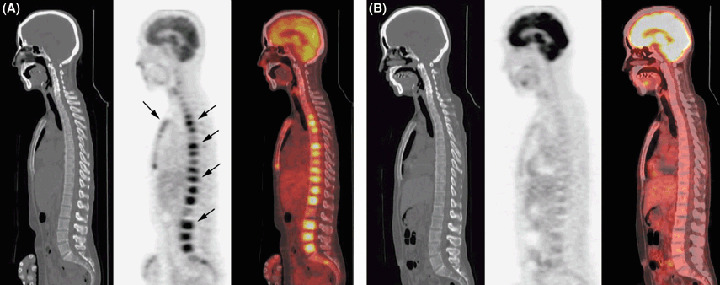
Positron emission tomography‐computed tomography (PET‐CT) with 18F‐FDG before and after therapy. PET‐CT in a 43‐year‐old woman with intravascular lymphoma. (A) PET‐CT before therapy clearly shows increased uptake of 18F‐FDG diffusely in the bone marrow (arrows). CT on the left does not show any abnormality. (B) After six cycles of therapy with rituximab plus cyclophosphamide, doxorubicin, vincristine, and prednisone, PET‐CT shows no evidence of increased uptake in the bone marrow, indicating that there was no residual lymphoma.
Figure 5
Figure 5
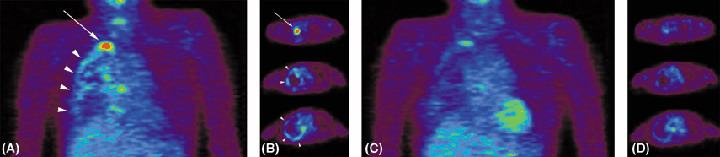
Positron emission tomography (PET) with 18F‐FDG before and after two doses of chemotherapy. A 57‐year‐old woman with non‐small‐cell lung cancer developed pleural dissemination of the tumor 9 months after upper and middle lobectomy of the right lung. (A) Coronal view and (B) axial view on PET performed at that time showed a markedly increased uptake of 18F‐FDG in the right apical portion (arrow) and also along the pleura (arrowheads). (C) Coronal view and (D) axial view on PET performed after two doses of gefitinib (250 mg/day) clearly shows decreased uptake of 18F‐FDG, indicating that the therapy was effective.

References

    1. Bos R, Van Der Hoeven JJ, Van Der Wall E et al. Biologic correlates of (18) fluorodeoxyglucose uptake in human breast cancer measured by positron emission tomography. J Clin Oncol 2002; 20: 379–87. - PubMed
    1. Kubota K. From tumor biology to clinical Pet: a review of positron emission tomography (PET) in oncology. Ann Nucl Med 2001; 15: 471–86. - PubMed
    1. Kubota K, Matsuzawa T, Fujiwara T et al. Differential diagnosis of lung tumor with positron emission tomography: a prospective study. J Nucl Med 1990; 31: 1927–33. - PubMed
    1. Kole AC, Nieweg KO, Prium J et al. Standardized uptake value and quantification of metabolism for breast cancer imaging with FDG and L‐[1‐11C] tyrosine PET. J Nucl Med 1997; 38: 692–6. - PubMed
    1. Hustinx R, Lemaire C, Jerusalem G et al. Whole‐body tumor imaging using PET and 2‐18F‐fluoro‐L‐tyrosine: Preliminary evaluation and comparison with 18F‐FDG. J Nucl Med 2003; 44: 533–9. - PubMed