


Occupational therapy for patients with problems in activities of daily living after stroke
- PMID: 17054178
- PMCID: PMC6464890
- DOI: 10.1002/14651858.CD003585.pub2
Occupational therapy for patients with problems in activities of daily living after stroke
Update in
-
Occupational therapy for adults with problems in activities of daily living after stroke.Cochrane Database Syst Rev. 2017 Jul 19;7(7):CD003585. doi: 10.1002/14651858.CD003585.pub3. Cochrane Database Syst Rev. 2017. PMID: 28721691 Free PMC article.
Abstract
Background: Occupational therapy aims to help people reach their maximum level of function and independence in all aspects of daily life.
Objectives: To determine whether occupational therapy focused specifically on personal activities of daily living improves recovery for patients following stroke.
Search strategy: We searched the Cochrane Stroke Group Trials Register (last searched January 2006). In addition, we searched the Cochrane Central Register of Controlled Trials (CENTRAL) (The Cochrane Library Issue 1, 2006), MEDLINE (1966 to March 2006), EMBASE (1980 to March 2006), CINAHL (1983 to March 2006), PsycLIT (1974 to March 2006), AMED (1985 to March 2006), Wilson Social Sciences Abstracts (1984 to March 2006) and the following Web of Science databases: Science Citation Index (1945 to March 2006), Social Science Citation Index (1956 to March 2006) and Arts and Humanities Citation Index (1975 to March 2006). In an effort to identify further published, unpublished and ongoing trials we searched The Occupational Therapy Research Index and Dissertation Abstracts register, scanned reference lists of relevant articles, contacted authors and researchers and handsearched relevant journals.
Selection criteria: We identified randomised controlled trials of an occupational therapy intervention (compared to usual care or no care) where stroke patients practiced personal activities of daily living, or performance in activities of daily living was the focus of the occupational therapy intervention.
Data collection and analysis: Two review authors independently selected trials and extracted data for pre-specified outcomes. The primary outcomes were the proportion of patients who had deteriorated or were dependent in personal activities of daily living and performance in personal activities of daily living at the end of follow up.
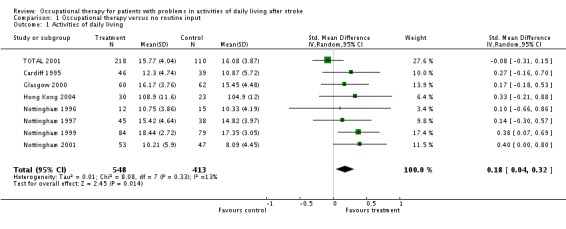
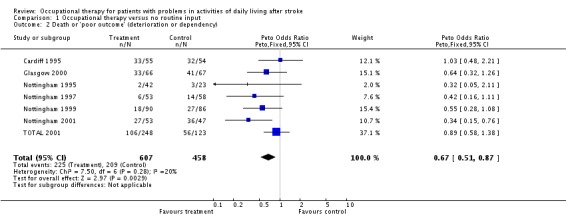
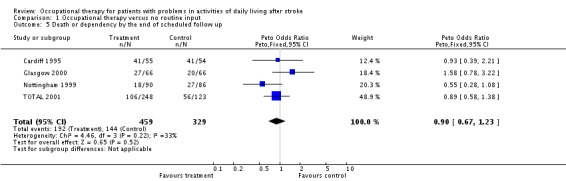
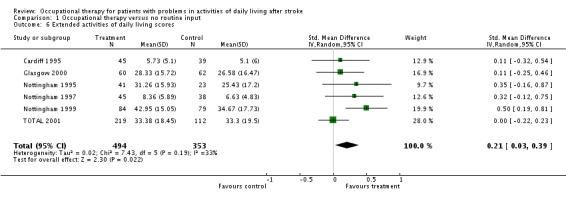
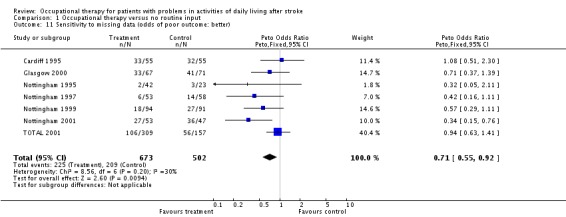
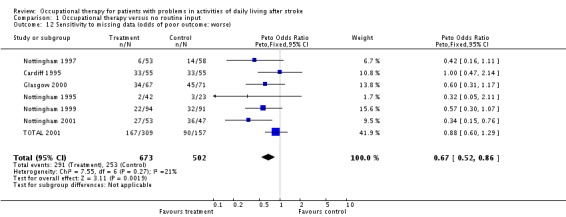
Main results: We identified 64 potentially eligible trials and included 10 studies (1348 participants). Occupational therapy interventions reduced the odds of a poor outcome (Peto odds ratio 0.67 (95% confidence interval (CI) 0.51 to 0.87; P = 0.003). and increased personal activity of daily living scores (standardised mean difference 0.18 (95% CI 0.04 to 0.32; P = 0.01). For every 11 (95% CI 7 to 30) patients receiving an occupational therapy intervention to facilitate personal activities of daily living, one patient was spared a poor outcome.
Authors' conclusions: Patients who receive occupational therapy interventions are less likely to deteriorate and are more likely to be independent in their ability to perform personal activities of daily living. However, the exact nature of the occupational therapy intervention to achieve maximum benefit needs to be defined.
Conflict of interest statement
None known.
Figures
References
References to studies included in this review
-
- Corr S, Bayer A. Occupational therapy for stroke patients after hospital discharge. Clinical Rehabilitation 1995;9:291‐6.
-
- Chiu WY, Man DWK. The effect of training older adults with stroke to use home‐based assistive devices. Occupational Therapy Journal of Research 2004;24(3):113‐20.
-
- Drummond AER, Walker MF. Generalisation of the effects of leisure rehabilitation for stroke patients. British Journal of Occupational Therapy 1996;59(7):330‐4.
-
- Walker MF, Drummond AER. Evaluation of dressing practice for stroke patients after discharge from hospital: a crossover design study. Clinical Rehabilitation 1996;10:23‐31.
References to studies excluded from this review
-
- Byl N, Roderick J, Mohamed O, Hanny M, Kotler J, Smith A, et al. Effectiveness of sensory and motor rehabilitation of the upper limb following the principles of neuroplasticity: patients stable poststroke. Neurorehabilitation and Neural Repair 2003;173:176‐91. - PubMed
-
- Chamberlain MA, Thornley G, Stowe J, Wright V. Evaluation of aids and equipment for the bath: II. A possible solution to the problem. Rheumatology and Rehabilitation 1981;20:38‐43. - PubMed
-
- Chase SL, Passarella PM, Lewetag BL, Ford LG. Cotreatment and functional outcome in stroke. Archives of Physical Medicine and Rehabilitation 1991;72:787.
-
- Corr S, Phillips CJ, Walker M. Evaluation of a pilot service designed to provide support following stroke: a randomized cross‐over design study. Clinical Rehabilitation 2004;18:69‐75. - PubMed
-
- Diller L, Ben‐Yishay Y, Gerstman LJ, Goodkin R, Gordon W, Weinberg J. Study I: training hemiplegics to pass block designs. Institute of Rehabilitation Medicine Monograph. Studies in Cognition and Rehabilitation in Hemiplegia. New York: New York University Medical Center, 1974:1‐85.
References to studies awaiting assessment
-
- Sun YH, Wang L, Wang ZS. Effects of the home‐based occupational therapy on motor function of limbs in patients with hemiplegia. Hong Kong Medical Journal 2001;7(4):25 (Abst P9).
-
- Stalhandske M, Tuvemo‐Johnson S, Terent A, Fugl‐Meyer A. After stroke; a home rehabilitation project 'lara leva efter stroke'. 9th Scandinavian Meeting on Cerebrovascular Diseases. Uppsala, Sweden, August 16‐19, 1997.
Additional references
-
- College of Occupational Therapy. What is occupational therapy?. www.cot.org.uk (accessed 5/7/2004).
-
- Dale S. Stroke. Office of Health Economics1988; Vol. London:3‐41.
-
- Dennis M, Warlow CP. Stroke: Incidence, risk factor and outcome. British Journal of Hospital Medicine 1987;37(3):194‐8. - PubMed
-
- Higgins JPT, Green S (eds). Cochrane Handbook for Systematic Reviews of Interventions 4.2.5 [updated May 2005]. The Cochrane Library Issue 3, 2005. Chichester: John Wiley & Sons, Ltd2005.
-
- Higgins JPT, Green S (eds). Cluster‐randomized trials. Cochrane Handbook for Systematic Reviews of Interventions 4.2.5 [updated May 2005]; Section 8.11.2. In: The Cochrane Library, Issue 3, 2005. Chichester, UK: John Wiley & Sons, Ltd2005.
References to other published versions of this review
-
- Chiu WY, Man DWK. The effect of training older adults with stroke to use home‐based assistive devices. Occupational Therapy Journal of Research 2004;24(3):113‐20.
Publication types
MeSH terms
LinkOut - more resources
Full Text Sources
Medical
