


Antidotes for acute cardenolide (cardiac glycoside) poisoning
- PMID: 17054261
- PMCID: PMC8889883
- DOI: 10.1002/14651858.CD005490.pub2
Antidotes for acute cardenolide (cardiac glycoside) poisoning
Abstract
Background: Cardenolides are naturally occurring plant toxins which act primarily on the heart. While poisoning with the digitalis cardenolides (digoxin and digitoxin) are reported worldwide, cardiotoxicity from other cardenolides such as the yellow oleander are also a major problem, with tens of thousands of cases of poisoning each year in South Asia. Because cardenolides from these plants are structurally similar, acute poisonings are managed using similar treatments. The benefit of these treatments is of interest, particularly in the context of cost since most poisonings occur in developing countries where resources are very limited.
Objectives: To determine the efficacy of antidotes for the treatment of acute cardenolide poisoning, in particular atropine, isoprenaline (isoproterenol), multiple-dose activated charcoal (MDAC), fructose-1,6-diphosphate, sodium bicarbonate, magnesium, phenytoin and anti-digoxin Fab antitoxin.
Search strategy: We searched MEDLINE, EMBASE, the Controlled Trials Register of the Cochrane Collaboration, Current Awareness in Clinical Toxicology, Info Trac, www.google.com.au, and Science Citation Index of studies identified by the previous searches. We manually searched the bibliographies of identified articles and personally contacted experts in the field.
Selection criteria: Randomised controlled trials where antidotes were administered to patients with acute symptomatic cardenolide poisoning were identified.
Data collection and analysis: We independently extracted data on study design, including the method of randomisation, participant characteristics, type of intervention and outcomes from each study. We independently assessed methodological quality of the included studies. A pooled analysis was not appropriate.
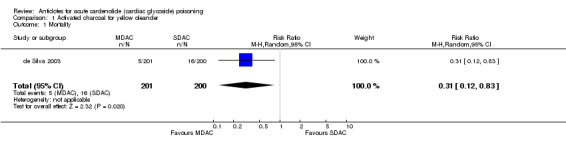
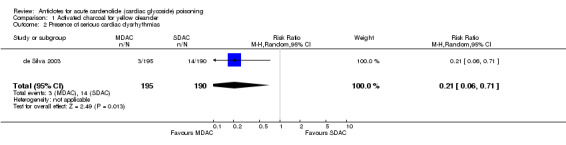
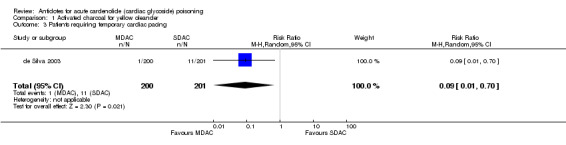
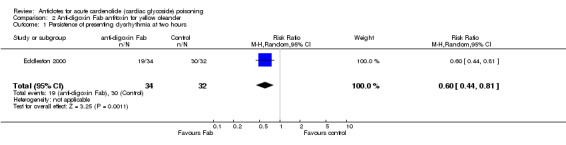
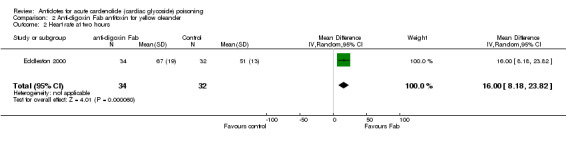
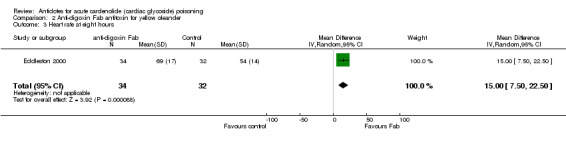
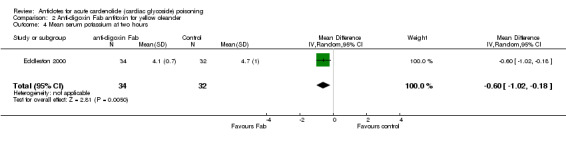
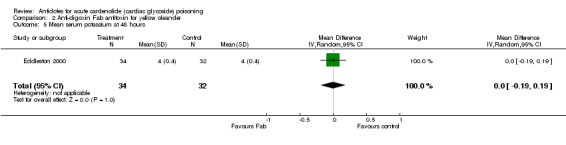
Main results: Two randomised controlled trials were identified, both were conducted in patients with yellow oleander poisoning. One trial investigated the effect of MDAC on mortality, the relative risk (RR) was 0.31 (95% confidence interval (CI) 0.12 to 0.83) indicating a beneficial effect. The second study found a beneficial effect of anti-digoxin Fab antitoxin on the presence of cardiac dysrhythmias at two hours post-administration; the RR was 0.60 (95% CI 0.44 to 0.81). Other benefits were also noted in both studies and serious adverse effects were minimal. Studies assessing the effect of antidotes on other cardenolides were not identified. One ongoing study investigating the activated charcoal for acute yellow oleander self-poisoning was also identified.
Authors' conclusions: There is some evidence to suggest that MDAC and anti-digoxin Fab antitoxin may be effective treatments for yellow oleander poisoning. However, the efficacy and indications of these interventions for the treatment of acute digitalis poisoning is uncertain due to the lack of good quality controlled clinical trials. Given pharmacokinetic differences between individual cardenolides, the effect of antidotes administered to patients with yellow oleander poisoning cannot be readily translated to those of other cardenolides. Unfortunately cost limits the use of antidotes such as anti-digoxin Fab antitoxin in developing countries where cardenolide poisonings are frequent. More research is required using relatively cheap antidotes which may also be effective.
Conflict of interest statement
NAB is an investigator in the above‐mentioned ongoing RCT (Eddleston 2005) investigating the effect of single or multiple dose activated charcoal for acute self‐poisoning with yellow oleander. He is also an investigator in the phase II study investigating the effect of fructose‐1,6‐diphosphate for acute self‐poisoning with yellow oleander (Dawson 2006).
Figures
Update of
References
References to studies included in this review
de Silva 2003 {published data only}
-
- Silva HA, Fonseka MM, Pathmeswaran A, Alahakone DG, Ratnatilake GA, Gunatilake SB, Ranasinha CD, Lalloo DG, Aronson JK, Silva HJ. Multiple‐dose activated charcoal for treatment of yellow oleander poisoning: a single‐blind, randomised, placebo‐controlled trial. Lancet 2003;361(9373):1935‐8. - PubMed
Eddleston 2000 {published data only}
-
- Eddleston M, Rajapakse S, Rajakanthan S, Sjöström L, Santharaj W, Thenabadu PN, Sheriff MHR, Warrell DA. Anti‐digoxin Fab fragments in cardiotoxicity induced by ingestion of yellow oleander: a randomised controlled trial. Lancet 2000;355(9208):967‐72. - PubMed
References to studies excluded from this review
Albrecht 1988 {published data only}
-
- Albrecht K, Hagen N, Falkowski KP, Ickert K. Treatment of the life‐threatening digitalis‐intoxication with heterologous antibodies [Die behandlung der lebensbedrohlichen digitalis‐intoxikation mit heterologen antikörper‐fragmenten]. Zeitschrift Fur Klinische Medizin 1988;43(8):617‐20.
Antman 1990 {published data only}
-
- Antman EM, Wenger TL, Butler VP Jr, Haber E, Smith TW. Treatment of 150 cases of life‐threatening digitalis intoxication with digoxin‐specific Fab antibody fragments. Final report of a multicenter study. Circulation 1990;81(6):1744‐52. - PubMed
Eddleston 2003 {published data only}
-
- Eddleston M, Senarathna L, Mohamed F, Buckley N, Juszczak E, Sheriff MHR, et al. Deaths due to absence of an affordable antitoxin for plant poisoning. Lancet 2003;362(9389):1041‐4. - PubMed
Hickey 1991 {published data only}
-
- Hickey AR, Wenger TL, Carpenter VP, Tilson HH, Hlatky MA, Furberg CD, et al. Digoxin Immune Fab therapy in the management of digitalis intoxication: safety and efficacy results of an observational surveillance study. Journal of the American College of Cardiology 1991;17(3):590‐8. - PubMed
Ibanez 1995 {published data only}
-
- Ibanez C, Carcas AJ, Frias J, Abad F. Activated charcoal increases digoxin elimination in patients. International Journal of Cardiology 1995;48(1):27‐30. - PubMed
Kirkpatrick 1991 {published data only}
-
- Kirkpatrick CH. Allergic histories and reactions of patients treated with digoxin immune Fab (ovine) antibody. American Journal of Emergency Medicine 1991;9(2 SUPPL. 1):7‐10. - PubMed
Lavaux 2004 {published data only}
-
- Lavaux T, Assemi P, Casset A, Lavigne T, Castelain V, Seydi A, et al. Efficiency of a non‐equimolar neutralisation of digoxin by immune Fab therapy. Journal of Toxicology ‐ Clinical Toxicology. 2004; Vol. 42:464‐5.
Love 1998 {published data only}
-
- Love JN, Sachdeva DK, Bessman ES, Curtis LA, Howell JM. A potential role for glucagon in the treatment of drug‐induced symptomatic bradycardia. Chest 1998;114(1):323‐6. - PubMed
Montoya 1995 {published data only}
-
- Montoya CMA, Escalante GP, Sauceda GJM, Marquez ELM, Gonzalez CH, Flores Alvarez E. Treatment of acute poisoning caused by carbamazepine, digoxin, and acetylsalicylic acid, with repeated doses of activated charcoal [El tratamiento de las intoxicaciones agudas causadas por carbamazepina, digoxina y acido acetilsalicilico, mediante la administracion de dosis repetidas de carbon activado]. Gaceta Médica de México 1995;131(3):349‐54. - PubMed
Oliveri 1971 {published data only}
-
- Oliveri R, Balestrini AE. Evaluation of sodium diphenylhydantoin in arrhythmies associated with digitalis poisoning [Valoracion de la difenihidantoina sodica en arritmias asociadas a la intoxicacion digitalica]. Prensa Médica Argentina 1971;58(32):1613‐7. - PubMed
Reissell 1982 {published data only}
-
- Reissell P, Manninen V. Effect of administration of activated charcoal and fibre on absorption, excretion and steady state blood levels of digoxin and digitoxin. Evidence for intestinal secretion of the glycosides. Acta Medica Scandinavica Supplementum 1982;668:88‐90. - PubMed
Roberts 2006 {published and unpublished data}
Schaumann 1986 {published data only}
-
- Schaumann W, Kaufmann B, Neubert P, Smolarz A. Kinetics of the Fab fragments of digoxin antibodies and of bound digoxin in patients with severe digoxin intoxication. European Journal of Clinical Pharmacology 1986;30(5):527‐33. - PubMed
Smith 1982 {published data only}
-
- Smith TW, Butler VP Jr, Haber E, Fozzard H, Marcus FI, Bremner WF, et al. Treatment of life‐threatening digitalis intoxication with digoxin‐specific Fab antibody fragments: experience in 26 cases. New England Journal of Medicine 1982;307(22):1357‐62. - PubMed
Smith 1991 {published data only}
-
- Smith TW. Review of clinical experience with digoxin immune Fab (ovine). American Journal of Emergency Medicine 1991;9(2 Suppl 1):1‐6. - PubMed
Smolarz 1984 {published data only}
-
- Smolarz A, Roesch E, Lenz H. Report on the treatment of 16 cases of severe glycoside poisoning with sheep antidigoxin fragments (Fab) [Erfahrungsbericht uber die behandlung von 16 schweren glykosidvergiftungen mit digitalis antikorper fragmenten (Fab)]. Zeitschrift Fur Kardiologie 1984;73(2):113‐9. - PubMed
Taboulet 1993b {published data only}
-
- Taboulet P, Baud FJ, Bismuth C, Vicaut E. Acute digitalis intoxication ‐ Is pacing still appropriate?. Journal of Toxicology ‐ Clinical Toxicology 1993;31(2):261‐73. - PubMed
Wenger 1985 {published data only}
-
- Wenger TL, Butler VP Jr, Haber E, Smith TW. Treatment of 63 severely digitalis‐toxic patients with digoxin‐specific antibody fragments. Journal of the American College of Cardiology 1985;5(5 Suppl A):118‐23. - PubMed
Wenger 1991 {published data only}
-
- Wenger TL. Experience with digoxin immune Fab (ovine) in patients with renal impairment. American Journal of Emergency Medicine 1991;9(2 Suppl 1):21‐3. - PubMed
Woolf 1991 {published data only}
-
- Woolf AD, Wenger TL, Smith TW, Lovejoy FH Jr. Results of multicenter studies of digoxin‐specific antibody fragments in managing digitalis intoxication in the pediatric population. American Journal of Emergency Medicine 1991;9(2 Suppl 1):16‐20. - PubMed
Woolf 1992 {published data only}
-
- Woolf AD, Wenger T, Smith TW, Lovejoy FH Jr. The use of digoxin‐specific Fab fragments for severe digitalis intoxication in children. New England Journal of Medicine 1992;326(26):1739‐44. - PubMed
References to ongoing studies
Eddleston 2005 {published and unpublished data}
-
- Eddleston M, Juszczak E, Buckley NA, Senarathna L, Mohamed F, Sheriff MHS, Warrell DA. Randomised controlled trial of routine single or multiple dose superactivated charcoal for self‐poisoning in a region with high mortality. Clinical Toxicology 2005;43:442‐3.
Additional references
Dawson 2006
-
- Dawson AH. Fructose‐1,6‐diphosphate (FDP) in yellow oleander poisoning. Correspondence 2006.
Higgins 2005
-
- Higgins JPT, Green S, editors. Cochrane Handbook for Systematic Reviews of Interventions 4.2.5 [updated May 2005]. http://www.cochrane.org/resources/handbook/hbook.htm.
Hoffman 2002
-
- Hoffman RS. Non‐pharmacological cardioactive steroids. Journal of Toxicology ‐ Clinical Toxicology 2002;40(3):285‐6.
Jadad 1996
-
- Jadad AR, Moore RA, Carroll D, Jenkinson C, Reynolds DJM, Gavaghan DJ, et al. Assessing the quality of randomized clinical trials: Is blinding necessary?. Controlled Clinical Trials 1996;17:1‐12. - PubMed
Langford 1996
-
- Langford SD, Boor PJ. Oleander toxicity: an examination of the human and animal toxic exposures. Toxicology 1996;109:1‐13. - PubMed
Markov 1999
-
- Markov AK, Payment MF, Hume AS, Rao MR, Markov MA, Skelton TN, et al. Fructose‐1,6‐diphosphate in the treatment of oleander toxicity in dogs. Veterinary and Human Toxicology 1999;41(1):9‐15. - PubMed
Roberts 2005
-
- Roberts DM, Eddleston M. Yellow oleander poisoning. In: Nayyar V editor(s). Critical Care Update 2004. 1. New Delhi: Jaypee Brothers Medical Publishers (P) Ltd, 2005:189‐200.
Schulz 1995
-
- Schulz KF, Chalmers I, Hayes RJ, Altman DG. Empirical evidence of bias. Dimensions of methodological quality associated with estimates of treatment effects in controlled trials. Journal of the American Medical Association 1995;273(5):408‐12. - PubMed
Taboulet 1993a
-
- Taboulet P, Baud FJ, Bismuth C. Clinical features and management of digitalis poisoning ‐ rationale for immunotherapy. Journal of Toxicology ‐ Clinical Toxicology 1993;31(2):247‐60. - PubMed
Publication types
MeSH terms
Substances
Grants and funding
LinkOut - more resources
Full Text Sources
