


Apelin increases contractility in failing cardiac muscle
- PMID: 17055480
- PMCID: PMC1815301
- DOI: 10.1016/j.ejphar.2006.09.034
Apelin increases contractility in failing cardiac muscle
Abstract
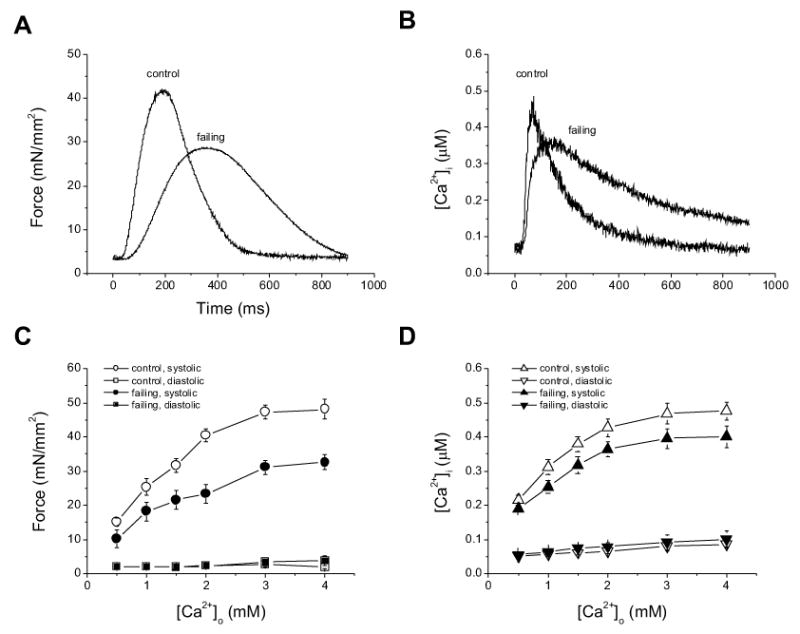
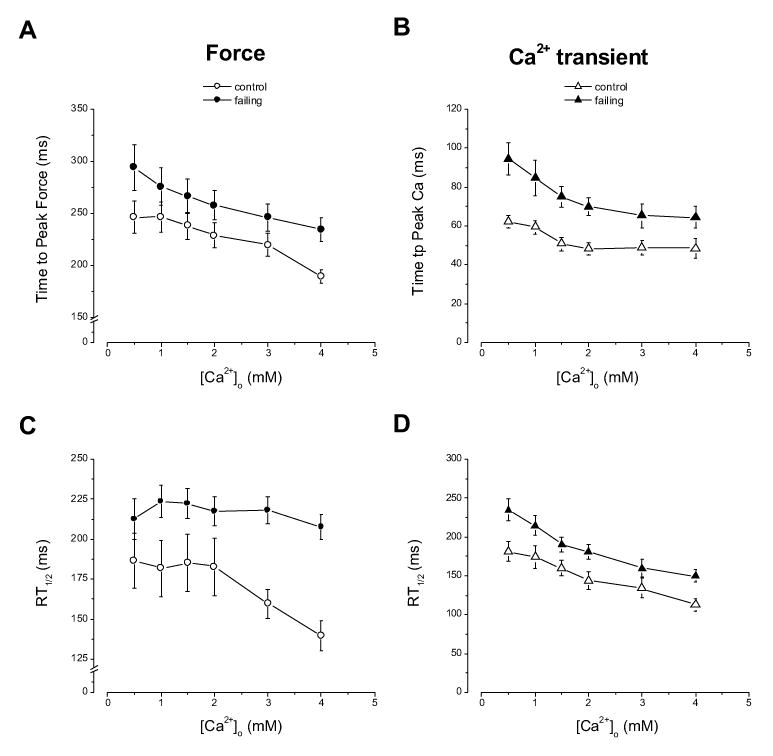
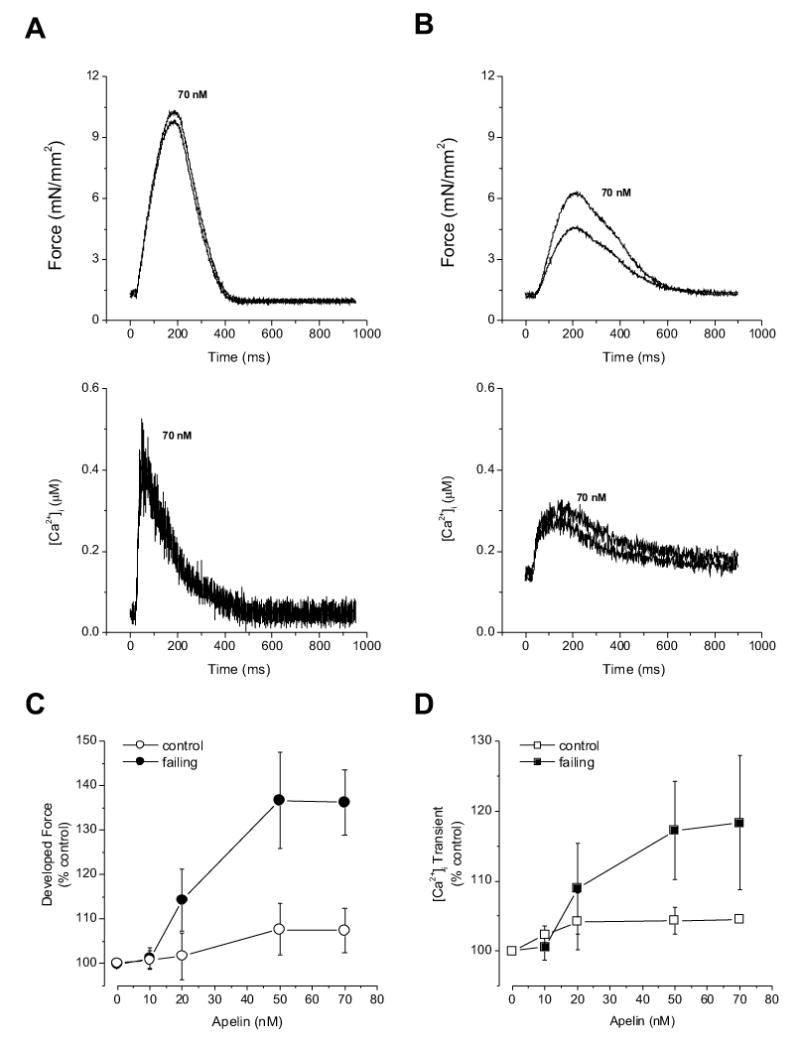
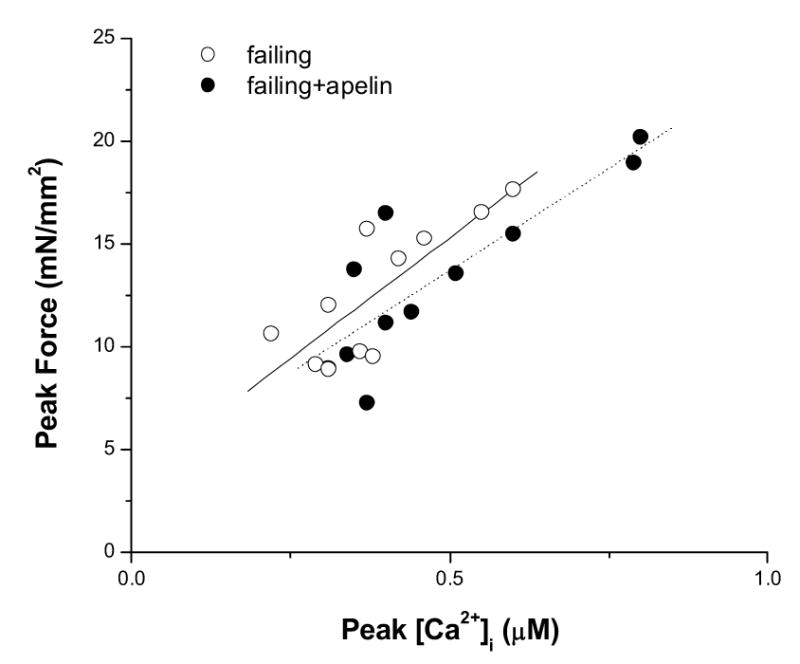
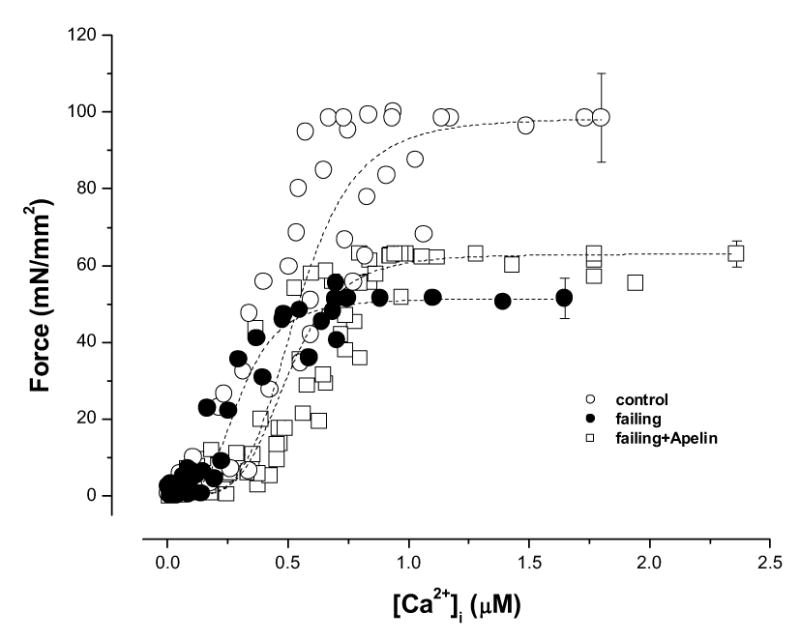
Apelin, a ligand for apelin-angiotension receptor-like 1 (APJ), has recently been shown to be a potent positive inotropic agent in normal hearts. In humans, levels of apelin have been shown to rise in early-stage heart failure and to fall in late-stage heart failure. In this study, we tested the hypothesis that apelin augments contraction directly in failing rat cardiac muscle. Right ventricular heart failure secondary to pulmonary hypertension was induced by exposing the rats to hypoxia (10% O(2) inhaled air) for 14-16 weeks. Trabeculae were dissected and mounted between a force transducer and a motor arm, superfused with Krebs-Henseleit (K-H) solution (pH 7.4, 22 degrees C), and loaded with fura-2. Both force development and [Ca(2+)](i) transient amplitude increased in a dose-dependent manner in the presence of Apelin-12 (10 approximately 70 nM, [Ca(2+)](o)=0.5 mM) in failing muscles as compared to control (36+/-7% vs. 7.4+/-5% at 70 nM, P<0.05). Also, [Ca(2+)](i) transients increased up to 18.4+/-9.5% as compared to control (4.5+/-1.9%, P<0.05). The increases in contraction in the presence of apelin were also maintained over a range of external Ca(2+) (0.5-2.0 mM). Steady-state force-[Ca(2+)](i) relation of the failing muscles reveals decreased maximal Ca(2+)-activated force (F(max)) (51.45+/-5.3 vs. 98.5+/-11.5 mN/mm(2), P<0.001), with no changes in Ca(2+) required for 50% of maximal activation (Ca(50)) (0.45+/-0.07 vs. 0.30+/-0.04 muM, P>0.05) and Hill coefficient (4.60+/-0.73 vs. 3.17+/-0.92, P>0.05). Apelin (70 nM) had no effect on the steady-state force-[Ca(2+)](i) relation in failing muscles (F(max): 63.03+/-3.5 mN/mm(2); Ca(50): 0.50+/-0.08 microM; Hill coefficient: 4.73+/-0.89). These results indicate that apelin exerts a selective positive inotropic action in failing myocardium. The increased force development is the result of increased [Ca(2+)](i) transients rather than changes in myofilament calcium responsiveness.
Figures
References
-
- Ashley EA, Powers J, Chen M, Kundu R, Finsterbach T, Caffarelli A, Deng A, Eichhorn J, Mahajan R, Agrawal R, Greve J, Robbins R, Patterson AJ, Bernstein D, Quertermous T. The endogenous peptide apelin potently improves cardiac contractility and reduces cardiac loading in vivo. Cardiovasc Res. 2005;65:73–82. - PMC - PubMed
-
- Berry MF, Pirolli TJ, Jayasankar V, Burdick J, Morine KJ, Gardner TJ, Woo YJ. Apelin has in vivo inotropic effects on normal and failing hearts. Circulation. 2004;110:II187–193. - PubMed
-
- Chen MM, Ashley EA, Deng DX, Tsalenko A, Deng A, Tabibiazar R, Ben-Dor R, Fenster b, Yang B, King JY, Fowler M, Robbins R, Johnson FL, Bruhn L, McDonagh T, Dargie H, Yakhini Z, Tsao PS, Quertermous T. Novel role for the potent endogenous inotrope apelin in human cardiac dysfunction. Circulation. 2003;108:1432–1439. - PubMed
-
- Dai T, Ramirez-Correa G, Gao WD. Apelin disproportionally increases contraction in failing cardiac muscle. Circulation. 2005;112:II–159.
Publication types
MeSH terms
Substances
Grants and funding
LinkOut - more resources
Full Text Sources
Other Literature Sources
Medical
Molecular Biology Databases
Miscellaneous
