


doi: 10.1111/j.1467-7687.2006.00530.x.
The development of area discrimination and its implications for number representation in infancy
Affiliations
- PMID: 17059447
- PMCID: PMC1661837
- DOI: 10.1111/j.1467-7687.2006.00530.x
Item in Clipboard
The development of area discrimination and its implications for number representation in infancy
Dev Sci.
2006 Nov.
Abstract
This paper investigates the ability of infants to attend to continuous stimulus variables and how this capacity relates to the representation of number. We examined the change in area needed by 6-month-old infants to detect a difference in the size of a single element (Elmo face). Infants successfully discriminated a 1:4, 1:3 and 1:2 change in the area of the Elmo face but failed to discriminate a 2:3 change. In addition, the novelty preference was linearly related to the ratio difference between the novel and familiar area. Results suggest that Weber's Law holds for area discriminations in infancy and also reveal that at 6 months of age infants are equally sensitive to number, time and area.
Figures
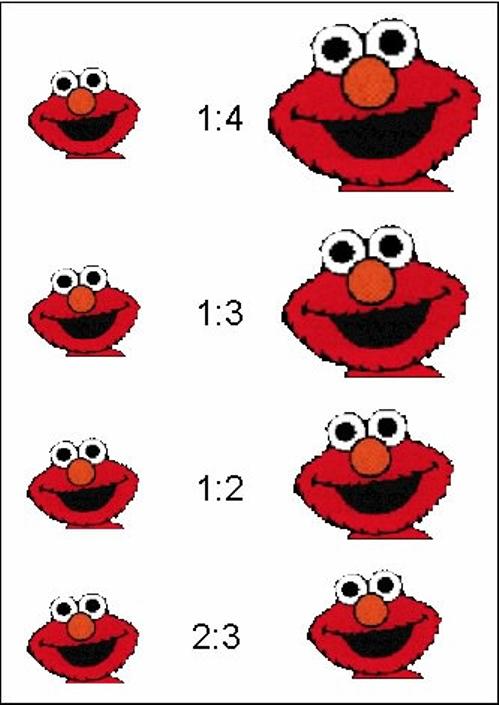
Schematic representation of the ratios of the stimuli used in Experiment 1.
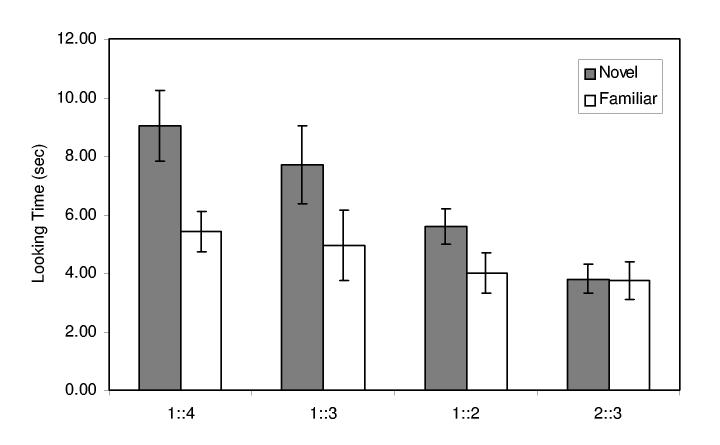
Average looking times for infants in Experiment 1 to the novel and familiar surface areas by ratio condition.
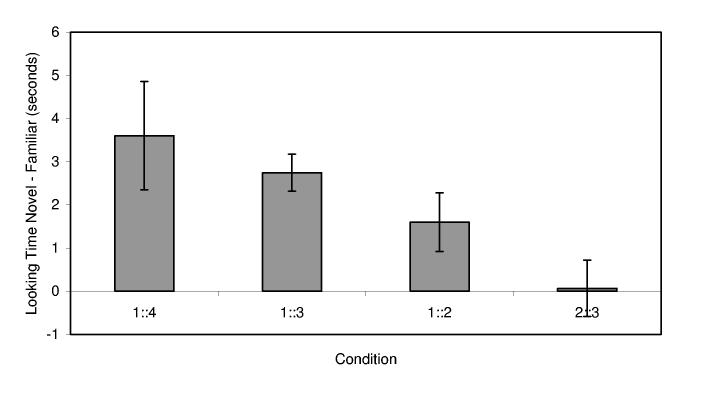
Difference in looking time (novel-familiar) for the 4 conditions. Error bars reflect standard errors.
References
-
- Antell SE, Keating DP. Perception of numerical invariance in neonates. Child Development. 1983;54:695–701. - PubMed
-
- Brannon EM. The development of ordinal numerical knowledge in infancy. Cognition. 2002;83:223–240. - PubMed
-
- Brannon EM, Abbott S, Lutz DJ. Number bias for the discrimination of large visual sets in infancy. Cognition. 2004;93:B59–B68. - PubMed
-
- Clearfield MW, Mix KS. Number versus contour length in infants’discrimination of small visual sets. Psychological Science. 1999;10:408–411.
-
- Clearfield MW, Mix KS. Amount versus number: Infants’use of are and contour length to discriminate small sets. Journal of Cognition and Development. 2001;2(3):243–260.
Publication types
MeSH terms
Grants and funding
LinkOut - more resources
Full Text Sources
