. 2006 Oct 31;103(44):16598-603.
doi: 10.1073/pnas.0603522103. Epub 2006 Oct 24.

Roles of Arabidopsis ATP/ADP isopentenyltransferases and tRNA isopentenyltransferases in cytokinin biosynthesis

Affiliations

Roles of Arabidopsis ATP/ADP isopentenyltransferases and tRNA isopentenyltransferases in cytokinin biosynthesis

Kaori Miyawaki et al. Proc Natl Acad Sci U S A. .

Abstract

Cytokinins, which are central regulators of cell division and differentiation in plants, are adenine derivatives carrying an isopentenyl side chain that may be hydroxylated. Plants have two classes of isopentenyltransferases (IPTs) acting on the adenine moiety: ATP/ADP isopentenyltransferases (in Arabidopsis thaliana, AtIPT1, 3, 4-8) and tRNA IPTs (in Arabidopsis, AtIPT2 and 9). ATP/ADP IPTs are likely to be responsible for the bulk of cytokinin synthesis, whereas it is thought that cis-zeatin (cZ)-type cytokinins are produced possibly by degradation of cis-hydroxy isopentenyl tRNAs, which are formed by tRNA IPTs. However, these routes are largely hypothetical because of lack of in vivo evidence, because the critical experiment necessary to verify these routes, namely the production and analysis of mutants lacking AtIPTs, has not yet been described. We isolated null mutants for all members of the ATP/ADP IPT and tRNA IPT gene families in Arabidopsis. Notably, our work demonstrates that the atipt1 3 5 7 quadruple mutant possesses severely decreased levels of isopentenyladenine and trans-zeatin (tZ), and their corresponding ribosides, ribotides, and glucosides, and is retarded in its growth. In contrast, these mutants possessed increased levels of cZ-type cytokinins. The atipt2 9 double mutant, on the other hand, lacked isopentenyl- and cis-hydroxy isopentenyl-tRNA, and cZ-type cytokinins. These results indicate that whereas ATP/ADP IPTs are responsible for the bulk of isopentenyladenine- and tZ-type cytokinin synthesis, tRNA IPTs are required for cZ-type cytokinin production. This work clarifies the long-standing questions of the biosynthetic routes for isopentenyladenine-, tZ-, and cZ-type cytokinin production.


Conflict of interest statement

The authors declare no conflict of interest.

Figures

Fig. 1.
Fig. 1.
Mutants of AtIPT genes. (A) Description of the mutant alleles used in this study. T-DNA insert positions within the AtIPT1, 2, 3, 4, 5, 7, and 9 are represented by a triangle. The atipt6 mutation is indicated by alignment of short sequences corresponding to the region of AtIPT6 differing between Col and Ws. The atipt8 mutation is represented by a schematic of the construct used for deletion of the gene by homologous recombination. Coding regions are depicted with open squares, and noncoding regions are depicted with bars. NPTII, NEOMYCIN PHOSPHOTRANSFERASE II. (B) Expression of AtIPT9 in wild-type and atipt9-1. Because the T-DNA was inserted in an intron in the atipt9-1allele, expression of AtIPT9 was examined. RT-PCR was performed on cDNA derived from Col WT or atipt9-1plants by using primers upstream and downstream of the T-DNA insert. The 18S rRNA gene was used as a control. PCR cycles were 35 cycles for the AtIPT9 gene and 20 cycles for the 18S rRNA gene.
Fig. 2.
Fig. 2.
Phenotypes of atipt1 3 5 7. (A) Plants grown on vertical plates for 10 days. (B) Plants grown on nutrient-vermiculite for 39 days. (A and B Left) Col WT. (A and B Right) atipt1 3 5 7. (C and D) Shoot apical meristems in 5-day-old WT Columbia (C) and 5-day-old atipt1 3 5 7 (D). (Scale bars: A, 1 cm; B, 5 cm; C and D, 50 μm.)
Fig. 3.
Fig. 3.
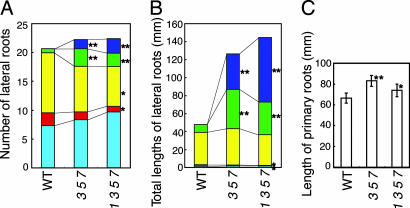
Enhanced root elongation in the atipt3 5 7 (3 5 7) and atipt1 3 5 7 (1 3 5 7) mutants. (A and B) Average number of lateral roots (A) and total length of lateral roots (B), with individual length ranges discriminated by color. (C) Primary root length. Values are mean ± SD. In A and B, light blue, 0–0.5 mm; red, 0.5–1.0 mm; yellow, 1.0–10.0 mm; green, 10.0–20.0 mm; blue, >20.0 mm. At least nine plants were used for a genotype. Single and double asterisks indicate significant difference between values of mutants and WT (0.01 < P < 0.05 and P < 0.01, respectively).
Fig. 4.
Fig. 4.
Partial rescue of the atipt1 3 5 7 quadruple mutant by external application of cytokinin and complementation of the atipt3 5-1 6 7 mutant by AtIPT3 promoter::AtIPT3-GFP. (A and B) WT (Left) and atipt1 3 5 7 (Right) grown without (A) or with (B) 10 nM tZ for 21 days. (C Left) atipt3 5-1 6 7. (C Right) atipt3 5-1 6 7 carrying AtIPT3 promoter::AtIPT3-GFP. (D–G) Expression of AtIPT3 promoter::AtIPT3-GFP in WT root (D) or cotyledon (F), or in atipt3 5-1 6 7 root (E) or cotyledon (G). (Scale bars: A and B, 1 cm; C, 10 cm; D–G, 50 μm.)
Fig. 5.
Fig. 5.
Cytokinin levels in AtIPT mutants. Values are mean ± SD of five samples. (A) iPRMP (black) and iPR (gray). (B) tZRMP (black) and tZR (gray). (C) cZRMP (black) and cZR (gray). (D) Free-base cytokinins: iP (black), tZ (gray), and cZ (open). (E) Glucosylated cytokinins: tZ7G (black), tZ9G (gray), and tZOG (open). Mutant names are shown as numbers (e.g., the atipt1 atipt3 double mutant is shown as 1 3).

References

    1. Miller CO, Skoog F, von Saltza MH, Strong F. J Am Chem Soc. 1955;77:1392.
    1. Skoog F, Miller CO. Symp Soc Exp Biol. 1957;11:118–131. - PubMed
    1. Sakakibara H. Annu Rev Plant Biol. 2006;57:431–449. - PubMed
    1. Mok MC. In: Cytokinins: Chemistry, Activity, and Function. Mok DWS, Mok MC, editors. Boca Raton, FL: CRC Press; 1994. pp. 155–166.
    1. Mähönen AP, Bishopp A, Higuchi M, Nieminen KM, Kinoshita K, Tormakangas K, Ikeda Y, Oka A, Kakimoto T, Helariutta Y. Science. 2006;311:94–98. - PubMed

Publication types

MeSH terms