Review
. 2006 Nov;6(11):823-35.
doi: 10.1038/nri1957.

Toll-like receptors in systemic autoimmune disease

Affiliations
Review

Toll-like receptors in systemic autoimmune disease

Ann Marshak-Rothstein. Nat Rev Immunol. 2006 Nov.

Abstract

Toll-like receptors (TLRs) have a crucial role in the early detection of pathogen-associated molecular patterns and the subsequent activation of the adaptive immune response. Whether TLRs also have an important role in the recognition of endogenous ligands has been more controversial. Numerous in vitro studies have documented activation of both autoreactive B cells and plasmacytoid dendritic cells by mammalian TLR ligands. The issue of whether these in vitro observations translate to an in vivo role for TLRs in either the initiation or the progression of systemic autoimmune disease is a subject of intense research; data are beginning to emerge showing that this is the case.


Conflict of interest statement

US patent application 10/487,885 (entitled Method and Composition for Treating Immune Complex Associated Disorders) and corresponding foreign applications have been licensed and provide royalty income to Ann Marshak-Rothstein.

Figures
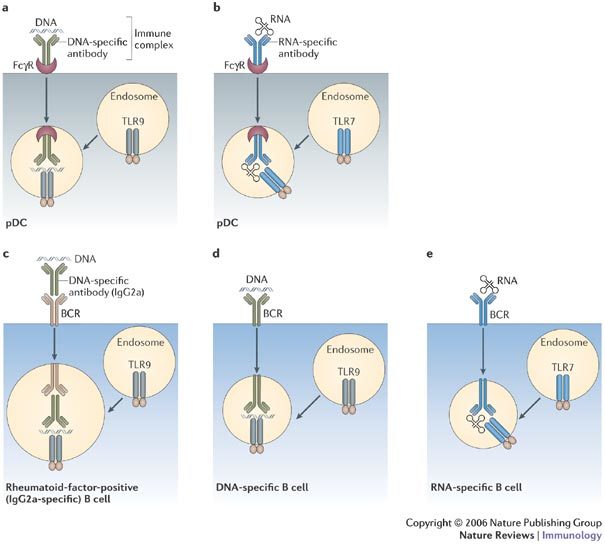
Figure 1
Figure 1. Receptor-mediated delivery of autoantigens to Toll-like receptor 7 or Toll-like receptor 9.
Receptors for the Fc portion of IgG (FcγRs) that are present at the surface of plasmacytoid dendritic cells (pDCs) bind immune complexes and transport both the autoantibody and the autoantigen (such as DNA or RNA) to the cytoplasmic compartment that contains Toll-like receptor 9 (TLR9) (a) or TLR7 (b). The B-cell receptor (BCR) at the surface of AM14 B cells (which are specific for IgG2a) has the same function and can transport both DNA- and RNA-containing immune complexes (c). BCRs that directly bind autoantigen, either DNA (d) or RNA (e), provide the same delivery system.
Figure 2
Figure 2. Virus-induced interferon-α initiates a self-perpetuating feedback loop to drive autoantibody production.
a | Viral infection induces plasmacytoid dendritic cells (pDCs) to produce interferon-α (IFNα). b | IFNα upregulates expression of Toll-like receptor 7 (TLR7) by B cells, promotes cell death and increased release of certain RNA autoantigens, and primes pDCs to respond more effectively to immune complexes. c | Autoreactive B cells that have upregulated TLR7 expression bind the autoantigen that is released from apoptotic cells. d | The B-cell receptors (BCRs) of these cells deliver RNA autoantigen to TLR7, and engagement of TLR7 leads to proliferation and differentiation of these B cells. e | These B cells produce autoantibody, which combines with autoantigen to form immune complexes. f | Immune complexes bind the receptors for the Fc portion of IgG (FcγRs) at the surface of pDCs that are derived from circulating monocytes. g | The internalized autoantigen engages TLR7, and more IFNα is then produced by the pDCs. IFNαR, IFNα receptor.

References

    1. Casciola-Rosen LA, Anhalt G, Rosen A. Autoantigens targeted in systemic lupus erythematosus are clustered in two populations of surface structures on apoptotic keratinocytes. J. Exp. Med. 1994;179:1317–1330. doi: 10.1084/jem.179.4.1317. - DOI - PMC - PubMed
    1. Rosen A, Casciola-Rosen L. Autoantigens as substrates for apoptotic proteases: implications for the pathogenesis of systemic autoimmune disease. Cell Death Differ. 1999;6:6–12. doi: 10.1038/sj.cdd.4400460. - DOI - PubMed
    1. Utz PJ, Gensler TJ, Anderson P. Death, autoantigen modifications, and tolerance. Arthritis Res. 2000;2:101–114. doi: 10.1186/ar75. - DOI - PMC - PubMed
    1. Plotz PH. The autoantibody repertoire: searching for order. Nature Rev. Immunol. 2003;3:73–78. doi: 10.1038/nri976. - DOI - PubMed
    1. Medzhitov R, Janeway CA., Jr Innate immune recognition: mechanisms and pathways. Immunol. Rev. 2000;173:89–97. doi: 10.1034/j.1600-065X.2000.917309.x. - DOI - PubMed

Publication types
