. 2006 Nov 7;103(45):17042-7.
doi: 10.1073/pnas.0607877103. Epub 2006 Oct 25.

Cloning of DOG1, a quantitative trait locus controlling seed dormancy in Arabidopsis

Affiliations

Cloning of DOG1, a quantitative trait locus controlling seed dormancy in Arabidopsis

Leónie Bentsink et al. Proc Natl Acad Sci U S A. .

Abstract

Genetic variation for seed dormancy in nature is a typical quantitative trait controlled by multiple loci on which environmental factors have a strong effect. Finding the genes underlying dormancy quantitative trait loci is a major scientific challenge, which also has relevance for agriculture and ecology. In this study we describe the identification of the DELAY OF GERMINATION 1 (DOG1) gene previously identified as a quantitative trait locus involved in the control of seed dormancy. This gene was isolated by a combination of positional cloning and mutant analysis and is absolutely required for the induction of seed dormancy. DOG1 is a member of a small gene family of unknown molecular function, with five members in Arabidopsis. The functional natural allelic variation present in Arabidopsis is caused by polymorphisms in the cis-regulatory region of the DOG1 gene and results in considerable expression differences between the DOG1 alleles of the accessions analyzed.


Conflict of interest statement

The authors declare no conflict of interest.

Figures
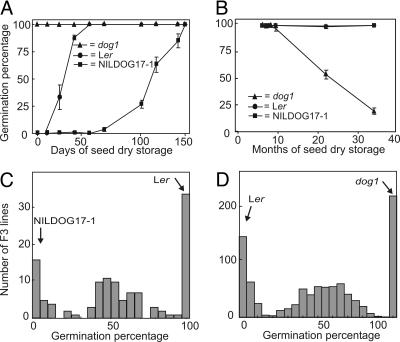
Fig. 1.
Fig. 1.
Phenotypes of the different DOG1 alleles. (A) Germination behavior of Ler, NILDOG17-1, and dog1 at different time points after seed harvest. The means and SE of four replicates are shown. (B) Seed storability phenotypes of the different DOG1 alleles. Germination behavior of the different DOG1 alleles, Ler, NILDOG17-1, and dog1 at different time points after seed harvest. The means and SE of triplicates are shown. (C and D) Segregation of DOG1 alleles. Shown are frequency distributions of germination percentages of F3 seed batches harvested from individual F2 plants derived from the crosses Ler × NILDOG17-1 (C) and Ler × dog1 (D).
Fig. 2.
Fig. 2.
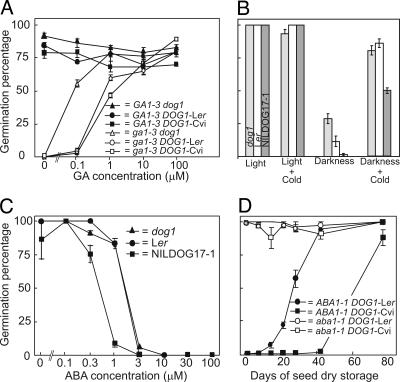
Germination behavior of DOG1 under different environmental circumstances and in different genetic backgrounds. (A) GA requirement for germination. Germination on various concentrations of GA4+7 of after-ripened seeds of GA1-3 dog1, GA1-3 DOG1-Ler, and GA1-3 DOG1-Cvi and on the GA-deficient seeds ga1-3 dog1, ga1-3 DOG1-Ler, and ga1-3 DOG1-Cvi. Seeds of GA1-3 dog1 and ga1-3 dog1 were 1 month after-ripened, and seeds of the other combinations were after-ripened for 25 months. Percentages are averages of four measurements ± SE. (B) Germination in darkness. Shown are germination percentages of after-ripened seeds of dog1, Ler, and NILDOG17-1 under different environmental conditions, in light, in light after a cold stratification, in darkness, and in darkness after a cold stratification. The means and SE of triplicates are shown. (C) ABA sensitivity of the three DOG1 alleles. Shown is germination in different ABA concentrations of after-ripened seeds of dog1, DOG1-Ler, and DOG1-Cvi. Seeds of dog1 and DOG1-Ler were after-ripened for 4 months, and seeds of DOG1-Cvi were after-ripened for 25 months. The percentages are means of triplicates ± SE. (D) ABA dependency of DOG1. Shown is germination behavior of aba1-1 in two different DOG1 backgrounds (DOG1-Ler and DOG1-Cvi) at different time points after seed harvest.
Fig. 3.
Fig. 3.
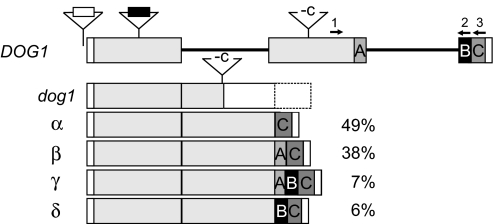
Schematic illustration and relative abundance of the DOG1 transcripts. At the top of the figure the DOG1 genomic DNA is shown. The insertions of SALK 000867 (white box), SM_3.20808, SM_3.20873, and SM_3.20886 (black box) and the position of the mutation in the dog1 mutant (-c) are indicted on top of this genomic structure. Boxes on the black solid line indicate the exons, white boxes indicate 3′ and 5′ untranslated regions, and the different grayscales are used to illustrate the different exon compositions of the transcripts α, β, γ, and δ, which are shown below. The percentages indicate the relative abundance of the different transcripts; this is an average of the abundance measured in dry dormant and nondormant seeds of several accessions analyzed. Primers used for PCR amplification are indicated by the black arrows (1, pyro F2; 2, pyro R2; 3, pyro R3).
Fig. 4.
Fig. 4.
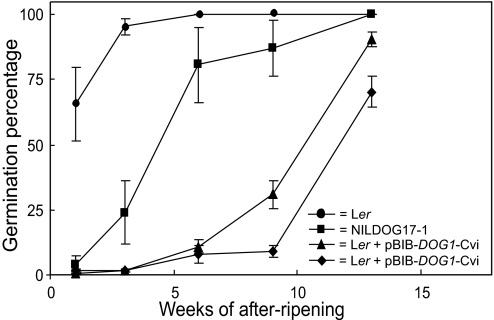
Introduction of the DOG1-Cvi allele into the Ler genetic background. The germination of homozygous transformants obtained by Agrobacterium-mediated transformation of Ler with the genomic fragment of DOG1-Cvi is shown. Shown is germination behavior of Ler, NILDOG17-1, and two independent transformants at different time points after seed harvest. The means and SE of triplicates for Ler and NILDOG17-1 and 11 and 12 replicates for the two transformants, respectively, are shown.
Fig. 5.
Fig. 5.
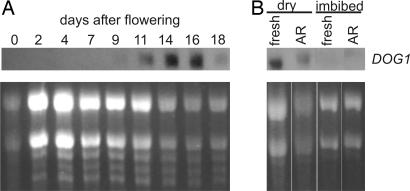
Northern blot analyses of the expression of DOG1 in seeds of NILDOG17-1. (A) The expression at different developmental stages, starting at the day of pollination until 18 days after pollination, when the seeds are mature and the silique opens (analyzed in developing siliques). (B) The expression in fresh (dormant) and after-ripened (AR; nondormant) dry and imbibed mature seeds is shown. (Upper) Autoradiograph. (Lower) RNA loading stained with ethidium bromide.
Fig. 6.
Fig. 6.
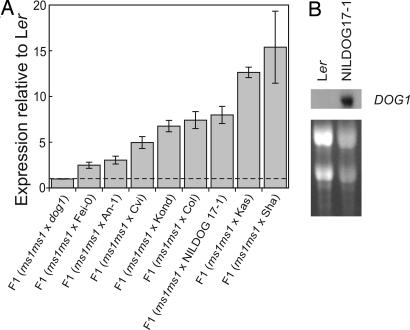
Expression analyses of DOG1 in different genetic backgrounds. (A) Relative expression levels were measured by pyrosequencing of cDNAs derived from RNA extracted from F1 seeds made by pollinating a male sterile 1 (ms1) mutant in a Ler background with pollen of each of nine other genotypes (the accessions Fei-0, An-1, Cvi, Kond, Col, Kas-2, and Sha and NILDOG17-1 and dog1). The relative values are means of triplicates ± SE. The horizontal dashed line indicates a relative expression level of 1. (B) Northern blot analyses of the expression of DOG1 in mature seeds of Ler and NILDOG17-1. (Upper) Autoradiograph. (Lower) RNA loading stained with ethidium bromide.

References

    1. Bewley JD. Plant Cell. 1997;9:1055–1066. - PMC - PubMed
    1. Donohue K. Seed Sci Res. 2005;15:175–187.
    1. Fenner M, Thompson K. The Ecology of Seeds. Cambridge, UK: Cambridge Univ Press; 2005.
    1. Ooms JJJ, Léon-Kloosterziel KM, Bartels D, Koornneef M, Karssen CM. Plant Physiol. 1993;102:1185–1191. - PMC - PubMed
    1. Nambara E, Keith K, McCourt P, Naito S. Development (Cambridge, UK) 1995;121:629–636.

Publication types