Review
. 2006 Nov;3(8):703-8.
doi: 10.1513/pats.200605-121SF.

Cigarette smoke inhibits alveolar repair: a mechanism for the development of emphysema

Affiliations
Review

Cigarette smoke inhibits alveolar repair: a mechanism for the development of emphysema

Stephen I Rennard et al. Proc Am Thorac Soc. 2006 Nov.

Abstract

Classically, emphysema has been believed to develop when mediators of tissue injury exceed protective mechanisms within the lung. Evidence also supports the concept that tissue destruction represents a balance between tissue injury and tissue repair. In this context, cigarette smoke is directly toxic to cells within the lung and can impair the repair functions of fibroblasts, epithelial cells, and mesenchymal cells. This may occur in the absence of overt cytotoxicity and may result from alteration of selected biochemical pathways. A variety of repair functions can be affected, including chemotaxis, proliferation, production of extracellular matrix, and remodeling of extracellular matrix. Finally, cigarette smoke can damage DNA but can also compromise apoptosis. As a result, DNA repair mechanisms can be initiated, leading to recovery of cells that potentially contain somatic cell mutations. This pathway may contribute not only to the development of cancer but to the persistent abnormalities in tissue structure that characterize chronic obstructive pulmonary disease. Understanding the mechanisms that mediate normal tissue repair and understanding the bases for altered tissue repair in the face of cigarette smoking offer new opportunities designed to address the structural alterations that characterize chronic obstructive pulmonary disease.


Figures
<b>Figure 1.</b>
Figure 1.
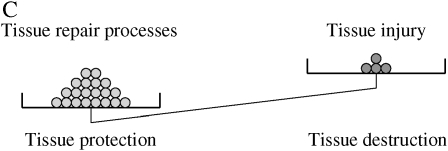
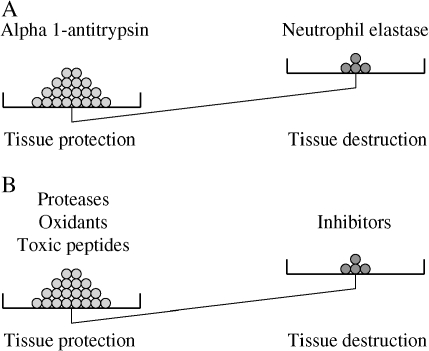
Emphysema represents an imbalance. (A) In the “classic” protease–antiprotease hypothesis of emphysema, tissue destruction resulted when neutrophil elastase overwhelmed the endogenous protection provided by α1-antitrypsin. This balance could be upset either by increasing the elastase burden (e.g., with inflammation from smoking) or by decreasing the antielastase protection (e.g., by genetic deficiency of α1-antitrypsin. (B) Expanded mediator of injury–inhibitor hypothesis. The classic concept has been expanded to include several classes of antiproteases, each with many members as well as other injurious mediators, including oxidants and toxic peptides. There is a corresponding set of inhibitors for each of these mediators, and the overall balance determines whether tissue injury results. (C) Injury repair hypothesis. Because tissues can repair injury, tissue integrity can be maintained in the face of injury if repair is adequate. Tissue destruction, therefore, represents an imbalance between tissue injury and repair.
<b>Figure 1.</b>
Figure 1.
Emphysema represents an imbalance. (A) In the “classic” protease–antiprotease hypothesis of emphysema, tissue destruction resulted when neutrophil elastase overwhelmed the endogenous protection provided by α1-antitrypsin. This balance could be upset either by increasing the elastase burden (e.g., with inflammation from smoking) or by decreasing the antielastase protection (e.g., by genetic deficiency of α1-antitrypsin. (B) Expanded mediator of injury–inhibitor hypothesis. The classic concept has been expanded to include several classes of antiproteases, each with many members as well as other injurious mediators, including oxidants and toxic peptides. There is a corresponding set of inhibitors for each of these mediators, and the overall balance determines whether tissue injury results. (C) Injury repair hypothesis. Because tissues can repair injury, tissue integrity can be maintained in the face of injury if repair is adequate. Tissue destruction, therefore, represents an imbalance between tissue injury and repair.
<b>Figure 2.</b>
Figure 2.
Scanning electron micrograph of normal mouse lung. (A) Normal young adult (2 mo) C57/Bl6 mouse. (B) Normal old (24 mo) C57/Bl6 mouse. Alveolar pores can be readily observed in both preparations. They are increased in size and number in the old mouse lung. An increase in alveolar size and effacement of the alveolar walls can also be appreciated.
<b>Figure 3.</b>
Figure 3.
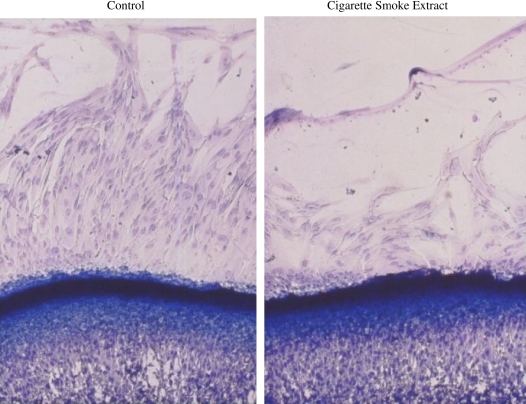
Cigarette smoke inhibition of fibroblast chemotaxis. Fibroblasts were plated in an agarose well and induced to migrate under the agarose toward a gradient of fibronectin contained in a separate well. Migrating cells can be recognized by the morphology as they stream along the surface of the culture dish beneath the agarose. The inhibitory effect of cigarette smoke extract is readily apparent.
<b>Figure 4.</b>
Figure 4.
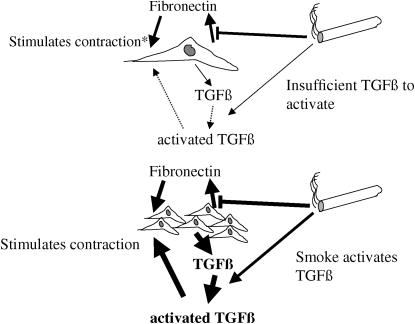
Cigarette smoke modulation of repair by paracrine mechanisms: effect of cell density. (Upper panel) At low cell density, cigarette smoke inhibits fibronectin production and because fibronectin stimulates contraction, smoke inhibits contraction as well. Any effect of smoke in activating transforming growth factor (TGF)-β is inconsequential as the concentrations of TGF-β are too low to elicit a response. *Loss of stimulation causes inhibition in the presence of smoke. (Lower panel) At higher cell density, sufficient TGF-β is produced by the many cells in the local milieu to elicit a response. Smoke-induced activation of TGF-β results in augmented contraction, even in the face of direct inhibition of fibronectin production. Other paracrine factors (e.g., prostaglandin E or matrix metalloproteinases) could also interact and would also have effects that would depend on cell density.

References

    1. Shapiro SD, Snider GL, Rennard SI. Chronic bronchitis and emphysema. In: Mason RJ, Broadus VC, Murray JF, Nadel JA, editors. Textbook of respiratory medicine. Vol. 1. Philadelphia: Elsevier; 2005. pp. 1115–1167.
    1. Global Initiative for Chronic Obstructive Lung Disease (GOLD). Workshop Report: Global strategy for the diagnosis, management, and prevention of chronic obstructive pulmonary disease. Update 2005. Available from: www.goldcopd.com - PubMed
    1. Laurell CB, Eriksson S. The electrophoretic alpha 1-globulin pattern of serum in alpha 1-antitrypsin deficiency. Scand J Clin Lab Invest 1963;15:132–140. - PubMed
    1. Shapiro SD. The pathogenesis of emphysema: the elastase:antielastase hypothesis 30 years later. Proc Assoc Am Physicians 1995;107:346–352. - PubMed
    1. Seagrave J. Oxidative mechanisms in tobacco smoke-induced emphysema. J Toxicol Environ Health A 2000;61:69–78. - PubMed

Publication types

LinkOut - more resources