


Validation of Roche LightCycler Epstein-Barr virus quantification reagents in a clinical laboratory setting
- PMID: 17065428
- PMCID: PMC1876171
- DOI: 10.2353/jmoldx.2006.050152
Validation of Roche LightCycler Epstein-Barr virus quantification reagents in a clinical laboratory setting
Abstract
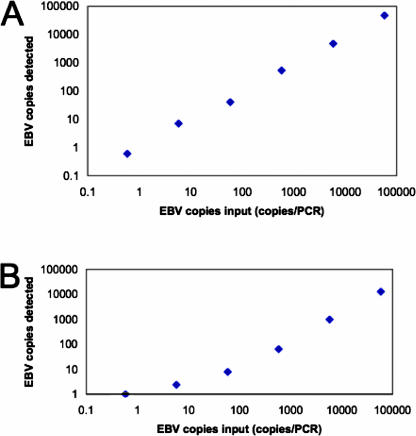
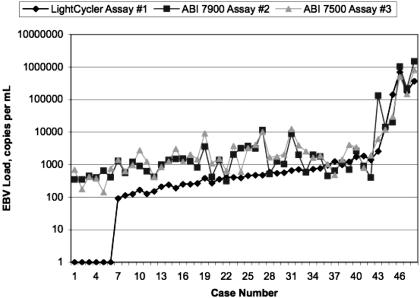
Epstein-Barr virus (EBV) is associated with a wide range of benign and malignant diseases, including infectious mononucleosis, lymphoma, posttransplant lymphoproliferative disorder, and nasopharyngeal carcinoma. Measurement of EBV viral load in plasma is increasingly used for rapid assessment of disease status. We evaluated the performance characteristics of an EBV polymerase chain reaction assay that uses commercial reagents and instruments from Roche Diagnostics (Indianapolis, IN). DNA was extracted from plasma using a MagNaPure instrument, and viral load was measured by real-time polymerase chain reaction on a LightCycler. Analyte-specific reagents included primers and hybridization probes targeting the EBV LMP2 gene and a spiked control sequence. Accuracy and reproducibility were established using DNA from three cell lines. The assay was sensitive to approximately 750 copies of EBV DNA per milliliter of plasma and was linear across at least four orders of magnitude. The assay detected EBV DNA in three of five samples from nasopharyngeal carcinoma patients, seven of nine infectious mononucleosis samples, and 34/34 samples from immunosuppressed patients with clinically significant EBV-related disease, whereas EBV DNA was undetectable in plasma from 21 individuals without EBV-related disease. In conclusion, this LightCycler EBV assay is rapid, sensitive, and linear for quantifying EBV viral load. The assay appears to be useful for measuring clinically significant EBV levels in immunodeficient patients.
Figures
References
-
- Ryan JL, Fan H, Swinnen LJ, Schichman SA, Raab-Traub N, Covington M, Elmore S, Gulley ML. Epstein-Barr Virus (EBV) DNA in plasma is not encapsidated in patients with EBV-related malignancies. Diagn Mol Pathol. 2004;13:61–68. - PubMed
-
- Fafi-Kremer S, Morand P, Brion JP, Pavese P, Baccard M, Germi R, Genoulaz O, Nicod S, Jolivet M, Ruigrok RW, Stahl JP, Seigneurin JM. Long-term shedding of infectious epstein-barr virus after infectious mononucleosis. J Infect Dis. 2005;191:985–989. - PubMed
-
- Balfour HH, Jr, Holman CJ, Hokanson KM, Lelonek MM, Giesbrecht JE, White DR, Schmeling DO, Webb CH, Cavert W, Wang DH, Brundage RC. A prospective clinical study of Epstein-Barr virus and host interactions during acute infectious mononucleosis. J Infect Dis. 2005;192:1505–1512. - PubMed
-
- Fan H, Gulley ML. Epstein-Barr viral load measurement as a marker of EBV-related disease. Mol Diagn. 2001;6:279–289. - PubMed
Publication types
MeSH terms
Substances
LinkOut - more resources
Full Text Sources
