


Dominant negative pleiotrophin induces tetraploidy and aneuploidy in U87MG human glioblastoma cells
- PMID: 17067552
- PMCID: PMC1850963
- DOI: 10.1016/j.bbrc.2006.09.148
Dominant negative pleiotrophin induces tetraploidy and aneuploidy in U87MG human glioblastoma cells
Abstract
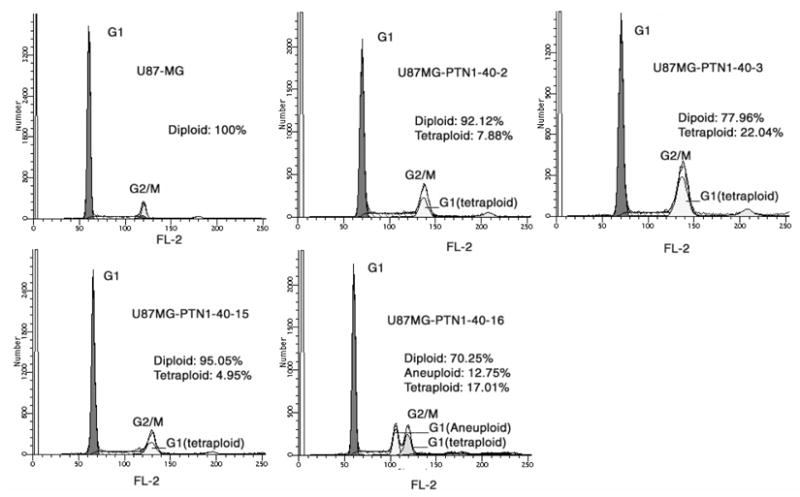
Pleiotrophin (PTN, Ptn) is an 18kDa secretory cytokine that is expressed in many human cancers, including glioblastoma. In previous experiments, interruption of the constitutive PTN signaling in human U87MG glioblastoma cells that inappropriately express endogenous Ptn reversed their rapid growth in vitro and their malignant phenotype in vivo. To seek a mechanism for the effect of the dominant-negative PTN, flow cytometry was used to compare the profiles of U87MG cells and four clones of U87MG cells that express the dominant-negative PTN (U87MG/PTN1-40 cells); here, we report that the dominant-negative PTN in U87MG cells induces tetraploidy and aneuploidy and arrests the tetraploid and aneuploid cells in the G1 phase of the cell cycle. The data suggest that PTN signaling may have a critical role in chromosomal segregation and cell cycle progression; the data suggest induction of tetraploidy and aneuploidy in U87MG glioblastoma cells may be an important mechanism that contributes to the loss of the malignant phenotype of U87MG cells.
Figures
References
-
- Milner PG, Shah D, Veile R, Donis-Keller H, Kumar BV. Cloning, nucleotide sequence, and chromosome localization of the human pleiotrophin gene. Biochemistry. 1992;31:12023–12028. - PubMed
-
- Li YS, Milner PG, Chauhan AK, Watson MA, Hoffman RM, Kodner CM, Milbrandt J, Deuel TF. Cloning and expression of a developmentally regulated protein that induces mitogenic and neurite outgrowth activity. Science. 1990;250:1690–1694. - PubMed
-
- Milner PG, Li YS, Hoffman RM, Kodner CM, Siegel NR, Deuel TF. A novel 17 kD heparin-binding growth factor (HBGF-8) in bovine uterus: purification and N-terminal amino acid sequence. Biochem Biophys Res Commun. 1989;165:1096–1103. - PubMed
-
- Bohlen P, Kovesdi I. HBNF and MK, members of a novel gene family of heparin-binding proteins with potential roles in embryogenesis and brain function. Prog Growth Factor Res. 1991;3:143–157. - PubMed
Publication types
MeSH terms
Substances
Grants and funding
LinkOut - more resources
Full Text Sources
