


SISYPHUS--structural alignments for proteins with non-trivial relationships
- PMID: 17068077
- PMCID: PMC1635320
- DOI: 10.1093/nar/gkl746
SISYPHUS--structural alignments for proteins with non-trivial relationships
Abstract
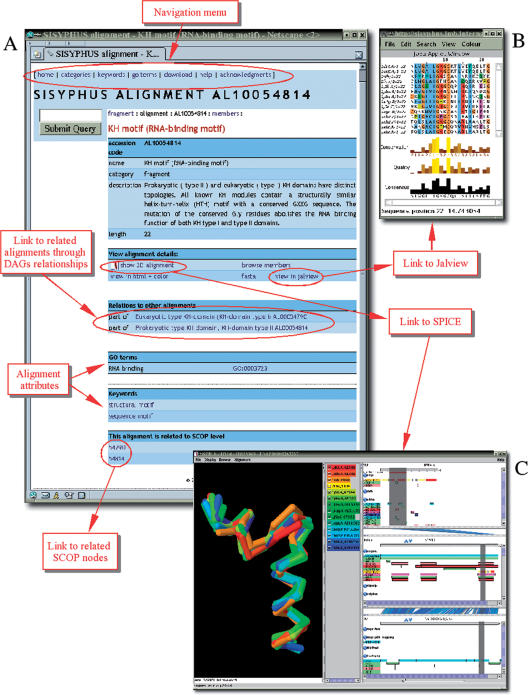
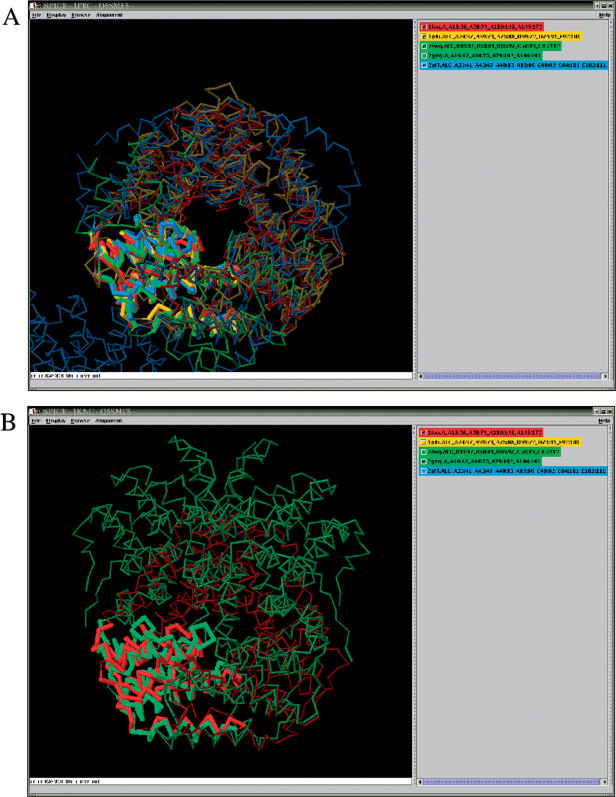
With the increasing amount of structural data, the number of homologous protein structures bearing topological irregularities is steadily growing. These include proteins with circular permutations, segment-swapping, context-dependent folding or chameleon sequences that can adopt alternative secondary structures. Their non-trivial structural relationships are readily identified during expert analysis but their automatic identification using the existing computational tools still remains difficult or impossible. Such non-trivial cases of protein relationships are known to pose a problem to multiple alignment algorithms and to impede comparative modeling studies. They support a new emerging concept of evolutionary changeable protein fold, which creates practical difficulties for the hierarchical classifications of protein structures.To facilitate the understanding of, and to provide a comprehensive annotation of proteins with such non-trivial structural relationships we have created SISYPHUS ([Sigmaomeganuphiomicronzeta]--in Greek crafty), a compendium to the SCOP database. The SISYPHUS database contains a collection of manually curated structural alignments and their inter-relationships. The multiple alignments are constructed for protein structural regions that range from oligomeric biological units, or individual domains to fragments of different size. The SISYPHUS multiple alignments are displayed with SPICE, a browser that provides an integrated view of protein sequences, structures and their annotations. The database is available from http://sisyphus.mrc-cpe.cam.ac.uk.
Figures
References
-
- Murzin A.G., Brenner S.E., Hubbard T., Chothia C. SCOP: a structural classification of proteins database for the investigation of sequences and structures. J. Mol. Biol. 1995;247:536–540. - PubMed
-
- Murzin A.G. How far divergent evolution goes in proteins. Curr. Opin. Struct. Biol. 1998;8:380–387. - PubMed
-
- Andreeva A., Murzin A.G. Evolution of protein fold in the presence of functional constraints. Curr. Opin. Struct. Biol. 2006;16:399–408. - PubMed
-
- Grishin N.V. Fold change in evolution of protein structures. J. Struct. Biol. 2001;134:167–185. - PubMed
Publication types
MeSH terms
Grants and funding
LinkOut - more resources
Full Text Sources
Other Literature Sources
Research Materials
Miscellaneous
