


A critical role of serum response factor in myofibroblast differentiation during experimental oesophageal ulcer healing in rats
- PMID: 17068115
- PMCID: PMC1942159
- DOI: 10.1136/gut.2006.106674
A critical role of serum response factor in myofibroblast differentiation during experimental oesophageal ulcer healing in rats
Abstract
Background: Myofibroblast differentiation is a key event during wound healing and is triggered primarily by transforming growth factor beta (TGFbeta). Serum response factor (SRF) is a TGFbeta-inducible transcription factor that is important for wound healing. Injection of SRF expression plasmid into rat gastric ulcers significantly accelerated restoration of epithelium and smooth muscle structures.
Aim: To determine the role of SRF in oesophageal ulcer healing, especially in myofibroblast differentiation.
Subjects: Rats (in vivo), oesophageal epithelial cells (Het1A) and fibroblasts (Rat1-R12) (in vitro) were used.
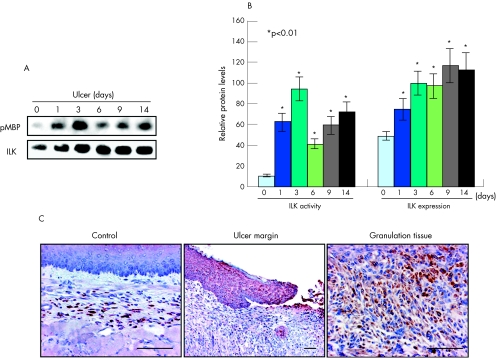
Methods: Oesophageal ulcers were induced in rats with acetic acid and subsequently treated by local injection of plasmids expressing either SRF or SRF antisense sequence. Rats were killed at 1, 3, 6, 9 and 14 days after treatment and tissues collected. For in vitro studies, both Het1A and Rat1-R12 cells were transfected with the plasmids used in ulcer treatment.
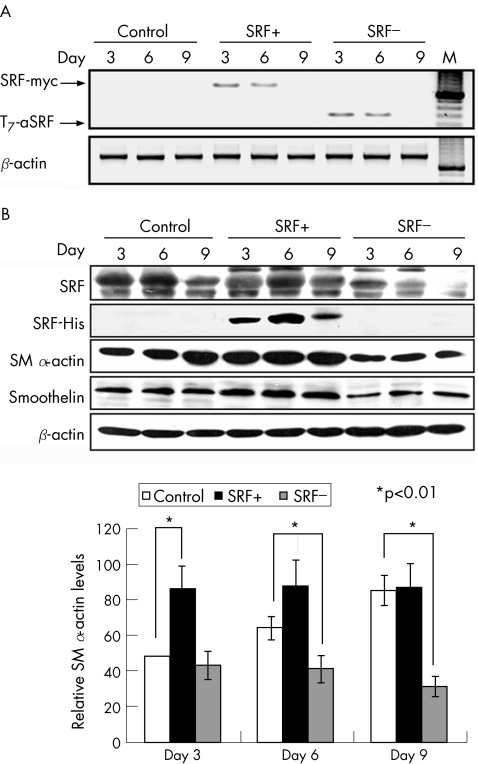
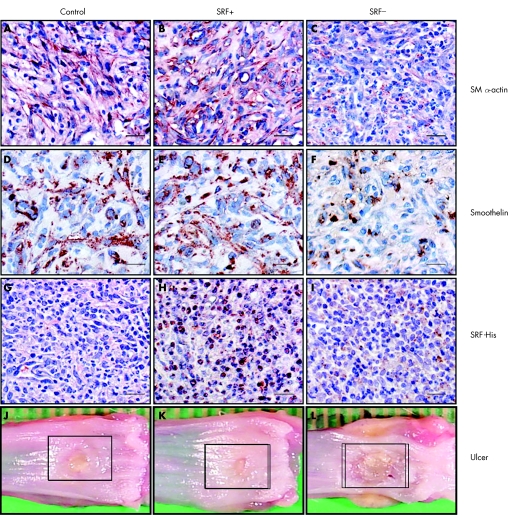
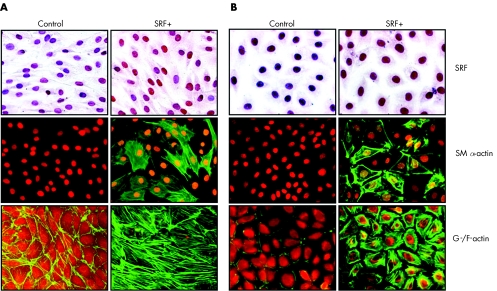
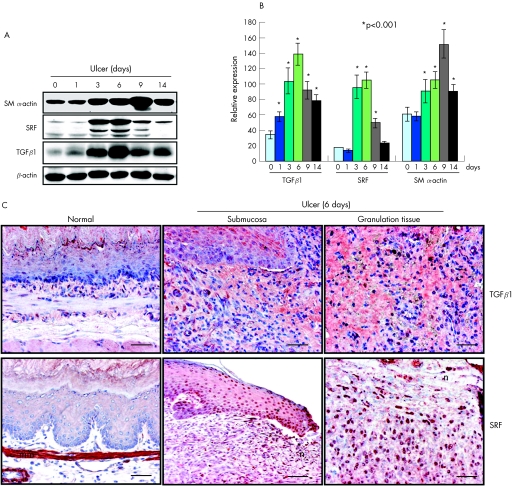
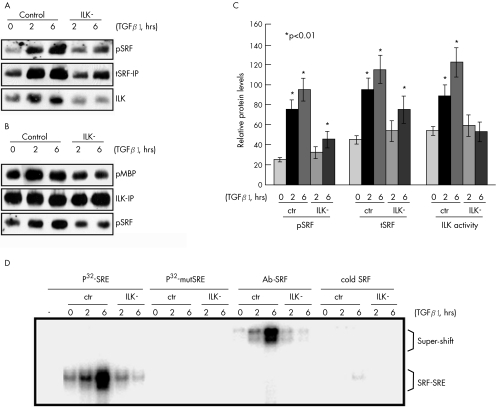
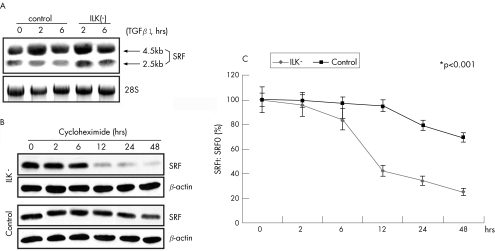
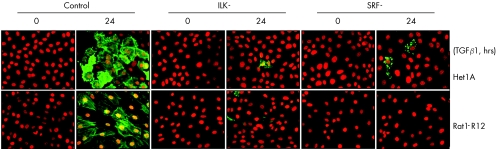
Results: Upregulation of SRF increased the myofibroblast population in ulcer granulation tissue; knockdown of SRF suppressed this event. In addition, ulceration induced SRF and TGFbeta expression coordinately. In vitro studies showed that overexpression of SRF in either oesophageal epithelial cells or fibroblasts was sufficient to induce myofibroblast phenotype. Furthermore, the TGFbeta-induced myofibroblast phenotype required integrin-linked kinase (ILK)-mediated SRF activation, as either knockdown of SRF or inactivation of ILK prevented this action.
Conclusions: SRF is indispensable for myofibroblast differentiation during oesophageal ulcer healing and is required for TGFbeta-induced myofibroblast transition from either epithelial cells or fibroblasts. ILK is a mediator in TGFbeta-induced SRF activation and subsequent myofibroblast differentiation. ILK is associated with SRF, and TGFbeta enhances this association.
Conflict of interest statement
Competing interests: None.
References
-
- Treisman R. Identification of a protein‐binding site that mediates transcriptional response of the c‐fos gene to serum factors. Cell 198646567–574. - PubMed
-
- Chai J, Tarnawski A S. Serum response factor: discovery, biochemistry, biological roles and implications for tissue injury healing. J Physiol Pharmacol 200253147–157. - PubMed
-
- Orr L. Scientists align billion‐year‐old protein with embryonic heart defects. Medical News Today 2004
-
- Wang J Y, Johnson L R. Expression of protooncogenes c‐fos and c‐myc in healing of gastric mucosal stress ulcers. Am J Physiol 1994266G878–G886. - PubMed
Publication types
MeSH terms
Substances
LinkOut - more resources
Full Text Sources
Other Literature Sources
Medical
Miscellaneous
