Review
. 2006;26(4):317-52.
doi: 10.1615/critrevimmunol.v26.i4.30.

Mycobacterium tuberculosis-specific CD8+ T cells and their role in immunity

Affiliations
Review

Mycobacterium tuberculosis-specific CD8+ T cells and their role in immunity

Joshua S M Woodworth et al. Crit Rev Immunol. 2006.

Abstract

There are more cases of tuberculosis in the world today than at any other time in history. The global epidemic has generated intense interest into the immunological mechanisms that control infection. Although CD4+ T cells play a critical role in host immunity to Mycobacterium tuberculosis, there is considerable interest in understanding the role of other T cell subsets in preventing disease development following infection. CD8+ T cells are required for optimum host defense following M. tuberculosis infection, which has led to investigation into how this protective effect is mediated. A critical review of recent literature regarding the role of CD8+ T cells in protective immunity to M. tuberculosis infection is now required to address the strengths and weaknesses of these studies. In this article, we evaluate the evidence that CD8+ T cells are critical in immunity to M. tuberculosis infection. We discuss the specific mycobacterial proteins that are recognized by CD8+ T cells elicited during infection. Finally, we examine the effector mechanisms of CD8+ T cells generated during infection and synthesize recent studies to consider the protective roles that these T cells serve in vivo.


Figures
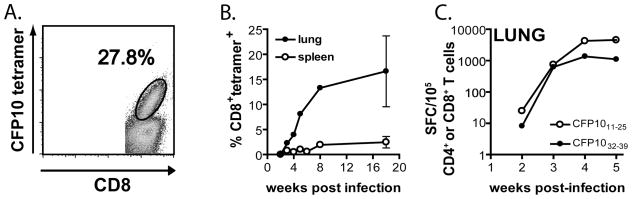
FIGURE 1
FIGURE 1. Frequency of CFP10-specific T cells elicited following aerosol infection with M. tuberculosis
A. A representative FACS plot shows the percentage of pulmonary CD8+ T cells from M. tuberculosis infected C3H mice that are specific for CFP1032–39, as determined using CFP1032–39-loaded H-2 Kk tetramers. B. Nearly 30% of the pulmonary CD8+ T cells from M. tuberculosis infected C3H mice are specific for CFP1032–39 as determined by staining with the CFP1032–39-loaded H-2 K tetramer. Lung mononuclear cells and splenocytes were gated on lymphocytes based on forward and side scatter and then gated on CD8+ events. C. The kinetics of the CD4+ and CD8+ T cell response to the CFP1011–25 and CFP1032–39 epitopes, respectively. C3H mice were infected by the respiratory route and the frequency of CFP10-specific CD4+ and CD8+ T cells in the lung was determined by Elispot at the indicated time points.
FIGURE 2
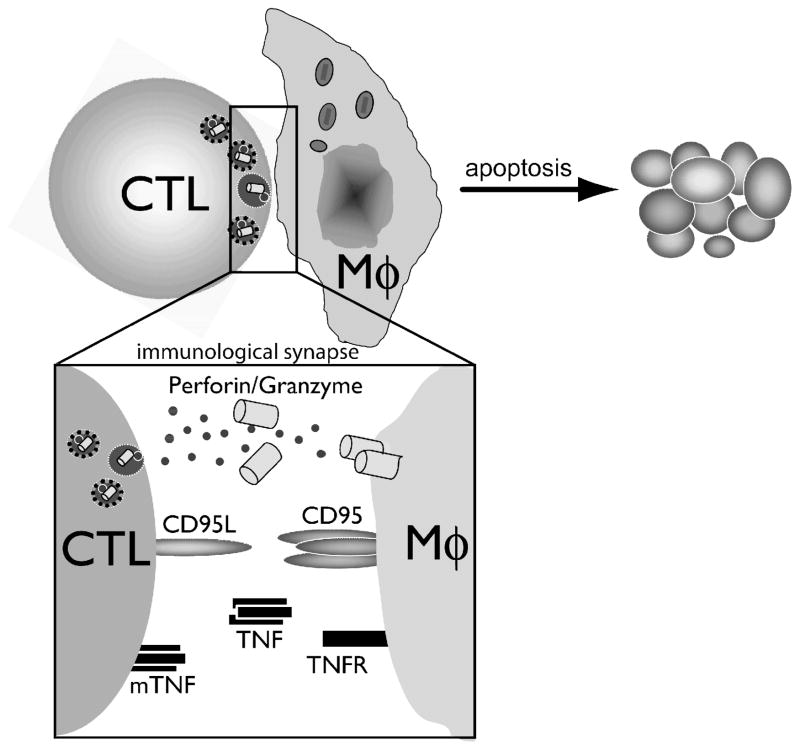
FIGURE 2
Molecular pathways mediate CD8+ T cell cytotoxic activity. Efficient CTL-mediated lysis of target cells requires cell-cell interaction and CTL activation mediated by signaling via the TCR triggered by recognition of the class I MHC/peptide complex (not shown). T cell activation leads to polarization of the T cell and development of an immunological synapse between the CTL and the target cell. CTL induction of target cell death can be mediated by three distinct molecular pathways. The cytotoxic-granule exocytosis pathway is dependent upon perforin, a pore-forming protein, which facilitates the entry of granzymes into the target cell cytosol, where they induce apoptosis. Although this is the principal mechanism by which CTL kill target cells, activated CTL also express CD95L (FasL) which can bind to CD95 (Fas) on the target cell surface and initiate Fas-induced apoptosis. Finally, expression of membrane TNF or secretion of TNF by CTL can promote TNF receptor induced death of the target cells.
FIGURE 3
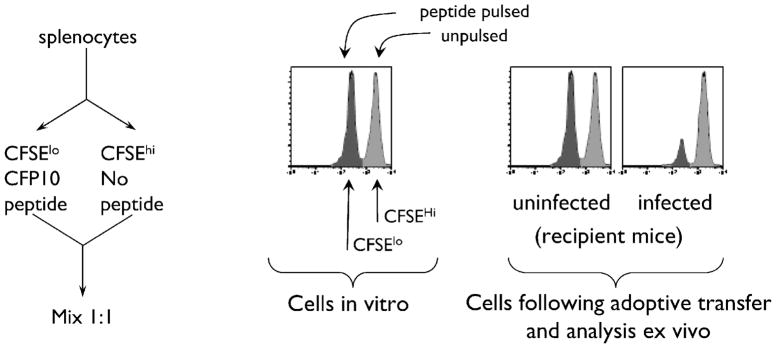
FIGURE 3
In vivo CTL assay. To monitor in vivo CTL activity, splenocytes from uninfected mice are used as target cells. One population of target cells is labeled with low concentrations of the fluorescent dye CFSE and pulsed with the CFP1032–39 synthetic peptide. A second population of cells is labeled with a higher concentration of CFSE in the absence of peptide. After extensive washing, the two cell populations are mixed at a 1:1 ratio. Flow cytometric analysis of these cells (in vitro), identifies two distinct peaks of CFSElo and CFSEHi cells, which correspond to peptide-pulsed and unpulsed target cells. These target cells are injected intravenously into uninfected or M. tuberculosis infected recipients. After 20 hrs, the recipient mice are sacrificed and the target cells in the different tissues are analyzed by flow cytometry. The two target cell populations in the tissue of the uninfected recipients maintain their original 1:1 ratio. In contrast, the ratio is dramatically altered in the tissues of the M. tuberculosis infected mice. In this analysis, the peptide pulsed CFSElo cells are markedly reduced representing their selective killing by CD8+ T cells in vivo. The “percent lysis” of the peptide pulsed cells can be calculated from the ratio of CFSElo/CFSEHi target cells from infected and uninfected recipients (see references for details). The specificity of this assay for CD8+ T cells is based on the use of a minimal epitope from a well-characterized class I MHC-presented peptide antigen.

References

    1. Sterne JA, Rodrigues LC, Guedes IN. Does the efficacy of BCG decline with time since vaccination? Int J Tuberc Lung Dis. 1998;2(3):200–207. - PubMed
    1. Flynn JL, Chan J. Immunology of tuberculosis. Annu Rev Immunol. 2001;19:93–129. - PubMed
    1. Orme IM. The kinetics of emergence and loss of mediator T lymphocytes acquired in response to infection with Mycobacterium tuberculosis. J Immunol. 1987;138(1):293–298. - PubMed
    1. Orme IM, Collins FM. Adoptive protection of the Mycobacterium tuberculosis-infected lung. Dissociation between cells that passively transfer protective immunity and those that transfer delayed-type hypersensitivity to tuberculin. Cell Immunol. 1984;84(1):113–120. - PubMed
    1. Mustafa AS, Kvalheim G, Degre M, Godal T. Mycobacterium bovis BCG-induced human T-cell clones from BCG-vaccinated healthy subjects: antigen specificity and lymphokine production. Infect Immun. 1986;53(3):491–497. - PMC - PubMed

Publication types

Substances