. 2007 Jan;51(1):215-22.
doi: 10.1128/AAC.00706-06. Epub 2006 Oct 30.

Poly-gamma-glutamate capsule-degrading enzyme treatment enhances phagocytosis and killing of encapsulated Bacillus anthracis

Affiliations

Poly-gamma-glutamate capsule-degrading enzyme treatment enhances phagocytosis and killing of encapsulated Bacillus anthracis

Angelo Scorpio et al. Antimicrob Agents Chemother. 2007 Jan.

Abstract

The poly-gamma-d-glutamic acid capsule confers antiphagocytic properties on Bacillus anthracis and is essential for virulence. In this study, we showed that CapD, a gamma-polyglutamic acid depolymerase encoded on the B. anthracis capsule plasmid, degraded purified capsule and removed the capsule from the surface of anthrax bacilli. Treatment with CapD induced macrophage phagocytosis of encapsulated B. anthracis and enabled human neutrophils to kill encapsulated organisms. A second glutamylase, PghP, a gamma-polyglutamic acid hydrolase encoded by Bacillus subtilis bacteriophage PhiNIT1, had minimal activity in degrading B. anthracis capsule, no effect on macrophage phagocytosis, and only minimal enhancement of neutrophil killing. Thus, the levels of both phagocytosis and killing corresponded to the degree of enzyme-mediated capsule degradation. The use of enzymes to degrade the capsule and enable phagocytic killing of B. anthracis offers a new approach to the therapy of anthrax.


Figures
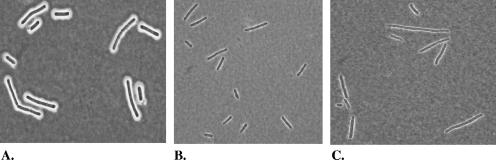
FIG. 1.
FIG. 1.
Removal of capsule from encapsulated B. anthracis by CapD and PghP. B. anthracis Ames bacilli were grown under conditions to express capsule and treated for 20 min at 37°C with PBS (A), 50 μg/ml CapD (B), or 50 μg/ml PghP (C) as described in Materials and Methods and examined by India ink and phase-contrast microscopy (magnification, ×1,000).
FIG. 2.
FIG. 2.
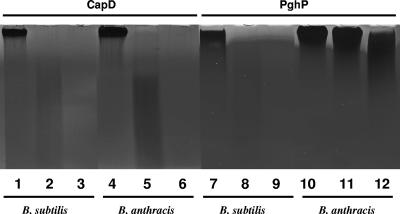
Degradation of capsules from B. anthracis and B. subtilis by CapD and PghP. Capsule purified from B. subtilis (lanes 1 to 3 and 7 to 9) and B. anthracis (lanes 4 to 6 and 10 to 12) were digested with CapD (lanes 1 to 6) or PghP (lanes 7 to 12) and examined by SDS-polyacrylamide gel electrophoresis as described in Materials and Methods. Lanes 1 and 4, 0.35 μg/ml of CapD; lanes 2 and 5, 3.5 μg/ml of CapD; lanes 3 and 6, 35 μg/ml of CapD; lane 7, 0.035 μg/ml of PghP; lanes 8 and 10, 0.35 μg/ml of PghP; lanes 9 and 11, 3.5 μg/ml of PghP; lane 12, 35 μg/ml of PghP.
FIG. 3.
FIG. 3.
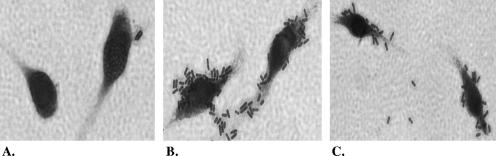
Phagocytosis of encapsulated B. anthracis by RAW264.7 macrophages. Encapsulated B. anthracis Ames bacilli were treated with PBS (A), CapD (20 μg/ml) (B), or PghP (20 μg/ml) (C) and incubated with macrophages as described in Materials and Methods. The PBS and PghP samples contained 0.5 μg/ml of erythromycin.
FIG. 4.
FIG. 4.
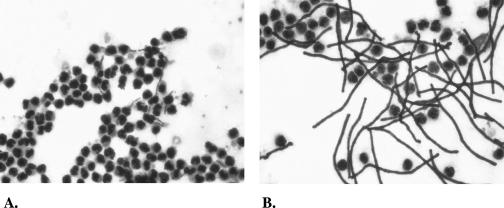
CapD-mediated killing of B. anthracis Ames by human neutrophils. Human neutrophils (5 × 10⁶ neutrophils/ml) were mixed with encapsulated bacilli (5 × 10⁶ neutrophils/ml) with (A) or without (B) 20 μg/ml of CapD and incubated for 3 h at 37°C on an Eppendorf tube rotator. Cells were then concentrated 10-fold by centrifugation and stained with Wright Giemsa stain (magnification, ×1,000). Viability was reduced by CapD treatment to 0.35% after 3 h compared to that at time zero. No killing occurred in the sample (B) incubated without CapD.
FIG. 5.
FIG. 5.
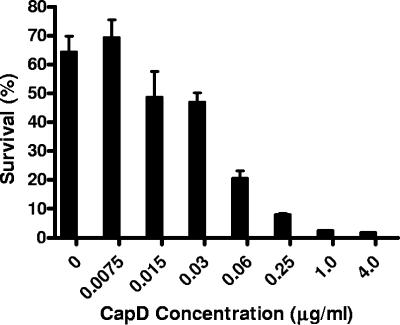
CapD concentration-dependent neutrophil killing. CapD was serially diluted in PBS and used to treat encapsulated B. anthracis Ames bacilli before being mixed with human neutrophils as described in Materials and Methods. The bacterial viability of duplicate samples (means ± standard deviations) was measured at 2 h.

References

    1. Abalakin, V. A., E. G. Sirina, and T. D. Cherkasova. 1990. The effect of lethal anthrax toxin on the functional activity of peritoneal mononuclear phagocytes and polymorphonuclear neutrophils in mice. Zh. Mikrobiol. Epidemiol. Immunobiol. 2:62-67. (In Russian.) - PubMed
    1. Avery, O. T., and R. Dubos. 1931. The protective action of a specific enzyme against type III pneumococcus infection in mice. J. Exp. Med. 54:73-89. - PMC - PubMed
    1. Bourgogne, A., M. Drysdale, S. G. Hilsenbeck, S. N. Peterson, and T. M. Koehler. 2003. Global effects of virulence gene regulators in a Bacillus anthracis strain with both virulence plasmids. Infect. Immun. 71:2736-2743. - PMC - PubMed
    1. Candela, T., and A. Fouet. 2005. Bacillus anthracis CapD, belonging to the gamma-glutamyltranspeptidase family, is required for the covalent anchoring of capsule to peptidoglycan. Mol. Microbiol. 57:717-726. - PubMed
    1. Candela, T., and A. Fouet. 2006. Poly-gamma-glutamate in bacteria. Mol. Microbiol. 60:1091-1098. - PubMed

MeSH terms

LinkOut - more resources