Facilitated psychiatric advance directives: a randomized trial of an intervention to foster advance treatment planning among persons with severe mental illness
- PMID: 17074946
- PMCID: PMC3747558
- DOI: 10.1176/ajp.2006.163.11.1943
Facilitated psychiatric advance directives: a randomized trial of an intervention to foster advance treatment planning among persons with severe mental illness
Abstract
Objective: Studies show a high potential demand for psychiatric advance directives but low completion rates. The authors conducted a randomized study of a structured, manualized intervention to facilitate completion of psychiatric advance directives.
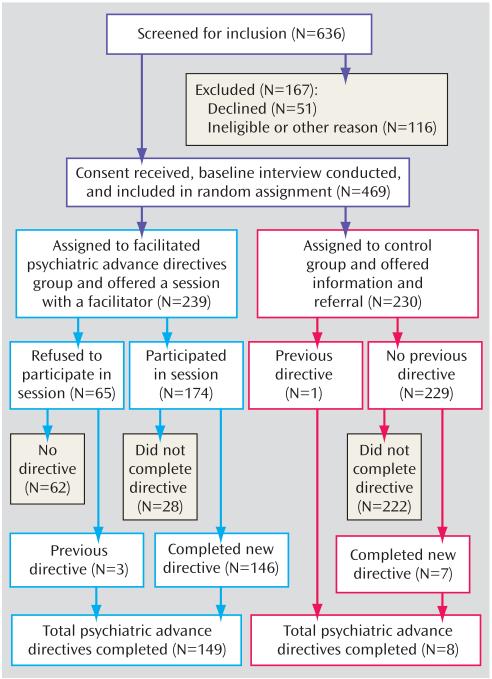
Method: A total of 469 patients with severe mental illness were randomly assigned to a facilitated psychiatric advance directive session or a control group that received written information about psychiatric advance directives and referral to resources in the public mental health system. Completion of an advance directive, its structure and content, and its short-term effects on working alliance and treatment satisfaction were recorded.
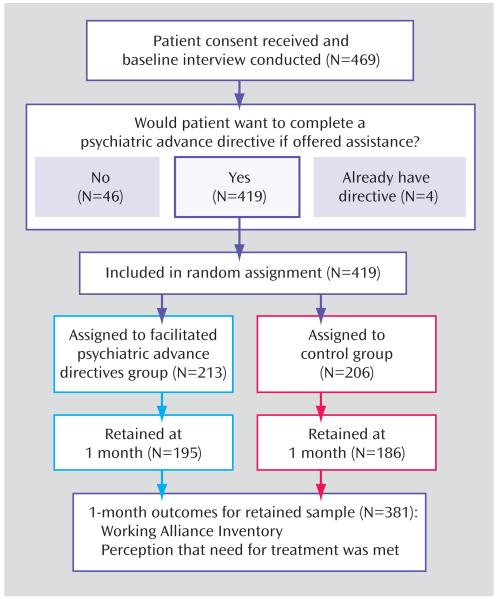
Results: Sixty-one percent of participants in the facilitated session completed an advance directive or authorized a proxy decision maker, compared with only 3% of control group participants. Psychiatrists rated the advance directives as highly consistent with standards of community practice. Most participants used the advance directive to refuse some medications and to express preferences for admission to specific hospitals and not others, although none used an advance directive to refuse all treatment. At 1-month follow-up, participants in the facilitated session had a greater working alliance with their clinicians and were more likely than those in the control group to report receiving the mental health services they believed they needed.
Conclusions: The facilitation session is an effective method of helping patients complete psychiatric advance directives and ensuring that the documents contain useful information about patients' treatment preferences. Achieving the promise of psychiatric advance directives may require system-level policies to embed facilitation of these instruments in usual-care care settings.
Figures
References
-
- Srebnik D, LaFond J. Advance directives for mental health services: current perspectives and future directions. Psychiatr Serv. 1999;50:919–925. - PubMed
-
- Joshi KG. Psychiatric advance directives. J Psychiatr Pract. 2003;9:303–306. - PubMed
-
- Keefe B, Pinals DA. Durable power of attorney for psychiatric care. J Am Acad Psychiatry Law. 2004;32:202–204.
-
- Swanson JW, Tepper MC, Backlar PB, Swartz MS, Estroff SE. Psychiatric advance directives: an alternative to coercive treatment? Psychiatry. 2000;63:160–172. - PubMed
-
- Srebnik DS, Rutherford LT, Peto T, Russo J, Zick E, Jaffe C, Holtzheimer P. The content and clinical utility of psychiatric advance directives. Psychiatr Serv. 2005;56:592–598. - PubMed
Publication types
MeSH terms
Grants and funding
LinkOut - more resources
Full Text Sources
Medical