Review
. 2007 Jan;100(2):307-13.
doi: 10.1111/j.1471-4159.2006.04205.x. Epub 2006 Oct 31.

Leptin: a diverse regulator of neuronal function

Affiliations
Review

Leptin: a diverse regulator of neuronal function

Jenni Harvey. J Neurochem. 2007 Jan.

Abstract

It is well documented that leptin is a circulating hormone that plays a key role in regulating food intake and body weight via its actions on specific hypothalamic nuclei. However, leptin receptors are widely expressed in the CNS, in regions not generally associated with energy homeostasis, such as the hippocampus, cortex and cerebellum. Moreover, evidence is accumulating that leptin has widespread actions in the brain. In particular, recent studies have demonstrated that leptin markedly influences the excitability of hippocampal neurons via its ability to activate large conductance Ca(2+)-activated K(+) (BK) channels, and also to promote long-term depression of excitatory synaptic transmission. Here, we review the evidence supporting a role for this hormone in regulating hippocampal excitability.


Figures
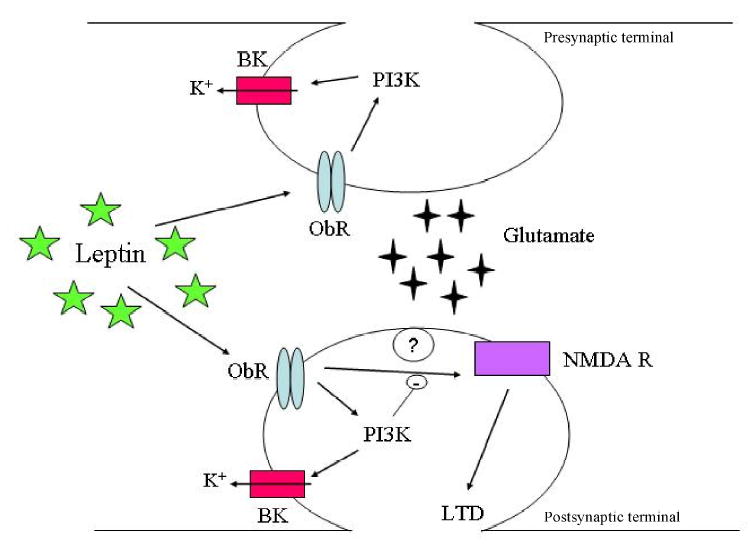
Figure 1
Figure 1. Leptin attenuates hippocampal excitability via synaptic and non-synaptic mechanisms
Schematic representation of a typical CA1 glutamatergic excitatory synapse and that illustrates the possible mechanisms underlying the effects of leptin on neuronal excitability. Leptin receptors (ObR) are located at both presynaptic and postsynaptic sites in hippocampal neurons. Leptin receptor activation results in phosphoinositide 3-kinase (PI 3-kinase)-dependent actin depolymerisation and subsequent stimulation of large conductance Ca2+-activated K+ (BK) channels. This in turn results in inhibition of epileptiform-like activity. Under conditions of enhanced excitability, leptin also markedly reduces the strength of excitatory synaptic transmission by promoting the induction of NMDA receptor (NMDA R)-dependent long-term depression (LTD). This process has a postsynaptic locus of expression and is negatively regulated by PI 3-kinase.
Figure 2
Figure 2. Diverse neuronal actions of leptin
Schematic representation of the key brain functions that are regulated by the hormone leptin. Leptin that is derived from adipocytes circulates in the plasma in amounts proportional to body weight and it can enter the brain via saturable transport across the blood brain barrier. The arcuate nucleus, an important component of hypothalamic feeding circuits, is a key target for leptin and in normal weight humans and animals this hormone acts as a signal to the brain to cease eating. Leptin also plays a pivotal role in regulating reproductive function and thermogenesis via its actions on this hypothalamic nucleus. Several lines of evidence also support a role for leptin in hippocampal learning and memory processes as leptin enhances NMDA receptor function and facilitates hippocampal long-term potentiation. Moreover in behavioural studies leptin-insensitive rodents display memory impairments whereas leptin administration improves memory performance. In the hippocampus, leptin also regulates neuronal excitability via its ability to activate BK channels; a process that may be an important mechanism for dampening down unregulated hyper-excitability. In cerebellar neurons, NMDA receptors are also an important target for leptin as facilitation of NR2B-mediated NMDA responses has been reported.

References

    1. Attoub S, Noe V, Pirola L, Bruyneel E, Chastre E, Mareel M, Wymann MP, Gespach C. Leptin promotes invasiveness of kidney and colonic epithelial cells via phosphoinositide 3-kinase-, rho-, and rac-dependent signaling pathways. FASEB J. 2000;14:2329–38. - PubMed
    1. Ayyildiz M, Yildirim M, Agar E, Baltaci AK. The effect of leptin on penicillin-induced epileptiform-like activity in rats. Brain Res Bull. 2006;68:374–378. - PubMed
    1. Banks WA. Enhanced leptin transport across the blood brain barrier by alpha 1-adrenergic agents. Brain Res. 2001;899:209–17. - PubMed
    1. Banks WA, Clever CM, Farrell CL. Partial saturation and regional variation in the blood-to-brain transport of leptin in normal weight mice. Am J Physiol Endocrinol Metab. 2000;278:E1158–65. - PubMed
    1. Banks WA, Coon AB, Robinson SM, Moinuddin A, Shultz JM, Nakaoke R, Morley JE. Triglycerides induce leptin resistance at the blood brain barrier. Diabetes. 2004;53:1253–60. - PubMed

MeSH terms
