


Hagfish and lancelet fibrillar collagens reveal that type II collagen-based cartilage evolved in stem vertebrates
- PMID: 17077149
- PMCID: PMC1636540
- DOI: 10.1073/pnas.0605630103
Hagfish and lancelet fibrillar collagens reveal that type II collagen-based cartilage evolved in stem vertebrates
Abstract
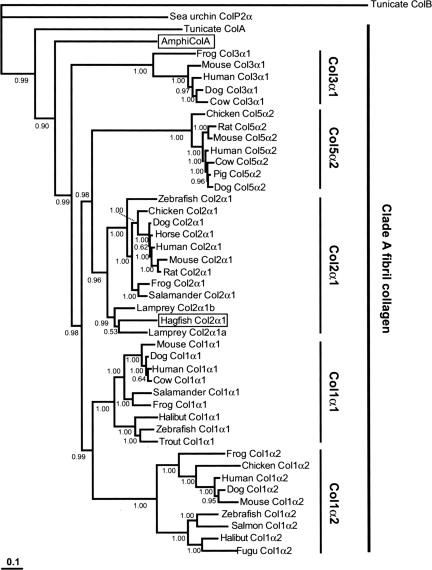
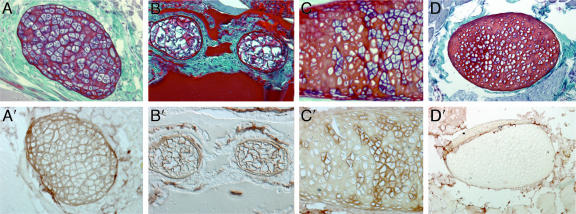
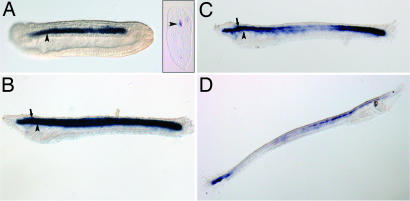
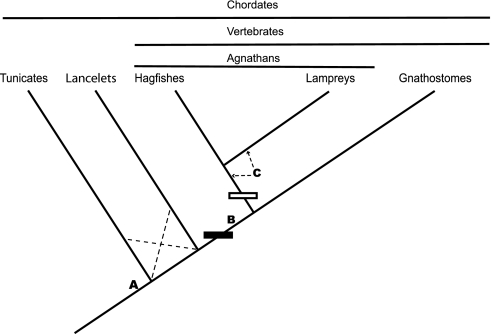
The origin of vertebrates was defined by evolution of a skeleton; however, little is known about the developmental mechanisms responsible for this landmark evolutionary innovation. In jawed vertebrates, cartilage matrix consists predominantly of type II collagen (Col2alpha1), whereas that of jawless fishes has long been thought to be noncollagenous. We recently showed that Col2alpha1 is present in lamprey cartilage, indicating that type II collagen-based cartilage evolved earlier than previously recognized. Here, we investigate the origin of vertebrate cartilage, and we report that hagfishes, the sister group to lampreys, also have Col2alpha1-based cartilage, suggesting its presence in the common ancestor of crown-group vertebrates. We go on to show that lancelets, a sister group to vertebrates, possess an ancestral clade A fibrillar collagen (ColA) gene that is expressed in the notochord. Together, these results suggest that duplication and diversification of ColA genes at the chordate-vertebrate transition may underlie the evolutionary origin of vertebrate skeletal tissues.
Conflict of interest statement
The authors declare no conflict of interest.
Figures
References
Publication types
MeSH terms
Substances
Associated data
- Actions
- Actions
LinkOut - more resources
Full Text Sources
Other Literature Sources
