. 2007 Feb 15;109(4):1653-9.
doi: 10.1182/blood-2006-04-015537. Epub 2006 Oct 31.

Emodin and DHA potently increase arsenic trioxide interferon-alpha-induced cell death of HTLV-I-transformed cells by generation of reactive oxygen species and inhibition of Akt and AP-1

Affiliations

Emodin and DHA potently increase arsenic trioxide interferon-alpha-induced cell death of HTLV-I-transformed cells by generation of reactive oxygen species and inhibition of Akt and AP-1

Megan Brown et al. Blood. .

Abstract

Adult T-cell leukemia (ATL) is an aggressive lymphoproliferative disease of poor clinical prognosis associated with infection by the human T-cell leukemia virus type I (HTLV-I). The use of arsenic trioxide (As2O3) has been shown to effectively treat acute promyelocytic leukemia (APL) with greater than 80% of patients achieving complete remission. The combination of arsenic and interferon has also shown promising results in the treatment of ATL. The requirement for slow dosage increases of arsenic and the time required to achieve a pharmacologic active dose in patients is a major obstacle because median survival of patients with ATL is about 6 months. In this study we report a potent synergistic effect of the combination of arsenic trioxide and interferon alpha (As/IFN-alpha) with emodin and DHA on cell-cycle arrest and cell death of HTLV-I-infected cells. Importantly, we found that clinically achievable doses of DHA and emodin allowed for reduced arsenic concentrations by 100-fold while still remaining highly toxic to tumor cells. Our data provide a rationale for combined use of As/IFN-alpha with emodin and DHA in patients with ATL refractory to conventional therapy.


Figures
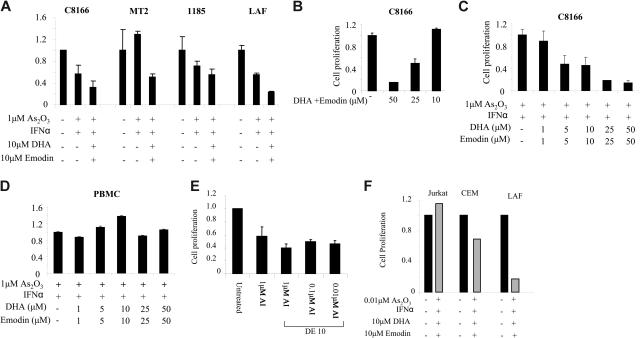
Figure 1
Figure 1
Emodin and DHA increase sensitivity of HTLV-1–transformed cell lines to As2O3 ± IFN-α treatment. (A) HTLV-1–transformed cells (C8166, MT-2) and IL-2–dependent immortalized cells 1185 and LAF were treated with buffer control, 1 μM As2O3/IFN-α (100 U/mL), As2O3/IFN-α with 10 μM emodin and DHA (AIDE) for 60 hours, and cellular proliferation was measured using the XTT assay. Results are representative of 3 independent experiments performed in duplicate. (B) Proliferation assay of HTLV-I–transformed C8166 cells treated with increasing amounts of emodin and DHA from 10 to 50μM. (C) Proliferation assay of HTLV-I–transformed C8166 cells treated with increasing amounts of emodin and DHA from 1 to 50 μM in the presence of 1 μM As2O3/IFN-α. (D) Proliferation assay of normal PBMCs treated with increasing amounts of emodin and DHA from 1 to 50 μM in the presence of 1 μM As2O3/IFN-α. (E) Proliferation assay of HTLV-I–transformed C8166 cells treated with 10 μM emodin and DHA, IFN-α (100 U/mL) and decreasing amounts of As2O3, 1 μM, 0.1 μM, and 0.01 μM. (F) Comparison of CEM, Jurkat, and LAF proliferation following treatment with As2O3/IFN-α and emodin/DHA. Error bars represent SD.
Figure 2
Figure 2
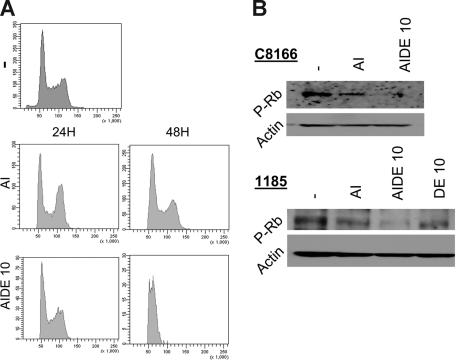
Emodin and DHA reduce the level of phosphorylated Rb and induce G1 cell-cycle arrest in HTLV-I–transformed cells. (A) Cell-cycle analysis of propidium iodide–stained HTLV-I–transformed C8166 cells treated with As2O3/IFN-α in the absence or the presence of emodin and DHA. (B) Western blot analysis of phosphorylated Rb in C8166 and 1185 cells treated with As2O3/IFN-α in the absence or the presence of emodin and DHA or emodin and DHA alone. Actin was used as loading control.
Figure 3
Figure 3
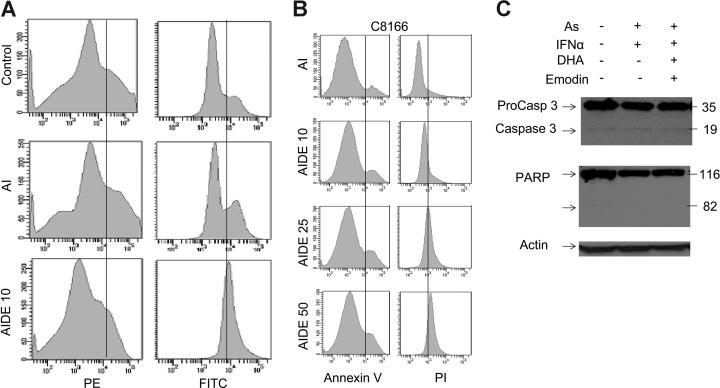
AIDE induces the collapse of mitochondrial membrane potential and increased Bax and decreased Bcl-2 expression and tumor-cell death. (A) ΔΨm collapse was measured using the Apoalert Mitochondrial Membrane Sensor kit. Results are representative of at least 2 experiments performed with different HTLV-1–transformed cells. (B) C8166 cells were treated with buffer control, As/IFN-α for 60 hours with or without increasing emodin and DHA. Cells were then harvested, washed in PBS without Ca++/Mg2+, and stained using the Vybrant Apoptosis kit. Annexin V conjugated to fluorescein allowed the identification of apoptosis (AV+/PI) versus necrosis cell death (AV/PI+) by fluorescence-activated cell sorting (FACS). (C) Western blot analysis of PARP and caspase 3 activation. Actin was used to confirm equal loading.
Figure 4
Figure 4
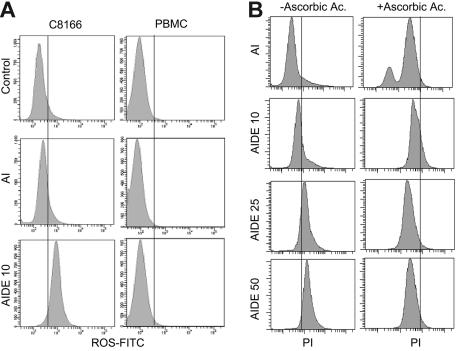
AIDE increases generation of ROS and Bax expression. (A) Measure of ROS production in PBMC control and HTLV-I–transformed C8166 cells treated with AI or AIDE. (B) Measure of cell death in AIDE-treated C8166 cells in the presence or absence of ascorbic acid, a ROS scavenger.
Figure 5
Figure 5
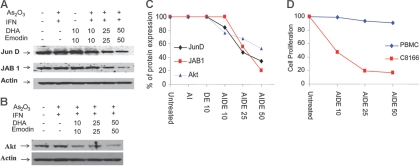
AIDE inhibits Akt and AP-1 pathways in HTLV-I–transformed cells. (A) Western blot analysis of AP-1 members JunD and JAB1 in C8166 cells after treatment with As2O3/IFN-α in the absence or presence of increasing doses of emodin and DHA. Actin was used to confirm equal loading. (B) Western blot analysis of Akt in C8166 cells treated with As2O3/IFN-α in the absence or presence of increasing doses of emodin and DHA. (C) Spot densitometry quantification expressed as the percentage of untreated control (100%) for Akt, JunD, and JAB1. (D) Proliferation assay of C8166 cells and PBMCs treated with As2O3/IFN-α and increasing doses of emodin and DHA.

References

    1. Bazarbachi A, Hermine O. Treatment of adult T-cell leukaemia/lymphoma: current strategy and future perspectives. Virus Res. 2001;78:79–92. - PubMed
    1. Bazarbachi A, Ghez D, Lepelletier Y, et al. New therapeutic approaches for adult T-cell leukaemia. Lancet Oncol. 2004;5:664–672. - PubMed
    1. Mahieux R, Hermine O. In vivo and in vitro treatment of HTLV-1 and HTLV-2 infected cells with arsenic trioxide and interferon-alpha. Leuk Lymphoma. 2005;46:347–355. - PubMed
    1. Besson C, Panelatti G, Delaunay C, et al. Treatment of adult T-cell leukemia-lymphoma by CHOP followed by therapy with antinucleosides, alpha interferon and oral etoposide. Leuk Lymphoma. 2002;43:2275–2279. - PubMed
    1. Taguchi H, Kinoshita KI, Takatsuki K, et al. An intensive chemotherapy of adult T-cell leukemia/lymphoma: CHOP followed by etoposide, vindesine, ranimustine, and mitoxantrone with granulocyte colony-stimulating factor support. J Acquir Immune Defic Syndr Hum Retrovirol. 1996;12:182–186. - PubMed

Publication types

MeSH terms