


Transport pathways for clearance of human Alzheimer's amyloid beta-peptide and apolipoproteins E and J in the mouse central nervous system
- PMID: 17077814
- PMCID: PMC2853021
- DOI: 10.1038/sj.jcbfm.9600419
Transport pathways for clearance of human Alzheimer's amyloid beta-peptide and apolipoproteins E and J in the mouse central nervous system
Abstract
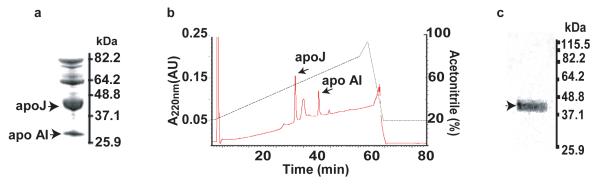
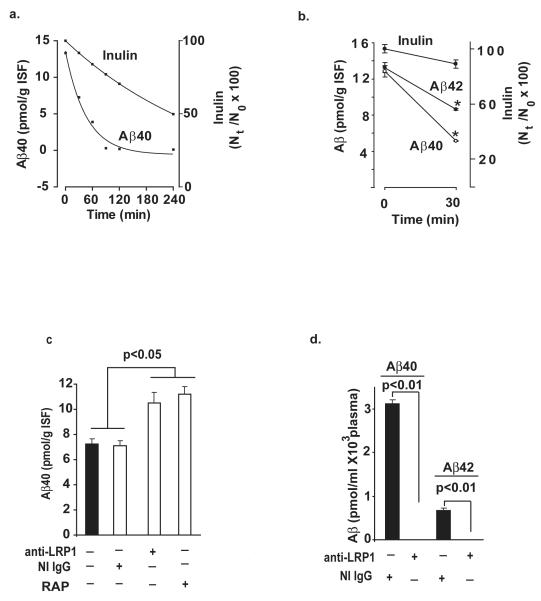
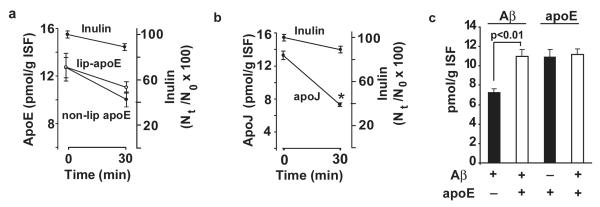
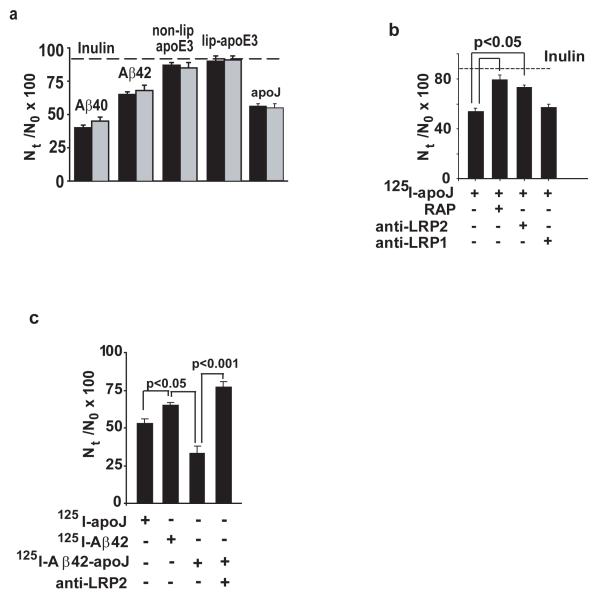
Amyloid beta-peptide (Abeta) clearance from the central nervous system (CNS) maintains its low levels in brain. In Alzheimer's disease, Abeta accumulates in brain possibly because of its faulty CNS clearance and a deficient efflux across the blood-brain barrier (BBB). By using human-specific enzyme-linked immunosorbent assays, we measured a rapid 30 mins efflux at the BBB and transport via the interstitial fluid (ISF) bulk flow of human-unlabeled Abeta and of Abeta transport proteins, apolipoprotein E (apoE) and apoJ in mice. We show (i) Abeta40 is cleared rapidly across the BBB via low-density lipoprotein receptor-related protein (LRP)1 at a rate of 0.21 pmol/min g ISF or 6-fold faster than via the ISF flow; (ii) Abeta42 is removed across the BBB at a rate 1.9-fold slower compared with Abeta40; (iii) apoE, lipid-poor isoform 3, is cleared slowly via the ISF flow and across the BBB (0.03-0.04 pmol/min g ISF), and after lipidation its transport at the BBB becomes barely detectable within 30 mins; (iv) apoJ is eliminated rapidly across the BBB (0.16 pmol/min g ISF) via LRP2. Clearance rates of unlabeled and corresponding 125I-labeled Abeta and apolipoproteins were almost identical, but could not be measured at low physiologic levels by mass spectrometry. Amyloid beta-peptide 40 binding to apoE3 reduced its efflux rate at the BBB by 5.7-fold, whereas Abeta42 binding to apoJ enhanced Abeta42 BBB clearance rate by 83%. Thus, Abeta, apoE, and apoJ are cleared from brain by different transport pathways, and apoE and apoJ may critically modify Abeta clearance at the BBB.
Figures
References
-
- Bales KR, Verina T, Dodel RC, Du Y, Altstiel L, Bender M, Hyslop P, Johnstone EM, Little SP, Cummins DJ, Piccardo P, Ghetti B, Paul SM. Lack of apolipoprotein E dramatically reduces amyloid β-peptide deposition. Nat Genet. 1997;17:263–264. - PubMed
-
- Best JD, Jay MT, Otu F, Ma J, Nadin A, Ellis S, Lewis HD, Pattison C, Reilly M, Harrison T, Shearman MS, Williamson TL, Atack JR. Quantitative measurement of changes in amyloid-β(40) in the rat brain and cerebrospinal fluid following treatment with the α-secretase inhibitor LY-411575 [N2-[(2S)-2-(3,5-difluorophenyl)-2-hydroxyethanoyl]-N1-[(7S)-5-methyl-6-oxo-6,7-dihydroxyethanoyl]-N1-[(7S)-5-methyl-6-oxo-6,7-dihydro-5H-dibenzo[b,d]azepin-7-yl]-L-alaninamide] J Pharmacol Exp Ther. 2005;313:902–908. - PubMed
-
- Calero M, Rostegno A, Matsubara E, Zlokovic BV, Ghiso J. Apolipoprotein J (clusterin) and Alzheimer’s disease. Micro Res Tech. 2000;50:305–315. - PubMed
-
- Cao D, Fukuchi K, Wan H, Kim H, Li L. Lack of LDL receptor aggravates learning deficits and amyloid deposits in Alzheimer transgenic mice. Neurobiol Aging. 2006 (in press) doi:10.1016/j.neurobiolaging.2005.09.011. - PubMed
Publication types
MeSH terms
Substances
Grants and funding
LinkOut - more resources
Full Text Sources
Other Literature Sources
Medical
Miscellaneous
