


Phenocopies in BRCA1 and BRCA2 families: evidence for modifier genes and implications for screening
- PMID: 17079251
- PMCID: PMC2597903
- DOI: 10.1136/jmg.2006.043091
Phenocopies in BRCA1 and BRCA2 families: evidence for modifier genes and implications for screening
Abstract
Background: The identification of BRCA1 and BRCA2 mutations in familial breast cancer kindreds allows genetic testing of at-risk relatives. Those who test negative are usually reassured and additional breast cancer surveillance is discontinued. However, we postulated that in high-risk families, such as those seen in clinical genetics centres, the risk of breast cancer might be influenced not only by the BRCA1/BRCA2 mutation but also by modifier genes. One manifestation of this would be the presence of phenocopies in BRCA1/BRCA2 kindreds.
Methods: 277 families with pathogenic BRCA1/BRCA2 mutations were reviewed and 28 breast cancer phenocopies identified. The relative risk of breast cancer in those testing negative was assessed using incidence rates from our cancer registry based on local population.
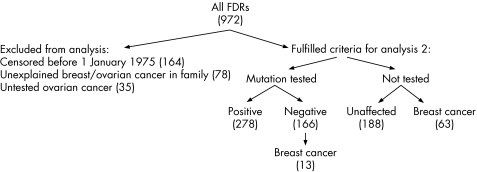
Results: Phenocopies constituted up to 24% of tests on women with breast cancer after the identification of the mutation in the proband. The standardised incidence ratio for women who tested negative for the BRCA1/BRCA2 family mutation was 5.3 for all relatives, 5.0 for all first-degree relatives (FDRs) and 3.2 (95% confidence interval 2.0 to 4.9) for FDRs in whose family all other cases of breast and ovarian cancer could be explained by the identified mutation. 13 of 107 (12.1%) FDRs with breast cancer and no unexplained family history tested negative.
Conclusion: In high-risk families, women who test negative for the familial BRCA1/BRCA2 mutation have an increased risk of breast cancer consistent with genetic modifiers. In light of this, such women should still be considered for continued surveillance.
Conflict of interest statement
Competing interests: None declared.
Comment in
-
No screening yet after a negative test for the family mutation.J Med Genet. 2007 May;44(5):e79. doi: 10.1136/jmg.2006.048785. J Med Genet. 2007. PMID: 17475915 Free PMC article. No abstract available.
-
Phenocopies in families seen by cancer geneticists.J Med Genet. 2007 Jun;44(6):e82. doi: 10.1136/jmg.2006.047597. J Med Genet. 2007. PMID: 17551082 Free PMC article. No abstract available.
-
BRCA phenocopies or ascertainment bias?J Med Genet. 2007 Aug;44(8):e86; author reply e88. J Med Genet. 2007. PMID: 17673440 Free PMC article. No abstract available.
-
Phenocopies: actual risk or self-fulfilling prophecy?J Med Genet. 2007 Aug;44(8):e87; author reply e88. J Med Genet. 2007. PMID: 17673441 Free PMC article. No abstract available.
-
A prospective study of breast cancer risk in relatives of BRCA1/BRCA2 mutation carriers.J Med Genet. 2007 Aug;44(8):e89; author reply e88. J Med Genet. 2007. PMID: 17673443 Free PMC article. No abstract available.
References
-
- Claus E B, Risch N, Thompson W D. Autosomal dominant inheritance of early‐onset breast cancer. Implications for risk prediction. Cancer 199473643–651. - PubMed
-
- Peto J, Mack T M. High constant incidence in twins and other relatives of women with breast cancer. Nat Genet 200026411–414. - PubMed
-
- Broca P.Traite des tumeurs. Paris: Asselin, 1866151–155.
-
- Hall J M, Lee M K, Newman B, Morrow J E, Anderson L A, Huey B, King M C. Linkage of early‐onset familial breast cancer to chromosome 17q21. Science 19902501684–1689. - PubMed
Publication types
MeSH terms
Grants and funding
LinkOut - more resources
Full Text Sources
Medical
Miscellaneous
