


Genetic protection against hepatitis B virus conferred by CCR5Delta32: Evidence that CCR5 contributes to viral persistence
- PMID: 17079285
- PMCID: PMC1797425
- DOI: 10.1128/JVI.01897-06
Genetic protection against hepatitis B virus conferred by CCR5Delta32: Evidence that CCR5 contributes to viral persistence
Abstract
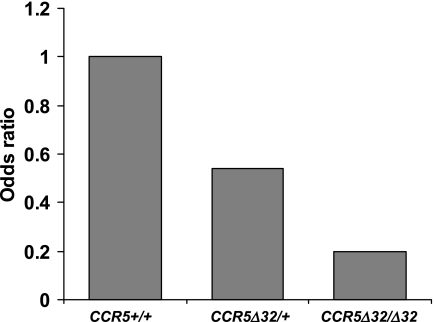
Recovery from acute hepatitis B virus (HBV) infection requires a broad, vigorous T-cell response, which is enhanced in mice when chemokine receptor 5 (CCR5) is missing. To test the hypothesis that production of a nonfunctional CCR5 (CCR5Delta32 [a functionally null allele containing a 32-bp deletion]) increases the likelihood of recovery from hepatitis B in humans, we studied 526 persons from three cohorts in which one person with HBV persistence was matched to two persons who recovered from an HBV infection. Recovery or persistence was determined prior to availability of lamivudine. We determined genotypes for CCR5Delta32 and for polymorphisms in the CCR5 promoter and in coding regions of the neighboring genes, chemokine receptor 2 (CCR2) and chemokine receptor-like 2 (CCRL2). Allele and haplotype frequencies were compared among the 190 persons with viral recovery and the 336 with persistence by use of conditional logistic regression. CCR5Delta32 reduced the risk of developing a persistent HBV infection by nearly half (odds ratio [OR], 0.53; 95% confidence interval [CI], 0.33 to 0.83; P = 0.006). This association was virtually identical in persons with and without a concomitant human immunodeficiency virus infection. Of the nine individuals who were homozygous for the deletion, eight recovered from infection (OR, 0.25; 95% CI, 0.03 to 1.99; P = 0.19). None of the other neighboring polymorphisms examined were associated with HBV outcome. These data demonstrate a protective effect of CCR5Delta32 in recovery from an HBV infection, provide genetic epidemiological evidence for a role of CCR5 in the immune response to HBV, and suggest a potential therapeutic treatment for patients persistently infected with HBV.
Figures
References
-
- Ajuebor, M. N., A. I. Aspinall, F. Zhou, T. Le, Y. Yang, S. J. Urbanski, et al. 2005. Lack of chemokine receptor CCR5 promotes murine fulminant liver failure by preventing the apoptosis of activated CD1d-restricted NKT cells. J. Immunol. 174:8027-8037. - PubMed
-
- Algood, H. M., and J. L. Flynn. 2004. CCR5-deficient mice control Mycobacterium tuberculosis infection despite increased pulmonary lymphocytic infiltration. J. Immunol. 173:3287-3296. - PubMed
-
- An, P., M. P. Martin, G. W. Nelson, M. Carrington, M. W. Smith, K. Gong, et al. 2000. Influence of CCR5 promoter haplotypes on AIDS progression in African-Americans. AIDS 14:2117-2122. - PubMed
-
- Bellamy, R., C. Ruwende, T. Corrah, K. P. McAdam, M. Thursz, H. C. Whittle, et al. 1999. Tuberculosis and chronic hepatitis B virus infection in Africans and variation in the vitamin D receptor gene. J. Infect. Dis. 179:721-724. - PubMed
-
- Carrington, M., M. Dean, M. P. Martin, and S. J. O'Brien. 1999. Genetics of HIV-1 infection: chemokine receptor CCR5 polymorphism and its consequences. Hum. Mol. Genet. 8:1939-1945. - PubMed
Publication types
MeSH terms
Substances
Grants and funding
- UO1-AI-35042/AI/NIAID NIH HHS/United States
- UO1-AI-35040/AI/NIAID NIH HHS/United States
- U01 AI035041/AI/NIAID NIH HHS/United States
- MO1-RR00071/RR/NCRR NIH HHS/United States
- N01-HD-4-3200/HD/NICHD NIH HHS/United States
- N01 CO012400/CA/NCI NIH HHS/United States
- R01-HD-4-1224/HD/NICHD NIH HHS/United States
- U01 AI035043/AI/NIAID NIH HHS/United States
- UO1-AI-35039/AI/NIAID NIH HHS/United States
- U01 AI035040/AI/NIAID NIH HHS/United States
- 5-MO1-RR-00722/RR/NCRR NIH HHS/United States
- U01 AI035039/AI/NIAID NIH HHS/United States
- K08 DA000441/DA/NIDA NIH HHS/United States
- U01 AI035042/AI/NIAID NIH HHS/United States
- DA00441/DA/NIDA NIH HHS/United States
- U01 AI037984/AI/NIAID NIH HHS/United States
- UO1-AI-37984/AI/NIAID NIH HHS/United States
- MO1-RR02558/RR/NCRR NIH HHS/United States
- MO1-RR00059/RR/NCRR NIH HHS/United States
- U01 AI037613/AI/NIAID NIH HHS/United States
- UO1-AI-35041/AI/NIAID NIH HHS/United States
- M01 RR000071/RR/NCRR NIH HHS/United States
- M01 RR000059/RR/NCRR NIH HHS/United States
- M01 RR000722/RR/NCRR NIH HHS/United States
- Z01 DA000441/ImNIH/Intramural NIH HHS/United States
- M01 RR002558/RR/NCRR NIH HHS/United States
- N01-CO-12400/CO/NCI NIH HHS/United States
- MO1-RR06020/RR/NCRR NIH HHS/United States
- UO1-AI-35043/AI/NIAID NIH HHS/United States
- UO1-AI-37613/AI/NIAID NIH HHS/United States
LinkOut - more resources
Full Text Sources
Other Literature Sources
