. 2007 Jan;18(1):324-35.
doi: 10.1091/mbc.e06-06-0557. Epub 2006 Nov 1.

Hse1, a component of the yeast Hrs-STAM ubiquitin-sorting complex, associates with ubiquitin peptidases and a ligase to control sorting efficiency into multivesicular bodies

Affiliations

Hse1, a component of the yeast Hrs-STAM ubiquitin-sorting complex, associates with ubiquitin peptidases and a ligase to control sorting efficiency into multivesicular bodies

Jihui Ren et al. Mol Biol Cell. 2007 Jan.

Abstract

Ubiquitinated integral membrane proteins are delivered to the interior of the lysosome/vacuole for degradation. This process relies on specific ubiquitination of potential cargo and recognition of that Ub-cargo by sorting receptors at multiple compartments. We show that the endosomal Hse1-Vps27 sorting receptor binds to ubiquitin peptidases and the ubiquitin ligase Rsp5. Hse1 is linked to Rsp5 directly via a PY element within its C-terminus and through a novel protein Hua1, which recruits a complex of Rsp5, Rup1, and Ubp2. The SH3 domain of Hse1 also binds to the deubiquitinating protein Ubp7. Functional analysis shows that when both modes of Rsp5 association with Hse1 are altered, sorting of cargo that requires efficient ubiquitination for entry into the MVB is blocked, whereas sorting of cargo containing an in-frame addition of ubiquitin is normal. Further deletion of Ubp7 restores sorting of cargo when the Rsp5:Hse1 interaction is compromised suggesting that both ubiquitin ligases and peptidases associate with the Hse1-Vps27 sorting complex to control the ubiquitination status and sorting efficiency of cargo proteins. Additionally, we find that disruption of UBP2 and RUP1 inhibits MVB sorting of some cargos suggesting that Rsp5 requires association with Ubp2 to properly ubiquitinate cargo for efficient MVB sorting.


Figures
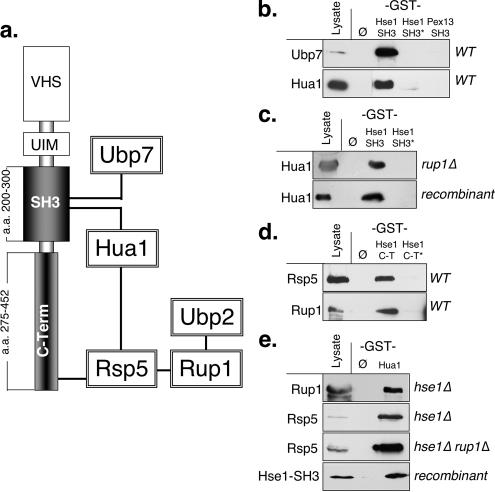
Figure 1.
Figure 1.
Interaction map of Hse1 with a ubiquitin ligase and ubiquitin peptidases. (a) Summary of interactions between Hse1, Ubp7, Hua1, and the Rsp5-Rup1-Ubp2 complex. (b) The SH3 domain of Hse1 binds Hua1 and Ubp7 in GST pulldown assays. GST fusion protein alone (Ø) or containing the wild-type Hse1 SH3 domain, a mutant (*) SH3 domain, or the SH3 domain from Pex13, were bound to GSH agarose and incubated with lysates from wild-type yeast (WT) expressing V5-epitope–tagged Ubp7 or V5-epitope–tagged Hua1. Bound fractions together with 10% of the input (lysate) were analyzed by immunoblotting. (c) Association of Hua1 with the Hse1-SH3 domain is direct and does not rely on the presence of Rup1. Hua1 from lysates of yeast lacking Rup1 (rup1Δ) or bacterial lysates expressing recombinant Hua1 was allowed to bind GST alone (Ø), GST-Hse1-SH3 domain, or GST fused to a mutant Hse1 SH3 domain. Bound fractions together with 10% of the input (lysate) were analyzed by immunoblotting. (d) Rsp5 and Rup1 interact with the C-terminal tail of Hse1 via a PY motif. A GST fusion protein containing the C-terminus of Hse1 (a.a. 275–452) or a truncated C-terminal fragment (*) lacking a the distal PPPGYEN (PY) motif (a.a. 275–445) were bound to GSH beads and incubated with lysates from wild-type (WT) yeast expressing HA-epitope–tagged Rsp5 or V5 epitope–tagged Rup1. Bound fractions together with 10% of the input lysate were analyzed by immunoblotting. (e) Interactions of Hua1. GST alone or GST fused to Hua1 were used in GST pulldown assays with lysates from yeast lacking Hse1 (hse1Δ) or both Hse1 and Rup1 (hse1Δ rup1Δ). Rup1 specifically bound GST-Hua1 independent of Hse1 while Rsp5 bound GST-Hua1 independent of Rup1 or Hse1. A recombinant Hse1 SH3 domain from bacterial lysates also bound to GST-Hua1. Shown is an immunoblot of bound fractions together with 10% of the input (lysate).
Figure 2.
Figure 2.
Full-length Hse1 interacts with Ubp2 and Ubp7. Yeast strains expressing the indicated TAP-tag fusion proteins were transformed with plasmids expressing epitope-tagged Hse1, Hua1, or Ubp7 as indicated. Yeast lysates were made from spheroplasts and were passed over calmodulin Sepharose beads in the presence of 2 mM CaCl2. As a control for specificity, wild-type yeast that did not express a TAP-tagged fusion protein were used. Bound fractions were eluted and immunoblotted as indicated along with 10% equivalent of input lysate.
Figure 3.
Figure 3.
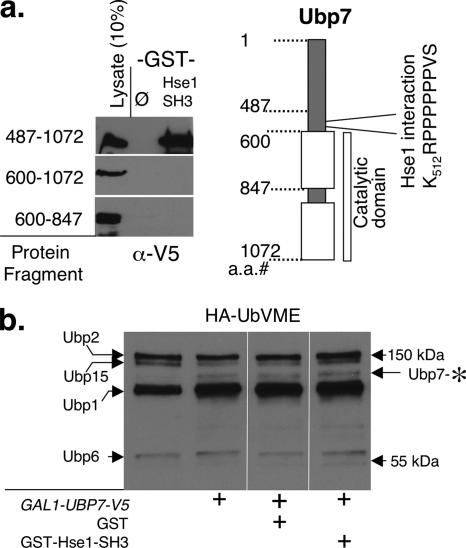
Direct binding of Ubp7 to the Hse1 SH3 domain does not alter activity. (a) V5-epitope tagged protein fragments of Ubp7 encompassing the designated residues made in E. coli were passed over GST fusion protein alone (Ø) or containing the wild-type Hse1 SH3 domain. Bound fractions were immunoblotted with anti-V5 along with a 10% equivalent of input lysate. At right is shown a schematic of Ubp7. The region that shares high homology to the catalytic domain of other Ubps is shown in white boxes. The putative SH3 ligand K512RPPPPPPVS is shown. (b) Ubp7 binds HA-UbVME. Yeast carrying vector plasmid or plasmid carrying UBP7 driven by the GAL1 promoter were grown in galactose and lysed. Lysates were preincubated with no additions or 100 μg/ml GST or GST-Hse1-SH3 fusion protein before labeling with HA-UbVME. Labeled extracts were analyzed by anti-HA immunoblotting. Arrows pointing to the positions of known DUbs are designated. A new band (*) corresponds to the predicted MW of Ubp7.
Figure 4.
Figure 4.
Hse1 interacts with Rsp5. (a) Binding of in vitro–translated Hse1 to GST-Rsp5 proteins. 35S-labeled Hse1 and Hse1 lacking the C-terminal Rsp5 binding PY element (Hse1-ΔPY) were translated in vitro using reticulocyte lysate and incubated with GST fusion proteins containing full-length Rsp5, a region containing the WW domains, or containing the HECT domain. Bound fractions were analyzed by SDS-PAGE and autoradiography together with 50% of the input reaction. (b) A schematic of the domain organization of Rsp5 and the regions corresponding to the recombinant protein fragments used. (c) V5-epitope tagged protein fragments of Rsp5 encompassing the designated residues made in E. coli were passed over GST fusion protein alone (Ø) or GST fused to Hua1. Bound fractions were immunoblotted with anti-V5 along with a 10% equivalent of input lysate.
Figure 5.
Figure 5.
Effect of disrupting association of Hse1 with Rsp5. (a) The extent of sorting of GFP-Cps1 to the vacuole interior was visualized in wild-type (WT) cells and the indicated mutant cells grown in SD media to midlog phase. Also shown is the corresponding DIC image. (b) Sorting of Fth1-GFP-Ub, Ste3-GFP, and Ub-GFP-Cps1 to the vacuole is normal in wild-type and mutant cells. Cells were transformed with Ste3-GFP– or Ub-GFP-Cps1–producing plasmid and grown in SD or Fth1-GFP-Ub–producing plasmid grown in SD media containing 100 μM BPS to midlog phase before photography. (c) Neither disrupting association of Hse1 with Rsp5 nor deletion of UBP2 or RUP1 results in secretion of vacuolar proteases. Wild-type and the indicated mutant cells were pulse labeled with 35S-Met for 10 min and chased with cold Met for 60 min. CPY was immunoprecipitated from intracellular (I) and extracellular/secreted (E) fractions and analyzed by SDS-PAGE and autoradiography. A CPY secretion phenotype was observed only for hse1Δ; all the other mutants analyzed sorted CPY normally. (d) Ste3-GFP degradation is delayed in ubp2Δ cells but not in hua1Δhse1-ΔPY cells. Wild-type and ubp2Δ and hua1Δ hse1-ΔPY cells expressing Ste3-GFP were grown at 30°C to midlog phase in SD media. Cells were harvested at 0, 5, 10, and 30 min after cycloheximide addition. Samples were examined by SDS-PAGE and Western blotting with anti-GFP antibodies.
Figure 6.
Figure 6.
Loss of Ubp7 increases efficiency of sorting GFP-Cps1 into the vacuole interior. Wild-type cells and the indicated mutants expressing GFP-Cps1 were grown to midlog phase in SD media and visualized for the extent of GFP-Cps1 sorting to the vacuole interior.
Figure 7.
Figure 7.
Rup1 and Ubp2 contribute to the ubiquitin-dependent trafficking of amino acid permeases. (a) Loss of Ubp2 or Rup1 renders cells sensitive to the proline analog ADCB. Wild-type (WT) and the indicated mutant cells were serially diluted and grown on plates containing SD alone or also containing 75 μg/ml ADCB. (b) Loss of UBP2 results in some rerouting of Gap1 from the Golgi to the cell surface in nitrogen-replete conditions. The indicated mutant cells were transformed with a plasmid expressing Gap1-GFP under the control of the CUP1 promoter. Cells were grown in YPD and induced for Gap1-GFP expression for 8 h with the addition of 100 μM CuSO4. The end3Δ ubp2Δ cells showed a fraction of the Gap1-GFP at the cell surface, whereas end3Δ mutants did not. (c) Mutant ubp2Δ cells are more sensitive to ADCB than end3Δ mutant cells. The indicated strains were grown on SD plates with or without 75 μg/ml ADCB. (d) Loss of Ubp7 does not suppress the ADCB sensitivity of ubp2Δ mutants. The indicated strains were grown on plates containing SD alone or also containing 75 μg/ml ADCB.

References

    1. Alwan H. A., van Zoelen E. J., van Leeuwen J. E. Ligand-induced lysosomal epidermal growth factor receptor (EGFR) degradation is preceded by proteasome-dependent EGFR de-ubiquitination. J. Biol. Chem. 2003;278:35781–35790. - PubMed
    1. Andreasson C., Neve E. P., Ljungdahl P. O. Four permeases import proline and the toxic proline analogue azetidine-2-carboxylate into yeast. Yeast. 2004;21:193–199. - PubMed
    1. Amerik A. Y., Nowak J., Swaminathan S., Hochstrasser M. The Doa4 deubiquitinating enzyme is functionally linked to the vacuolar protein-sorting and endocytic pathways. Mol. Biol. Cell. 2000;10:3365–3380. - PMC - PubMed
    1. Bache K. G., Raiborg C., Mehlum A., Stenmark H. STAM and Hrs are subunits of a multivalent ubiquitin-binding complex on early endosomes. J. Biol. Chem. 2003;278:12513–12521. - PubMed
    1. Beck T., Schmidt A., Hall M. N. Starvation induces vacuolar targeting and degradation of the tryptophan permease in yeast. J. Cell Biol. 1999;146:1227–1238. - PMC - PubMed

Publication types

MeSH terms

Substances