


Prediction of antitumour necrosis factor clinical efficacy by real-time visualisation of apoptosis in patients with Crohn's disease
- PMID: 17082252
- PMCID: PMC1856870
- DOI: 10.1136/gut.2006.105379
Prediction of antitumour necrosis factor clinical efficacy by real-time visualisation of apoptosis in patients with Crohn's disease
Abstract
Background: The human anti-tumour necrosis factor (TNF) antibody infliximab binds to the membrane TNF and subsequently induces apoptosis of activated lamina propria T lymphocytes in patients with Crohn's disease in vitro.
Aim: To test whether the ability of rapid anti-TNF-induced apoptosis in the gut predicts the efficacy of anti-TNF treatment in inflammatory bowel disease.
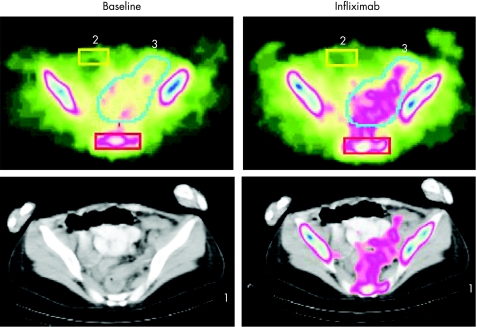
Methods: (99m)Technetium-annexin V single-photon emission computer tomography (SPECT) was performed in 2 models of murine experimental colitis and in 14 patients with active Crohn's disease as assessed by the Crohńs Disease Activity Index (CDAI) to study the effect of anti-TNF treatment on apoptosis in the intestine during active colitis. Disease activity was evaluated 2 weeks after infliximab infusion using the CDAI (definition response: drop of >100 points).
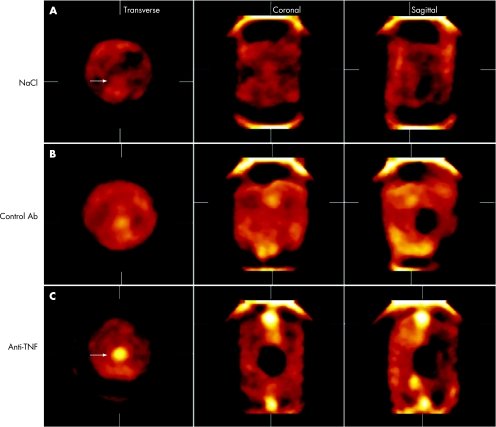
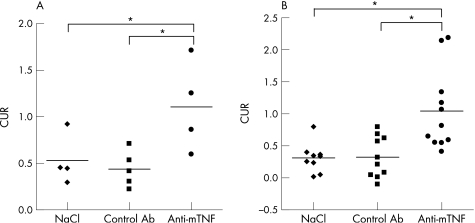
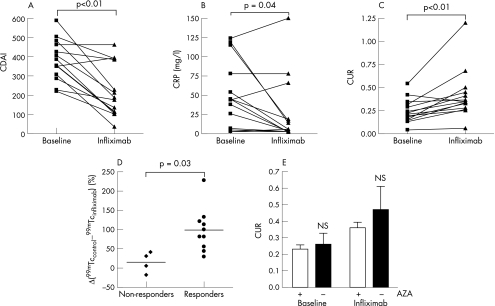
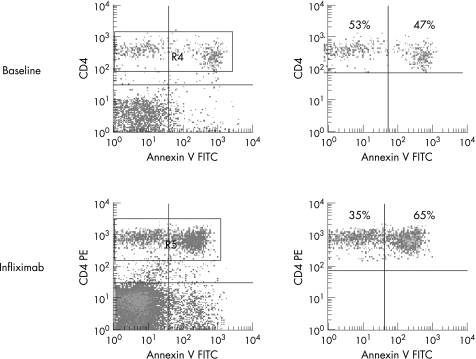
Results: Colonic uptake of (99m)Tc-annexin V significantly increased in 2,4,6-trinitrobenzene sulphonate-induced colitis as well as in transfer colitis on administration of anti-TNF antibodies compared with a control antibody as determined with dedicated animal pinhole SPECT. In addition, uptake of (99m)Tc-annexin V significantly increased in patients with active Crohn's disease responding to infliximab treatment. Colonic (99m)Tc-annexin V uptake ratio (mean (SEM)) increased from 0.24 (0.03) to 0.41(0.07) (p<0.01), 24 h after infliximab infusion (5 mg/kg). A mean increase of 98.7% in colonic uptake of (99m)Tc-annexin V could be detected in 10 of the 14 responding patients (CDAI >100 points at week 2) compared with 15.2% in non-responding patients (p = 0.03). Analysis of the mucosal biopsy specimens identified lamina propria T cells as target cells undergoing apoptosis.
Conclusions: These in vivo observations support the notion that colonic uptake of (99m)Tc-annexin V correlates with clinical benefit of anti-TNF treatment and might be predictive of therapeutic success.
Conflict of interest statement
Competing interests: None.
Comment in
-
In vivo single-photon emission computed tomography imaging of apoptosis in Crohn's disease and anti-tumour necrosis factor therapy.Gut. 2007 Apr;56(4):461-3. doi: 10.1136/gut.2006.111286. Gut. 2007. PMID: 17369380 Free PMC article. Review. No abstract available.
-
Salvation through death: preaching the dogma of apoptosis.Inflamm Bowel Dis. 2007 Nov;13(11):1446-7. doi: 10.1002/ibd.20219. Inflamm Bowel Dis. 2007. PMID: 17600817 No abstract available.
-
A possible link between TIMP-1 induction and response to infliximab.Gut. 2009 Jun;58(6):888; author reply 888-9. Gut. 2009. PMID: 19433609 No abstract available.
References
-
- Papadakis K A, Targan S R. Tumor necrosis factor: biology and therapeutic inhibitors. Gastroenterology 20001191148–1157. - PubMed
-
- van Deventer S J. Review article: targeting TNF alpha as a key cytokine in the inflammatory processes of Crohn's disease—the mechanisms of action of infliximab. Aliment Pharmacol Ther 199913(Suppl 4)3–8. - PubMed
-
- Black R A, Rauch C T, Kozlosky C J.et al A metalloproteinase disintegrin that releases tumour‐necrosis factor‐alpha from cells. Nature 1997385729–733. - PubMed
-
- Moss M L, Jin S L, Becherer J D.et al Structural features and biochemical properties of TNF‐alpha converting enzyme (TACE). J Neuroimmunol 199772127–129. - PubMed
-
- Vassalli P. The pathophysiology of tumor necrosis factors. Annu Rev Immunol 199210411–452. - PubMed
Publication types
MeSH terms
Substances
LinkOut - more resources
Full Text Sources
Other Literature Sources
Medical
