


Factors associated with intentions to adhere to colorectal cancer screening follow-up exams
- PMID: 17083746
- PMCID: PMC1664561
- DOI: 10.1186/1471-2458-6-272
Factors associated with intentions to adhere to colorectal cancer screening follow-up exams
Abstract
Background: To increase adherence rate to recommendations for follow-up after abnormal colorectal cancer (CRC) screening results, factors that inhibit and facilitate follow-up must be identified. The purpose of this study was to identify the factors associated with intention to adhere to CRC screening follow-up exams.
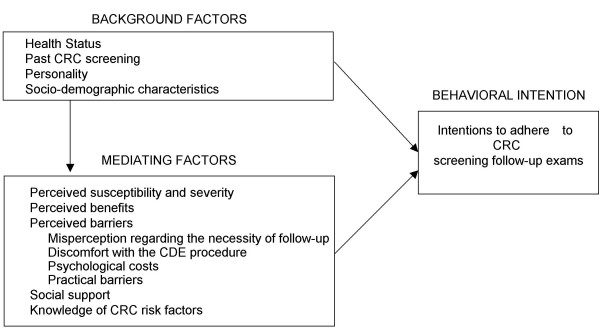
Methods: During a 4-week period in October 2003, this survey was conducted with 426 subjects participating in a community-based CRC screening program in Nagano, Japan. Study measures included intention to adhere to recommendation for clinical follow-up in the event of an abnormal fecal occult blood test (FOBT) result, perceived susceptibility and severity of CRC, perceived benefits and barriers related to undergoing follow-up examination, social support, knowledge of CRC risk factors, health status, previous CRC screening, personality and social demographic characteristics. Univariate and multivariate logistic regression analyses on intention to adhere to recommendations for follow-up were performed.
Results: Among the 288 individuals analyzed, approximately 74.7% indicated that they would definitely adhere to recommendations for follow-up. After controlling for age, gender, marital status, education, economic status, trait anxiety, bowel symptoms, family history of CRC, and previous screening FOBT, analyses revealed that lower levels of perceived barriers, higher levers of perceived benefits and knowledge of CRC risk factors were significantly associated with high intention respectively.
Conclusion: The results of this study suggest that future interventions should focus on reducing modifiable barriers by clarifying misperceptions about follow-up, promoting the acceptance of complete diagnostic evaluations, addressing psychological distress, and making follow-up testing more convenient and accessible. Moreover, educating the public regarding the risk factors of CRC and increasing understanding of the benefits of follow-up is also important.
Figures
References
-
- Japanese Vital Statistics, 2004 http://www.dbtk.mhlw.go.jp/toukei/data/010/2004/toukeihyou/0004982/t0109...
-
- Cancer statistics in Japan 2005 http://ganjoho.ncc.go.jp/pub/statistics/index.html
-
- Saito H, Soma Y, Koeda J, Wada T, Kawaguchi H, Sobue T, Aisawa T, Yoshida Y. Reduction in risk of mortality from colorectal cancer by fecal occult blood screening with immunochemical hemagglutination test. A case-control study. Int J Cancer. 1995;61:465–469. - PubMed
-
- Watanabe Y, Kawai K. The Health and Medical Service Law for the Aged based basic colorectal cancer screening methods. In: Tada M, Nagasako K, editor. The manual of colorectal cancer screening. Tokyo: Igaku-Shoin; 1994. pp. 5–15. (in Japanese)
Publication types
MeSH terms
LinkOut - more resources
Full Text Sources
Medical
