


Gender differences in management and outcome in non-ST-elevation acute coronary syndrome
- PMID: 17085528
- PMCID: PMC2016903
- DOI: 10.1136/hrt.2006.102012
Gender differences in management and outcome in non-ST-elevation acute coronary syndrome
Abstract
Objective: To study gender differences in management and outcome in patients with non-ST-elevation acute coronary syndrome.
Design, setting and patients: Cohort study of 53 781 consecutive patients (37% women) from the Register of Information and Knowledge about Swedish Heart Intensive care Admissions (RIKS-HIA), with a diagnosis of either unstable angina pectoris or non-ST-elevation myocardial infarction. All patients were admitted to intensive coronary care units in Sweden, between 1998 and 2002, and followed for 1 year.
Main outcome measures: Treatment intensity and in-hospital, 30-day and 1-year mortality.
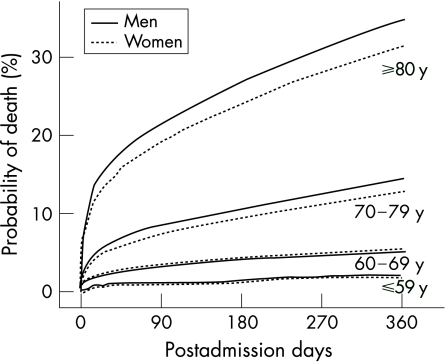
Results: Women were older (73 vs 69 years, p<0.001) and more likely to have a history of hypertension and diabetes, but less likely to have a history of myocardial infarction or revascularisation. After adjustment, there were no major differences in acute pharmacological treatment or prophylactic medication at discharge. Revascularisation was, however, even after adjustment, performed more often in men (OR 1.15; 95% CI, 1.09 to 1.21). After adjustment, there was no significant difference in in-hospital (OR 1.03; 95% CI, 0.94 to 1.13) or 30-days (OR 1.07; 95% CI, 0.99 to 1.15) mortality, but at 1 year being male was associated with higher mortality (OR 1.12; 95% CI, 1.06 to 1.19).
Conclusion: Although women are somewhat less intensively treated, especially regarding invasive procedures, after adjustment for differences in background characteristics, they have better long-term outcomes than men.
Conflict of interest statement
Competing interests: None declared.
Comment in
-
Sex in the CCU: women with non-ST-segment elevation acute coronary syndrome may do no worse despite less intervention.Heart. 2007 Nov;93(11):1327-8. doi: 10.1136/hrt.2006.106047. Heart. 2007. PMID: 17933985 Free PMC article.
References
-
- Stone P H, Thompson B, Anderson H V.et al Influence of race, sex, and age on management of unstable angina and non‐Q‐wave myocardial infarction: the TIMI III registry. JAMA 19962751104–1112. - PubMed
-
- Chandra N C, Ziegelstein R C, Rogers W J.et al Observations of the treatment of women in the United States with myocardial infarction: a report from the National Registry of Myocardial Infarction‐I. Arch Intern Med 1998158981–988. - PubMed
-
- Scirica B M, Moliterno D J, Every N R.et al Differences between men and women in the management of unstable angina pectoris (The GUARANTEE Registry). The GUARANTEE Investigators. Am J Cardiol 1999841145–1150. - PubMed
-
- Roger V L, Farkouh M E, Weston S A.et al Sex differences in evaluation and outcome of unstable angina. JAMA 2000283646–652. - PubMed
-
- Gan S C, Beaver S K, Houck P M.et al Treatment of acute myocardial infarction and 30‐day mortality among women and men. N Engl J Med 20003438–15. - PubMed
Publication types
MeSH terms
LinkOut - more resources
Full Text Sources
