


Board-invited review: recent advances in management of highly stressed, newly received feedlot cattle
- PMID: 17085724
- PMCID: PMC7109667
- DOI: 10.2527/jas.2006-501
Board-invited review: recent advances in management of highly stressed, newly received feedlot cattle
Abstract
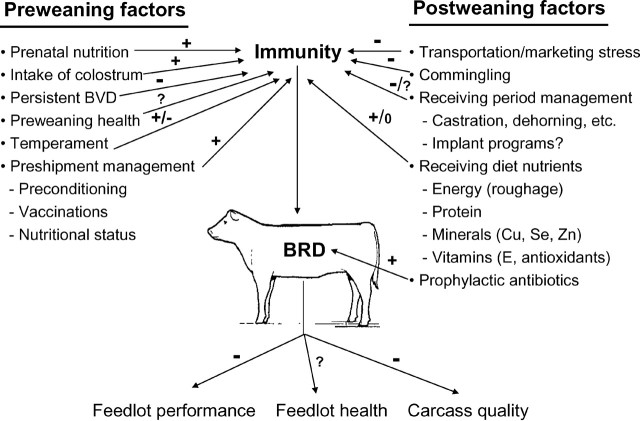
Morbidity and mortality from bovine respiratory disease (BRD) and associated losses in performance and carcass merit continue to plague the beef cattle industry. Several viral/bacterial agents are responsible for BRD, and interactions occur among the agents. Viral agents often predispose animals to bacterial infections, and Mannheimia haemolytica is the most frequently isolated organism in cattle with BRD. Laboratory tests are available to characterize organisms causing BRD using easily obtained nasal swab samples. Testing for persistent infection with bovine viral diarrhea virus can be done by a 2-stage technique using PCR and immunohistochemistry. Preconditioning programs that include preweaning viral vaccination programs along with castration could have a significant influence on decreasing BRD in the cattle feeding industry. Metaphylactic antibiotic programs continue to be effective; however, antibiotic resistance is a public concern, and additional management options (e.g., direct-fed microbials or other compounds with antimicrobial properties) deserve attention. Diets with an increased energy concentration achieved by decreasing the dietary roughage concentration may slightly increase the rate of BRD morbidity; however, these diets also increase ADG, DMI, and G:F compared with lower-energy, greater-roughage diets. The extent to which performance and BRD morbidity are affected by dietary protein concentration needs further study, but low and high protein concentrations should probably be avoided. Several trace minerals (e.g., Cu, Se, and Zn) affect immune function, but the effects of supplementation on performance and immune function in model challenge systems and in field studies are equivocal. Adding vitamin E to receiving diets at pharmacological levels (e.g., >1,000 IU x animal(-1) x day(-1)) seems beneficial for decreasing BRD morbidity, but it has little effect on performance. Given the limited ability to consistently modify immune function and BRD morbidity through dietary manipulations, we recommend that the diets for newly received cattle be formulated to adjust nutrient concentrations for low feed intake and to provide optimal performance during the receiving period.
Figures
References
-
- Aiken G. E., Looper M. L., Tabler S. F., Brauer D. K., Strickland J. R., and Schrick F. N.. 2006. Influence of stocking rate and steroidal implants on growth rate of steers grazing toxic tall fescue and subsequent physiological response. J. Anim. Sci. 84:1626–1632. - PubMed
-
- Anonymous. 2005a. Value added calf (VAC) – Management Program. Texas Coop. Ext. Service. http://animalscience.tamu.edu/ANSC/publications/beefpubs/vac_management.pdf Accessed June 15, 2005.
-
- Anonymous. 2005b. Value added calf (VAC) – Vaccination Programs. Texas Coop. Ext. Service. http://animalscience.tamu.edu/ANSC/publications/beefpubs/vac_vaccine.pdf Accessed June 15, 2005.
-
- Arthington J. D. 2005. Effects of copper oxide bolus administration or high-level copper supplementation on forage utilization and copper status in beef cattle. J. Anim. Sci. 83:2894–2900. - PubMed
-
- Arthington J. D., Corah L. R., Blecha F., and Hill D. A.. 1995. Effect of copper depletion and repletion on lymphocyte blastogenesis and neutrophil bactericidal function in beef heifers. J. Anim. Sci. 73:2079–2085. - PubMed
Publication types
MeSH terms
LinkOut - more resources
Full Text Sources
Other Literature Sources
