Life-span development of visual working memory: when is feature binding difficult?
- PMID: 17087544
- PMCID: PMC1635970
- DOI: 10.1037/0012-1649.42.6.1089
Life-span development of visual working memory: when is feature binding difficult?
Erratum in
-
"Life-span development of visual working memory: When is feature binding difficult?": Correction to Cowan et al. (2006).Dev Psychol. 2016 Oct;52(10):1544. doi: 10.1037/dev0000222. Dev Psychol. 2016. PMID: 27690494
Abstract
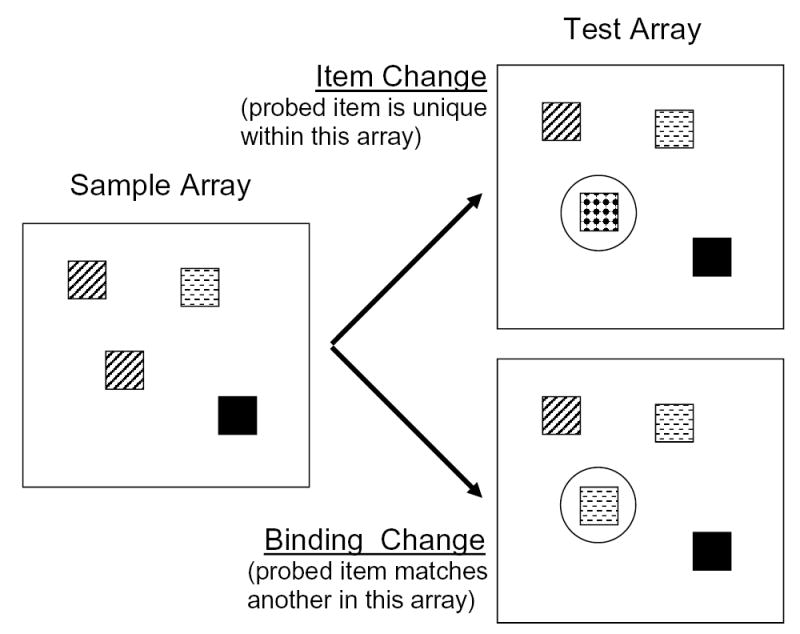
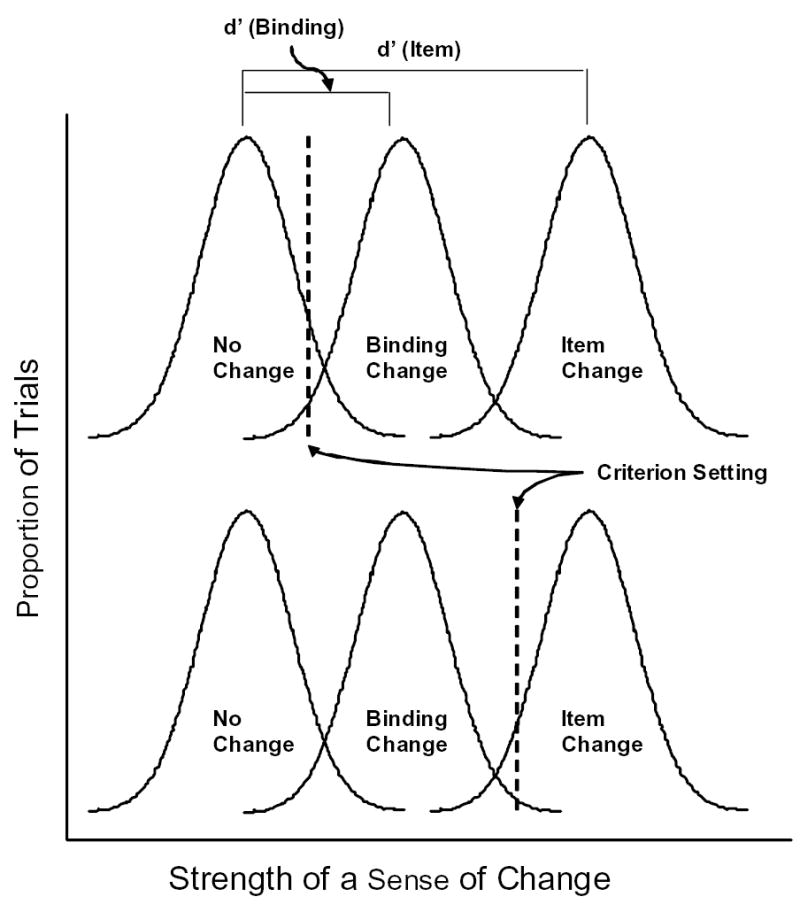
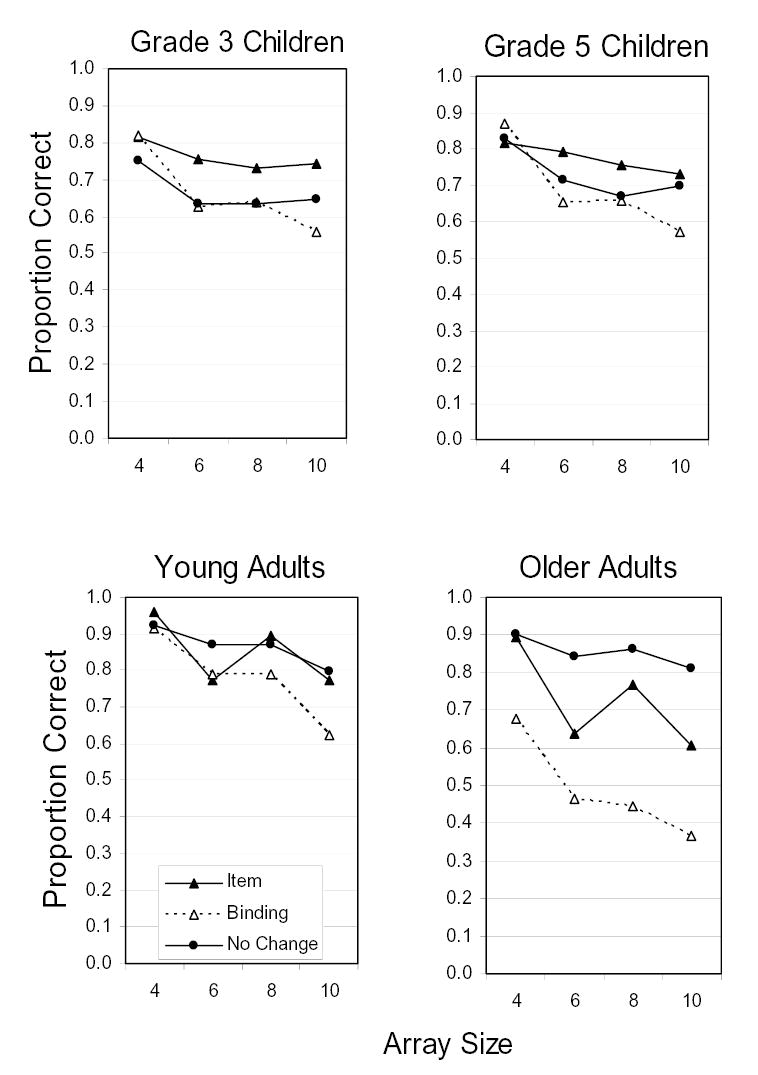
We asked whether the ability to keep in working memory the binding between a visual object and its spatial location changes with development across the life span more than memory for item information. Paired arrays of colored squares were identical or differed in the color of one square, and in the latter case, the changed color was unique on that trial (item change) or was duplicated elsewhere in the array (color-location binding change). Children (8-10 and 11-12 years old) and older adults (65-85 years old) showed deficits relative to young adults. These were only partly simulated by dividing attention in young adults. The older adults had an additional deficiency, specifically in binding information, which was evident only when item- and binding-change trials were mixed together. In that situation, the older adults often overlooked the more subtle, binding-type changes. Some working memory processes related to binding undergo life-span development in an inverted-U shape, whereas other, bias- and salience-related processes that influence the use of binding information seem to develop monotonically.
Figures



References
-
- Anooshian LJ. Understanding age differences in memory: Disentangling conscious and unconscious processes. International Journal of Behavioral Development. 1999;23:1–17.
-
- Baddeley A. The episodic buffer: a new component of working memory? Trends in cognitive sciences. 2000;4:417–423. - PubMed
-
- Baddeley A, Gathercole S, Papagno C. The phonological loop as a language learning device. Psychological Review. 1998;105:158–173. - PubMed
-
- Bauer PJ, Burch MM, Kleinknecht EE. Developments in early recall memory: Normative trends and individual differences. Advances in Child Development and Behavior. 2002;30:103–152. - PubMed
-
- Bayen UJ, Phelps MP, Spaniol J. Age-related differences in the use of contextual information in recognition memory: A global matching approach. Journals of Gerontology: Series B: Psychological Sciences & Social Sciences. 2000;55B:P131–P141. - PubMed