. 2006 Nov 6;175(3):377-82.
doi: 10.1083/jcb.200607116.

Rapidly inducible changes in phosphatidylinositol 4,5-bisphosphate levels influence multiple regulatory functions of the lipid in intact living cells

Affiliations

Rapidly inducible changes in phosphatidylinositol 4,5-bisphosphate levels influence multiple regulatory functions of the lipid in intact living cells

Peter Varnai et al. J Cell Biol. .

Abstract

Rapamycin (rapa)-induced heterodimerization of the FRB domain of the mammalian target of rapa and FKBP12 was used to translocate a phosphoinositide 5-phosphatase (5-ptase) enzyme to the plasma membrane (PM) to evoke rapid changes in phosphatidylinositol 4,5-bisphosphate (PtdIns(4,5)P(2)) levels. Rapa-induced PM recruitment of a truncated type IV 5-ptase containing only the 5-ptase domain fused to FKBP12 rapidly decreased PM PtdIns(4,5)P(2) as monitored by the PLCdelta1PH-GFP fusion construct. This decrease was paralleled by rapid termination of the ATP-induced Ca(2+) signal and the prompt inactivation of menthol-activated transient receptor potential melastatin 8 (TRPM8) channels. Depletion of PM PtdIns(4,5)P(2) was associated with a complete blockade of transferrin uptake and inhibition of epidermal growth factor internalization. None of these changes were observed upon rapa-induced translocation of an mRFP-FKBP12 fusion protein that was used as a control. These data demonstrate that rapid inducible depletion of PM PtdIns(4,5)P(2) is a powerful tool to study the multiple regulatory roles of this phospholipid and to study differential sensitivities of various processes to PtdIns(4,5)P(2) depletion.


Figures
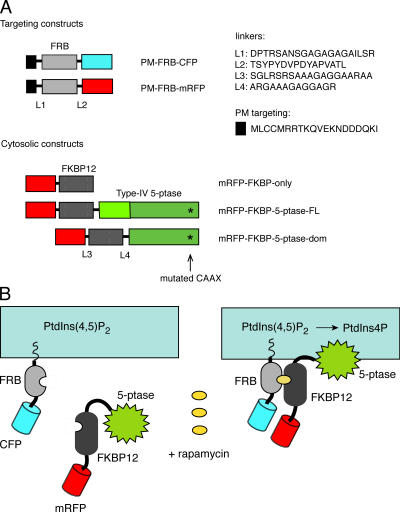
Figure 1.
Figure 1.
Rapa-induced translocation of the type IV 5-ptase domain to the PM. (A) Outline of the constructs used in the present study. The asterisk shows the C641A mutation that eliminates membrane localization of the 5-ptase. (B) Heterodimerization of the PM-targeted FRB fragment of mTOR with the cytosolic 5-ptase fused to FKBP12 upon rapa addition causes PM recruitment of the enzyme and rapid dephosphorylation of PtdIns(4,5)P 2.
Figure 2.
Figure 2.
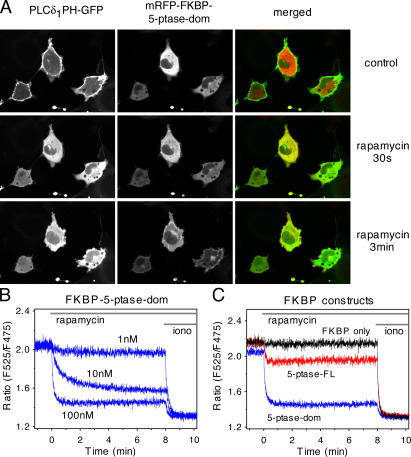
Changes in PtdIns(4,5)P2 levels after rapa-induced membrane targeting of the 5-ptase. (A) COS-7 cells were transfected with the PLCδ1PH-GFP plasmid to monitor PtdIns(4,5)P 2 in the PM along with the membrane-targeted FRB-CFP (CFP channel is not shown) and the mRFP−FKBP−5-ptase domain constructs. Addition of 100 nM rapa induces translocation of the 5-ptase to the membrane, causing a complete loss of PLCδ1PH-GFP localization. Even partial localization of the enzyme (at 30 s) is sufficient to eliminate PtdIns(4,5)P 2. (B) FRET analysis of the PLCδ1PH domain translocation in cell suspensions. COS-7 cells were transfected with the CFP- and YFP-tagged forms of the PLCδ1PH domains together with the membrane-targeted FRB and the FKBP−5-ptase both tagged with mRFP. Cells were trypsinized and analyzed in suspension in a spectrofluorometer as described in Materials and methods. Addition of rapa at the indicated concentrations induces PtdIns(4,5)P 2 depletion resulting in a decreased membrane localization of the PH domain reflected in the decreased FRET signal. 10 μM ionomycin (iono) was used to completely eliminate PtdIns(4,5)P 2 (Várnai and Balla, 1998). (C) Similar experiment as in B except that the FKBP construct did not contain the phosphatase (FKBP only; black trace) or contained the full-length 5-ptase (5-ptase−FL; red trace). Representative data are shown from two identical observations.
Figure 3.
Figure 3.
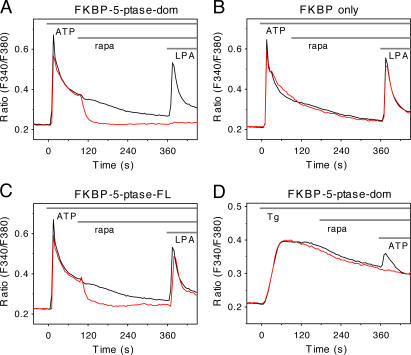
[Ca2+]i changes in single COS-7 cells after stimulation of the endogenous P2Y receptors with ATP or inhibition of the sarcoplasmic and ER Ca2+ ATPase with Tg. Cells were transfected with the membrane-targeted FRB-CFP plasmid together with the mRFP-FKBP fused to the isolated 5-ptase domain (A and D) or the full-length 5-ptase (C) or not containing the 5-ptase (B). Cells were loaded with fura-2/AM and examined at room temperature. Only cells that showed a response to ATP (50 μM) were included in the analysis in A−C. The effects of the constructs on the Ca2+ responses were calculated from cells that fell in the same range of FKBP construct expression (red traces) with a mean fluorescence of (in arbitrary units ± SEM) 1705 ± 150 (n = 44), 1827 ± 295 (n = 18), 1827 ± 217 (n = 22), and 2117 ± 276 (n = 44) for A, B, C, and D, respectively. The black traces are from untransfected cells in the same field (n = 120, 68, 120, and 38 for A, B, C, and D, respectively). Note the lack of effect of rapa on the 200 nM Tg-induced Ca2+ elevation (D) in contrast to the strong effect on the ATP-induced Ca2+ plateau (A). Error bars (<5%) have been omitted for better clarity. These data were reproduced at least in three different cell preparations.
Figure 4.
Figure 4.
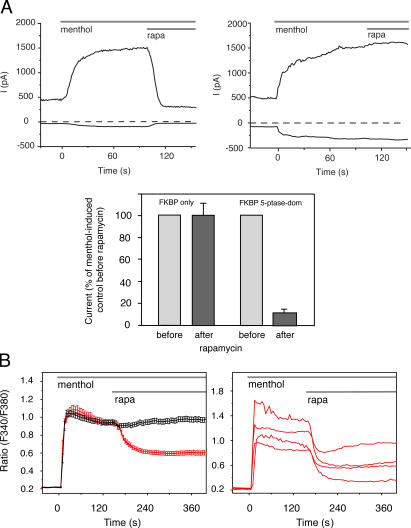
Electrophysiological recordings in HEK293 cells and [Ca2+]i changes in single COS-7 cells expressing TRPM8 channels. Cells were also transfected with the membrane-targeted FRB-CFP plasmid and either the mRFP-FKBP−fused isolated 5-ptase domain or mRFP-FKBP only. (A) Current recording measured in the whole-cell configuration, using the ramp protocol described in Materials and methods. The currents at +100 (top curves) and −100 mV (bottom curves) are shown. The averaged responses to rapa from 14 and 4 recordings for 5-ptase and FKBP-only expressing cells, respectively, measured at +100 mV are shown in the bottom histogram. (B) Averaged [Ca2+]i responses from cells expressing the mRFP−FKBP− 5-ptase domain (left, red) or mRFP-FKBP only (left, black) domain (means ± SEM from 79 and 76 cells, respectively). Representative single-cell [Ca2+]i responses from cells expressing the mRFP−FKBP−5-ptase domain are shown at the right (means ± SEM from 79 and 76 cells, respectively). Elimination of PtdIns(4,5)P 2 rapidly inhibits the whole cell current and reduces the Ca2+ signal stimulated by 500 μM menthol.
Figure 5.
Figure 5.
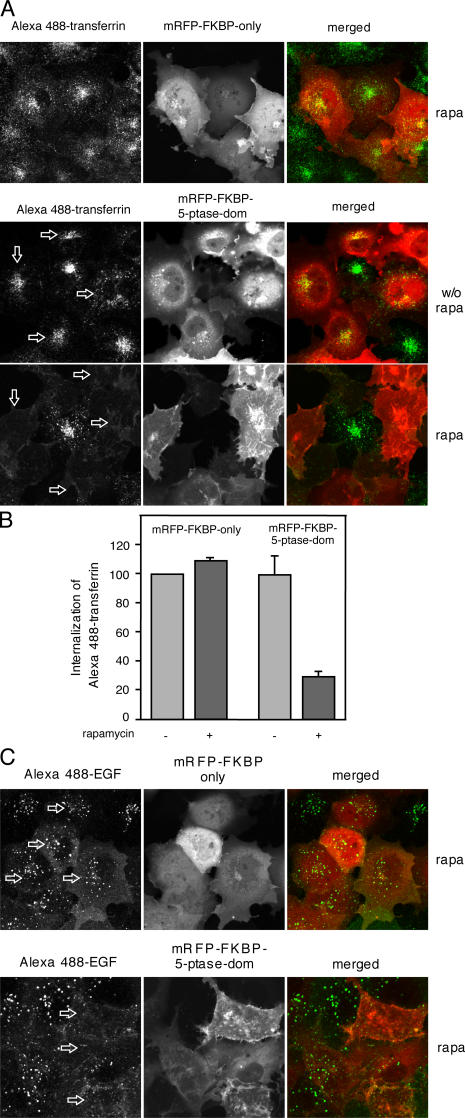
Internalization of Alexa 488−Tf or Alexa 488−EGF in COS-7 cells transfected with the membrane-targeted FRB and the indicated FKBP constructs. Where indicated, fluorescent ligand was added after 3-min pretreatment with 100 nM rapa. Confocal pictures were taken at 10 min after the addition of the ligand (Alexa 488−Tf in A and B and Alexa 488−EGF in C) and after removing and washing of the unbound protein. Note that the lack of internalization of Tf in cells expressing the 5-ptase domain was evident only after rapa addition (arrows). (B) FACS analysis of COS-7 cells expressing the membrane-targeted FRB-CFP plasmid and the indicated FKBP fusion protein after 5- or 10-min uptake of Alexa 488−Tf after treatment with solvent or rapa. Cells showing mRFP expression in the red channel were selected and their mean green signal intensities were calculated. Means ± SEM of three experiments.

References

    1. Berridge, M.J. 1993. Cell signalling: a tale of two messengers. Nature. 365:388–389. - PubMed
    1. Broad, L.M., F.J. Braun, J.P. Lievremont, G.S. Bird, T. Kurosaki, and J.W. Putney Jr. 2001. Role of the phospholipase C-inositol 1,4,5-trisphosphate pathway in calcium release-activated calcium current and capacitative calcium entry. J. Biol. Chem. 276:15945–15952. - PubMed
    1. Brown, F.D., A.L. Rozelle, H.L. Yin, T. Balla, and J.G. Donaldson. 2001. Phosphatidylinositol 4,5-bisphosphate and Arf6-regulated membrane traffic. J. Cell Biol. 154:1007–1017. - PMC - PubMed
    1. Chen, X., E.M. Talley, N. Patel, A. Gomis, W.E. McIntire, B. Dong, F. Viana, J.C. Garrison, and D.A. Bayliss. 2006. Inhibition of a background potassium channel by Gq protein alpha-subunits. Proc. Natl. Acad. Sci. USA. 103:3422–3427. - PMC - PubMed
    1. Fuster, D., O.W. Moe, and D.W. Hilgemann. 2004. Lipid- and mechanosensitivities of sodium/hydrogen exchangers analyzed by electrical methods. Proc. Natl. Acad. Sci. USA. 101:10482–10487. - PMC - PubMed

Publication types

MeSH terms