Trace amine-associated receptors and their ligands
- PMID: 17088868
- PMCID: PMC2014643
- DOI: 10.1038/sj.bjp.0706948
Trace amine-associated receptors and their ligands
Abstract
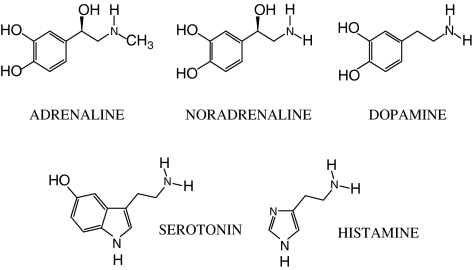
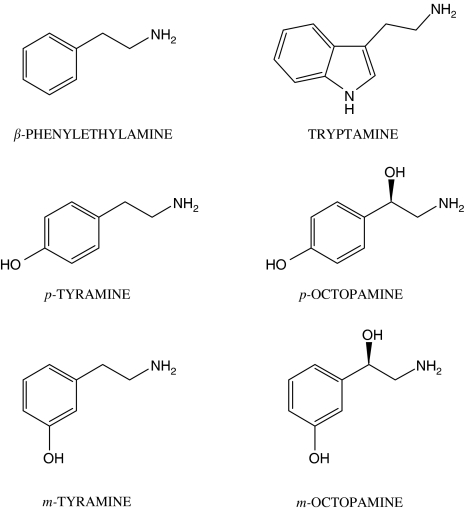
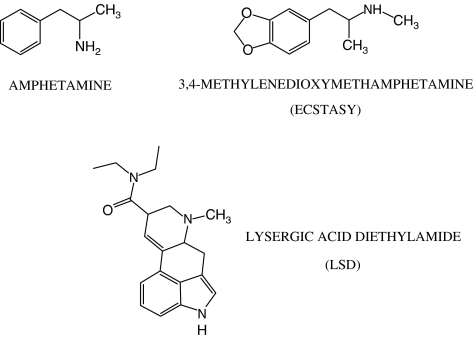
Classical biogenic amines (adrenaline, noradrenaline, dopamine, serotonin and histamine) interact with specific families of G protein-coupled receptors (GPCRs). The term 'trace amines' is used when referring to p-tyramine, beta-phenylethylamine, tryptamine and octopamine, compounds that are present in mammalian tissues at very low (nanomolar) concentrations. The pharmacological effects of trace amines are usually attributed to their interference with the aminergic pathways, but in 2001 a new gene was identified, that codes for a GPCR responding to p-tyramine and beta-phenylethylamine but not to classical biogenic amines. Several closely related genes were subsequently identified and designated as the trace amine-associated receptors (TAARs). Pharmacological investigations in vitro show that many TAAR subtypes may not respond to p-tyramine, beta-phenylethylamine, tryptamine or octopamine, suggesting the existence of additional endogenous ligands. A novel endogenous thyroid hormone derivative, 3-iodothyronamine, has been found to interact with TAAR1 and possibly other TAAR subtypes. In vivo, micromolar concentrations of 3-iodothyronamine determine functional effects which are opposite to those produced on a longer time scale by thyroid hormones, including reduction in body temperature and decrease in cardiac contractility. Expression of all TAAR subtypes except TAAR1 has been reported in mouse olfactory epithelium, and several volatile amines were shown to interact with specific TAAR subtypes. In addition, there is evidence that TAAR1 is targeted by amphetamines and other psychotropic agents, while genetic linkage studies show a significant association between the TAAR gene family locus and susceptibility to schizophrenia or bipolar affective disorder.
Figures

References
-
- Abou Jamra R, Sircar I, Becker T, Freudenberg-Hua Y, Ohlraun S, Freudenberg J, et al. A family-based and case–control association study of trace amine receptor genes on chromosome 6q23 in bipolar affective disorder. Mol Psychiatry. 2005;10:618–620. - PubMed
-
- Amann D, Avidan N, Kanyas K, Kohn Y, Hamdan A, Ben-Hasher E, et al. The trace amine receptor 4 gene is not associated with schizophrenia in a sample linked to chromosome 6q23. Mol Psychiatry. 2006;11:119–121. - PubMed
-
- Axelrod J, Saavedra JM. Octopamine. Nature. 1977;265:501–504. - PubMed
-
- Baud P, Arbilla S, Cantrill RC, Scatton B, Langer SZ. Trace amines inhibit the electrically evoked release of [3H]acetylcholine from slices of rat striatum in the presence of pargyline: similarities between beta-phenylethylamine and amphetamine. J Pharmacol Exp Ther. 1985;235:220–229. - PubMed
-
- Becu-Villalobos D, Thyssen SM, Rey EB, Lux-Lantos V, Libertun C. Octopamine and phenylethylamine inhibit prolactin secretion both in vivo and in vitro. Proc Soc Exp Biol Med. 1992;199:230–235. - PubMed
Publication types
MeSH terms
Substances
LinkOut - more resources
Full Text Sources
Other Literature Sources
Molecular Biology Databases