


Prognostic significance of downregulated expression of the candidate tumour suppressor gene SASH1 in colon cancer
- PMID: 17088907
- PMCID: PMC2360597
- DOI: 10.1038/sj.bjc.6603452
Prognostic significance of downregulated expression of the candidate tumour suppressor gene SASH1 in colon cancer
Abstract
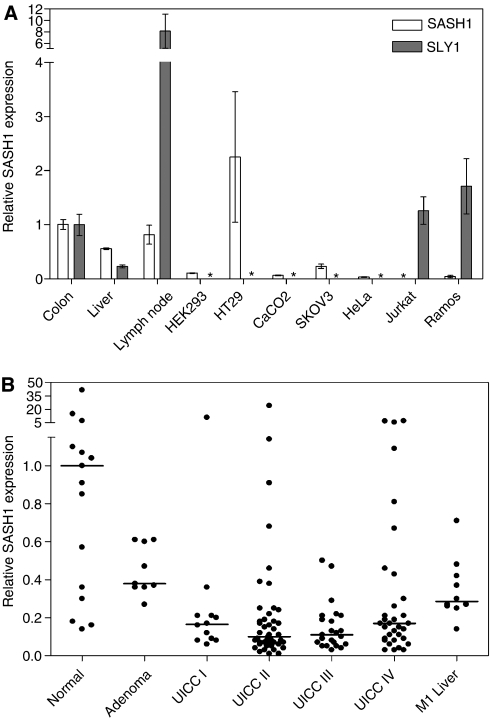
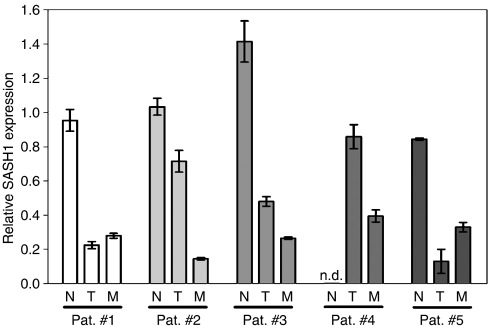
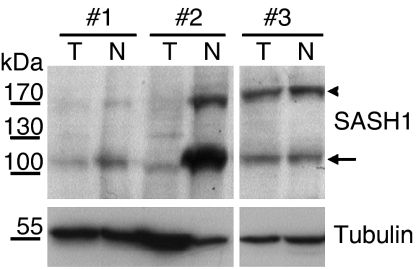
The gene SASH1 (SAM- and SH3-domain containing 1) has originally been identified as a candidate tumour suppressor gene in breast cancer. SASH1 is a member of the SH3-domain containing expressed in lymphocytes (SLY1) gene family that encodes signal adapter proteins composed of several protein-protein interaction domains. The other members of this family are expressed mainly in haematopoietic cells, whereas SASH1 shows ubiquitous expression. We have used quantitative real-time PCR to investigate the expression of SASH1 in tissue samples from 113 patients with colon carcinoma, and compared the expression with 15 normal colon tissue samples. Moreover, nine benign adenomas and 10 liver metastases were analysed. Expression levels of SASH1 were strongly and significantly reduced in colon cancer of UICC stage II, III, and IV, as well as in liver metastases. Moreover, SASH1 was also found to be downregulated on protein levels by immunoblot analysis. However, SASH1 expression was not significantly deregulated in precancerous adenomas and in earlier stage lesions (UICC I). Overall, 48 out of 113 primary colon tumours showed SASH1 expression that was at least 10-fold lower than the levels found in normal colon tissue. Downregulation of SASH1 expression was correlated with the formation of metachronous distant metastasis, and multivariate analysis identified SASH1 downregulation as an independent negative prognostic parameter for patient survival. This study demonstrates for the first time that expression of a member of the SLY1-gene family has prognostic significance in human cancer.
Figures
References
-
- Alcock HE, Stephenson TJ, Royds JA, Hammond DW (2003) Analysis of colorectal tumor progression by microdissection and comparative genomic hybridization. Genes Chromosomes Cancer 37: 369–380 - PubMed
-
- Beer S, Simins AB, Schuster A, Holzmann B (2001) Molecular cloning and characterization of a novel SH3 protein (SLY) preferentially expressed in lymphoid cells. Biochim Biophys Acta 1520: 89–93 - PubMed
-
- Claudio JO, Zhu YX, Benn SJ, Shukla AH, McGlade CJ, Falcioni N, Stewart AK (2001) HACS1 encodes a novel SH3–SAM adaptor protein differentially expressed in normal and malignant hematopoietic cells. Oncogene 20: 5373–5377 - PubMed
-
- Fearon ER, Vogelstein B (1990) A genetic model for colorectal tumorigenesis. Cell 61: 759–767 - PubMed
Publication types
MeSH terms
Substances
LinkOut - more resources
Full Text Sources
Molecular Biology Databases
