Quadriceps strength predicts mortality in patients with moderate to severe chronic obstructive pulmonary disease
- PMID: 17090575
- PMCID: PMC2111256
- DOI: 10.1136/thx.2006.062026
Quadriceps strength predicts mortality in patients with moderate to severe chronic obstructive pulmonary disease
Abstract
Background: Prognosis in chronic obstructive pulmonary disease (COPD) is poorly predicted by indices of air flow obstruction, because other factors that reflect the systemic nature of the disease also influence prognosis.
Objective: To test the hypothesis that a reduction in quadriceps maximal voluntary contraction force (QMVC) is a useful predictor of mortality in patients with COPD.
Methods: A mortality questionnaire was sent to the primary care physician of 184 patients with COPD who had undergone quadriceps strength measurement over the past 5 years. QMVC was expressed as a percentage of the patient's body mass index. The end point measured was death or lung transplantation, and median (range) follow-up was 38 (1-54) months.
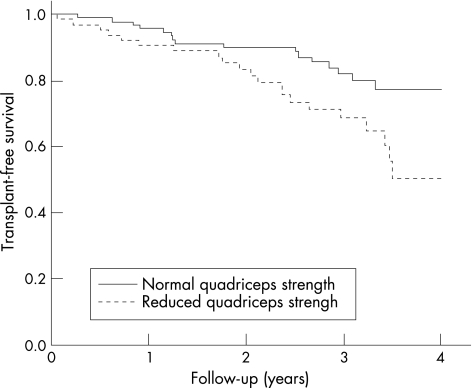
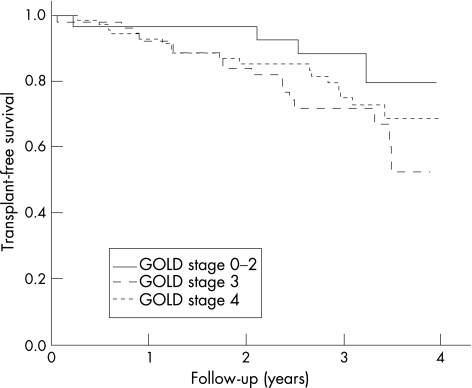
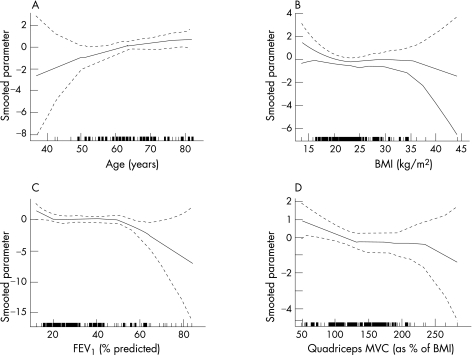
Results: Data were obtained for 162 patients (108 men and 54 women) with a mean (SD) percentage of forced expiratory volume in 1 s (FEV1) predicted of 35.6 (16.2), giving a response rate of 88%. Transplant-free survival of the cohort was 93.5% at 1 year and 87.1% at 2 years. Cox regression models showed that the mortality risk increased with increasing age and with reducing QMVC. Only age (HR 1.72 (95% CI 1.14 to 2.6); p = 0.01) and QMVC (HR 0.91 (95% CI 0.83 to 0.99); p = 0.036) continued to be significant predictors of mortality when controlled for other variables in the multivariate analysis.
Conclusion: QMVC is simple and provides more powerful prognostic information on COPD than that provided by age, body mass index and forced expiratory volume in 1 s.
Conflict of interest statement
Competing interests: None.

Comment in
-
Sarcopaenia in chronic obstructive pulmonary disease.Thorax. 2007 Feb;62(2):101-3. doi: 10.1136/thx.2006.067009. Thorax. 2007. PMID: 17287301 Free PMC article.
References
-
- World Health Organization World Health Report. Geneva: WHO, 2000
-
- Celli B R, Cote C G, Marin J M.et al The Body‐Mass Index, Airflow Obstruction, Dyspnea, and Exercise Capacity Index in chronic obstructive pulmonary disease. N Engl J Med 20043501005–1012. - PubMed
-
- Schols A M W J, Slangen J, Volovics L.et al Weight loss is a reversible factor in the prognosis of chronic obstructive pulmonary disease. Am J Respir Crit Care Med 19981571791–1797. - PubMed
-
- Landbo C, Prescott E, Lange P.et al Prognostic value of nutritional status in chronic obstructive pulmonary disease. Am J Respir Crit Care Med 19991601856–1861. - PubMed
-
- Prescott E, Almdal T, Mikkelsen K L.et al Prognostic value of weight change in chronic obstructive pulmonary disease: results from the Copenhagen City Heart Study. Eur Respir J 200220539–544. - PubMed
MeSH terms
LinkOut - more resources
Full Text Sources
Other Literature Sources
Medical
Miscellaneous