


Focusing on body sites: the role of spatial attention in action perception
- PMID: 17091293
- PMCID: PMC2079350
- DOI: 10.1007/s00221-006-0756-4
Focusing on body sites: the role of spatial attention in action perception
Abstract
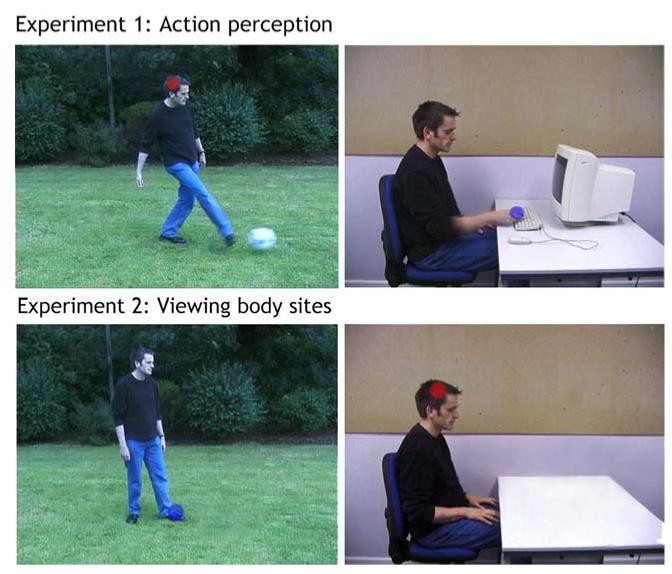
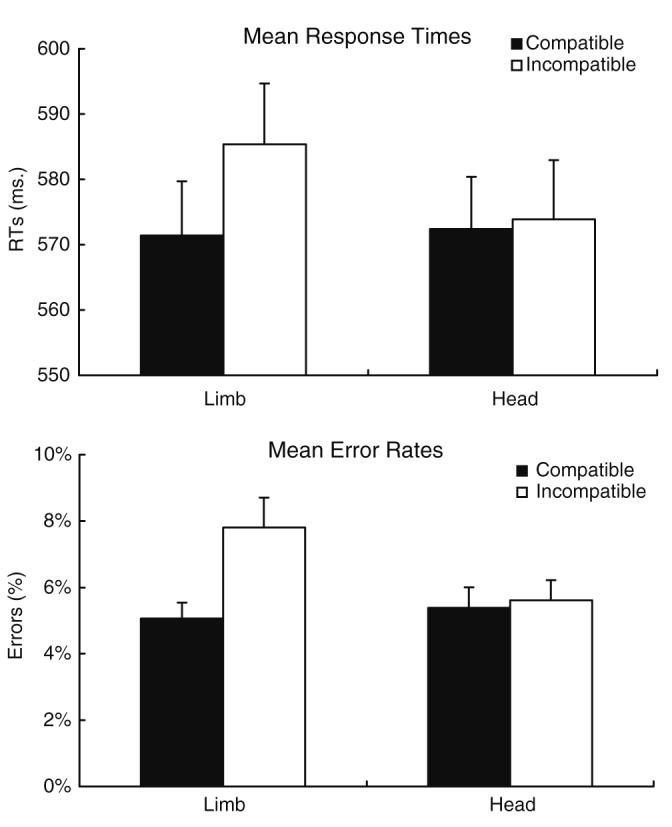
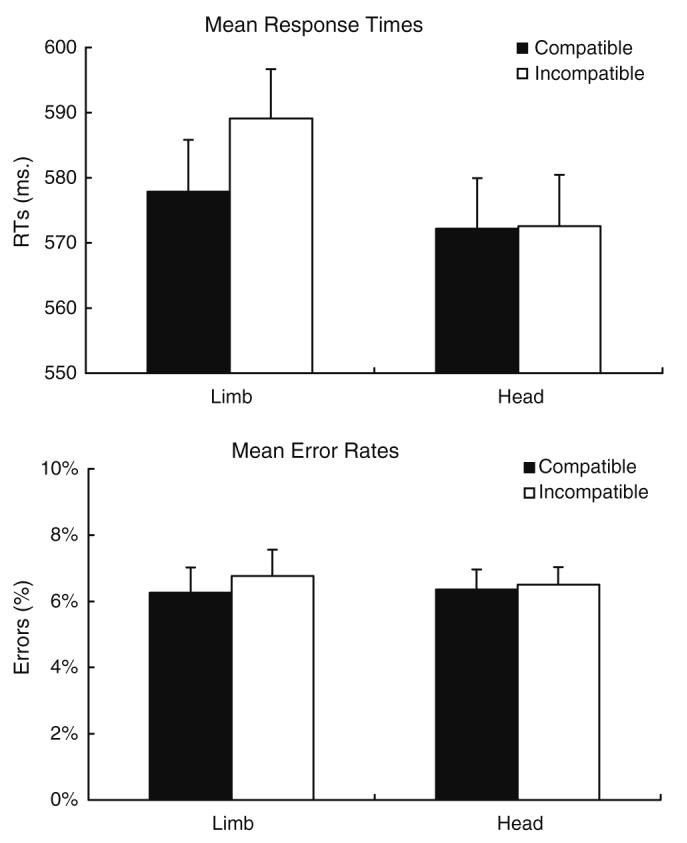
Humans use the same representations to code self-produced and observed actions. Neurophysiological evidence for this view comes from the discovery of the so-called mirror neurons in premotor cortex of the macaque monkey. These neurons respond when the monkey performs a particular action but also when it observes the same behavior in another individual. In humans, such direct links between perception and action seem to mediate action priming, where a response is facilitated when a similar action is observed. An issue that has not been fully resolved concerns the role of selective attention in these processes. Action priming appears to be an automatic process in the sense that the observed action can be irrelevant to the observer's task and nevertheless prime similar responses. However, it is not known whether attention has to be oriented to the action for these processes to be engaged. It is demonstrated here that spatial attention indeed has to be oriented to the action related body site for action priming to take place. Furthermore, if attention is oriented to the appropriate body site, there need be no visual cues to action for action priming to emerge.
Figures
References
-
- Arbib MA. From monkey-like action recognition to human language: an evolutionary framework for neurolinguistics. Behav Brain Sci. 2005;28(2):105–124. - PubMed
-
- Barsalou LW, Niedenthal PM, Barbey A, Ruppert J. Social embodiment. In: Ross B, editor. The psychology of learning and motivation. Vol. 43. San Diego: Academic; 2003. pp. 43–92.
-
- Bernieri FJ. Coordinated movement and rapport in teacher-student interactions. J Nonverbal Behav. 1988;12:120–138.
-
- Brass M, Bekkering H, Wohlschläger A, Prinz W. Compatibility between observed and executed finger movements: comparing symbolic, spatial and imitative cues. Brain Cogn. 2000;44:124–143. - PubMed
Publication types
MeSH terms
Grants and funding
LinkOut - more resources
Full Text Sources
