


Association of putative enteroaggregative Escherichia coli virulence genes and biofilm production in isolates from travelers to developing countries
- PMID: 17093030
- PMCID: PMC1828990
- DOI: 10.1128/JCM.01128-06
Association of putative enteroaggregative Escherichia coli virulence genes and biofilm production in isolates from travelers to developing countries
Abstract
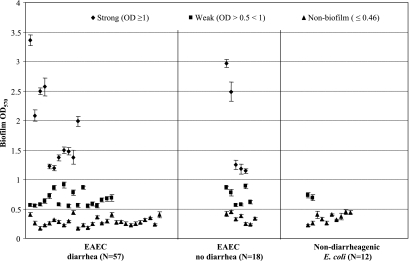
Enteroaggregative Escherichia coli (EAEC) is an emerging enteric pathogen that causes acute and chronic diarrhea among children, human immunodeficiency virus-infected patients, and travelers to developing regions of the world. The pathogenesis of EAEC strains involves the production of biofilm. In this study, we determined the association between presence of putative EAEC virulence genes and biofilm formation in 57 EAEC isolates (as defined by HEp-2 adherence) from travelers with diarrhea and in 18 EAEC isolates from travelers without diarrhea. Twelve nondiarrheagenic E. coli isolates from healthy travelers were used as controls. Biofilm formation was measured by using a microtiter plate assay with the crystal violet staining method, and the presence of the putative EAEC virulence genes aap, aatA, aggR, astA, irp2, pet, set1A, and shf was determined by PCR. EAEC isolates were more likely to produce biofilm than nondiarrheagenic E. coli isolates (P = 0.027), and the production of biofilm was associated with the virulence genes aggR, set1A, aatA, and irp2, which were found in 16 (40%), 17 (43%), 10 (25%), and 27 (68%) of the biofilm producers versus only 4 (11%), 6 (6%), 2 (6%), and 15 (43%) in non-biofilm producers (P = 0.008 for aggR, P = 0.0004 for set1A, P = 0.029 for aatA, and P = 0.04 for irp2). Although the proportion of EAEC isolates producing biofilm in patients with diarrhea (51%) was similar to that in patients without diarrhea (61%), biofilm production was related to the carriage of aggR (P = 0.015), set1A (P = 0.001), and aatA (P = 0.025). Since aggR is a master regulator of EAEC, the presence of aap (P = 0.004), astA (P = 0.001), irp2 (P = 0.0006), pet (P = 0.002), and set1A (P = 0.014) in an aggR versus an aggR-lacking background was investigated and was also found to be associated with biofilm production. This study suggests that biofilm formation is a common phenomenon among EAEC isolates derived from travelers with or without diarrhea and that multiple genes associated with biofilm formation are regulated by aggR.
Figures

References
-
- Adachi, J. A., C. D. Ericsson, Z. D. Jiang, M. W. DuPont, S. R. Pallegar, and H. L. DuPont. 2002. Natural history of enteroaggregative and enterotoxigenic Escherichia coli infection among US travelers to Guadalajara, Mexico. J. Infect. Dis. 185:1681-1683. - PubMed
-
- Adachi, J. A., Z. D. Jiang, J. J. Mathewson, M. P. Verenkar, S. Thompson, F. Martinez-Sandoval, R. Steffen, C. D. Ericsson, and H. L. DuPont. 2001. Enteroaggregative Escherichia coli as a major etiologic agent in traveler's diarrhea in 3 regions of the world. Clin. Infect. Dis. 32:1706-1709. - PubMed
-
- Bhardwaj, R., S. Majumdar, N. K. Ganguly, N. Taneja, S. Dutta, T. Ramamurthy, and A. Chakraborti. 2006. Characterization of adhesin variants in Indian isolates of enteroaggregative Escherichia coli. FEMS Microbiol. Lett. 258:274-283. - PubMed
-
- Clarke, S. C. 2001. Diarrhoeagenic Escherichia coli: an emerging problem? Diagn. Microbiol. Infect. Dis. 41:93-98. - PubMed
-
- Cohen, M. B., J. P. Nataro, D. I. Bernstein, J. Hawkins, N. Roberts, and M. A. Staat. 2005. Prevalence of diarrheagenic Escherichia coli in acute childhood enteritis: a prospective controlled study. J. Pediatr. 146:54-61. - PubMed
Publication types
MeSH terms
Substances
Grants and funding
LinkOut - more resources
Full Text Sources
Other Literature Sources
Medical
Miscellaneous
