


Broad-spectrum effects of 4-aminopyridine to modulate amyloid beta1-42-induced cell signaling and functional responses in human microglia
- PMID: 17093087
- PMCID: PMC6674791
- DOI: 10.1523/JNEUROSCI.2490-06.2006
Broad-spectrum effects of 4-aminopyridine to modulate amyloid beta1-42-induced cell signaling and functional responses in human microglia
Abstract
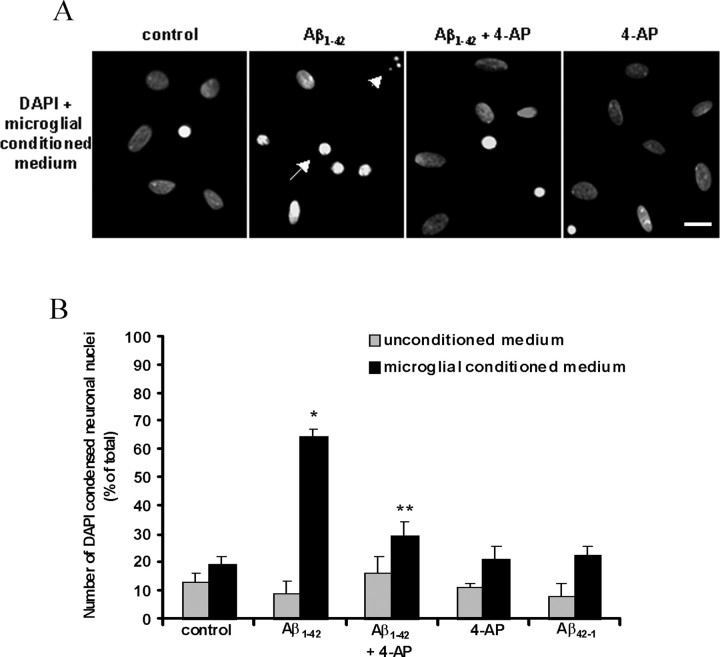
We investigated the modulating actions of the nonselective K(+) channel blocker 4-aminopyridine (4-AP) on amyloid beta (Abeta(1-42))-induced human microglial signaling pathways and functional processes. Whole-cell patch-clamp studies showed acute application of Abeta(1-42) (5 mum) to human microglia led to rapid expression of a 4-AP-sensitive, non-inactivating outwardly rectifying K(+) current (I(K)). Intracellular application of the nonhydrolyzable analog of GTP, GTPgammaS, induced an outward K(+) current with similar properties to the Abeta(1-42)-induced I(K) including sensitivity to 4-AP (IC(50) = 5 mm). Reverse transcriptase-PCR showed a rapid expression of a delayed rectifier Kv3.1 channel in Abeta(1-42)-treated microglia. Abeta(1-42) peptide also caused a slow, progressive increase in levels of [Ca(2+)](i) (intracellular calcium) that was partially blocked by 4-AP. Chronic exposure of human microglia to Abeta(1-42) led to enhanced p38 mitogen-activated protein kinase and nuclear factor kappaB expression with factors inhibited by 4-AP. Abeta(1-42) also induced the expression and production of the pro-inflammatory cytokines interleukin (IL)-1beta, IL-6, and tumor necrosis factor-alpha, the chemokine IL-8, and the enzyme cyclooxygenase-2; 4-AP was effective in reducing all of these pro-inflammatory mediators. Additionally, toxicity of supernatant from Abeta(1-42)-treated microglia on cultured rat hippocampal neurons was reduced if 4-AP was included with peptide. In vivo, injection of Abeta(1-42) into rat hippocampus induced neuronal damage and increased microglial activation. Daily administration of 1 mg/kg 4-AP was found to suppress microglial activation and exhibited neuroprotection. The overall results suggest that 4-AP modulation of an Abeta(1-42)-induced I(K) (candidate channel Kv3.1) and intracellular signaling pathways in human microglia could serve as a therapeutic strategy for neuroprotection in Alzheimer's disease pathology.
Figures



References
-
- Akiyama H, Barger S, Barnum S, Bradt B, Bauer J, Cole GM, Cooper NR, Eikelenboom P, Emmerling M, Fiebich BL, Finch CE, Frautschy S, Griffin WS, Hampel H, Hull M, Landreth G, Lue L, Mrak R, MacKenzie IR, McGeer PL, et al. Inflammation and Alzheimer's disease. Neurobiol Aging. 2000;21:383–421. - PMC - PubMed
-
- Arends YM, Duyckaerts C, Rozemuller JM, Eikelenboom P, Hauw JJ. Microglia, amyloid and dementia in Alzheimer disease. A correlative study. Neurobiol Aging. 2000;21:39–47. - PubMed
-
- Boland K, Behrens M, Choi D, Manias K, Perlmutter DH. The serpin-enzyme complex receptor recognizes soluble, nontoxic amyloid-beta peptide but not aggregated, cytotoxic amyloid-beta peptide. J Biol Chem. 1996;271:18032–18044. - PubMed
Publication types
MeSH terms
Substances
LinkOut - more resources
Full Text Sources
Research Materials
Miscellaneous
