


Total-body skeletal muscle mass: estimation by dual-energy X-ray absorptiometry in children and adolescents
- PMID: 17093152
- PMCID: PMC2747777
- DOI: 10.1093/ajcn/84.5.1014
Total-body skeletal muscle mass: estimation by dual-energy X-ray absorptiometry in children and adolescents
Abstract
Background: Skeletal muscle (SM) is an important compartment but is difficult to quantify in children and adolescents.
Objective: We investigated the potential of dual-energy X-ray absorptiometry (DXA) for measuring total-body SM in pediatric subjects.
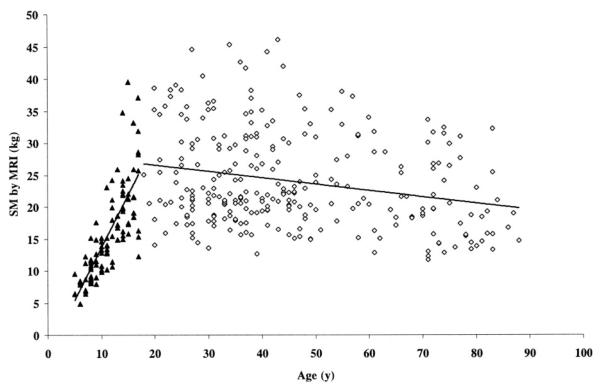
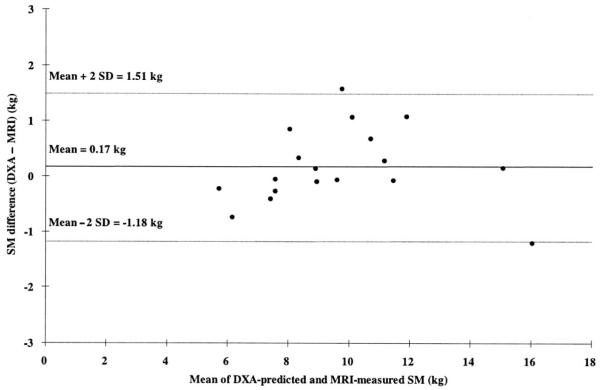
Design: A previously published adult DXA SM prediction formula was evaluated in children and adolescents aged 5-17 y (n = 99) who varied in pubertal maturation stage. SM estimated by whole-body magnetic resonance imaging (MRI) was used as the reference. The adult SM model was not accurate for subjects below Tanner stage 5 (n = 65; aged 5-14 y). New pediatric SM prediction models were therefore developed and validated in a separate group (n = 18).
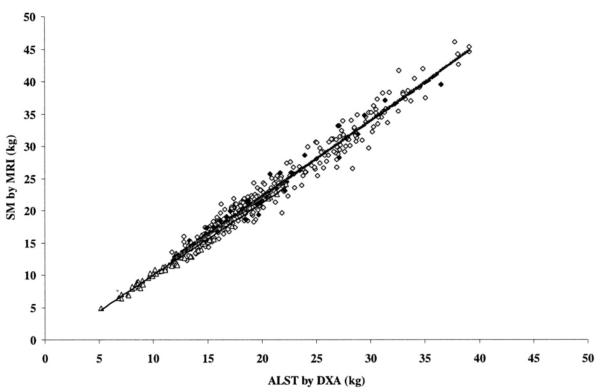
Results: The adult DXA SM prediction model was valid in subjects at Tanner stage 5 but significantly (P < 0.001) overestimated SM in subjects below Tanner stage 5. New SM prediction formulas were developed with appendicular lean soft tissue (ALST) estimates by DXA as the main predictor variable (eg, model 1, ALST alone: R(2) = 0.982, SEE = 0.565 kg, P < 0.001). The new models were validated by the leave-one-out method and were cross-validated in a separate validation group.
Conclusions: A previously reported adult DXA SM prediction model is applicable in children and adolescents late in pubertal development (Tanner stage 5). A new DXA SM prediction model was developed for prepubertal and pubertal subjects (Tanner stage </=4) aged >/=5 y. DXA thus provides an important opportunity for quantifying total-body SM mass across most of the human life span.
Figures
References
-
- Kanehisa H, Ikegawa S, Tsunoda N, Fukunaga T. Cross-sectional areas of fat and muscle in limbs during growth and middle age. Int J Sports Med. 1994;15:420–5. - PubMed
-
- Kanehisa H, Yata H, Ikegawa S, Fukunaga T. A cross-sectional study of the size and strength of the lower leg muscles during growth. Eur J Appl Physiol Occup Physiol. 1995;72:150–6. - PubMed
-
- Malina RM. Growth of muscle tissue and muscle mass. In: Falkner F, Tanner JM, editors. Human growth: a comprehensive treatise. Plenum Press; New York, NY: 1986.
-
- Malina RM, Bouchard C. Growth, maturation, and physical activity. Human Kinetics; Champaign, IL: 1991.
-
- Tanner JM. Growth at adolescence. Blackwell Scientific; Oxford, United Kingdom: 1962.
Publication types
MeSH terms
Grants and funding
LinkOut - more resources
Full Text Sources
Medical
