


Secular trends in patterns of self-reported food consumption of adult Americans: NHANES 1971-1975 to NHANES 1999-2002
- PMID: 17093177
- PMCID: PMC1785328
- DOI: 10.1093/ajcn/84.5.1215
Secular trends in patterns of self-reported food consumption of adult Americans: NHANES 1971-1975 to NHANES 1999-2002
Abstract
Background: The contributors to trends in increasing prevalence of obesity in the US population are poorly understood.
Objective: We examined secular trends in food consumption behaviors to understand their possible contribution to increasing energy intakes and adiposity in the American population.
Design: We used dietary data from 4 consecutive National Health and Nutrition Examination Surveys (NHANES) to examine trends (1971-2002) in frequency of eating episodes, meal and snack consumption, quantity of food consumed, and the energy density of foods reported by adult Americans (n = 39 094). Logistic and linear regression methods were used to adjust for multiple covariates and survey design.
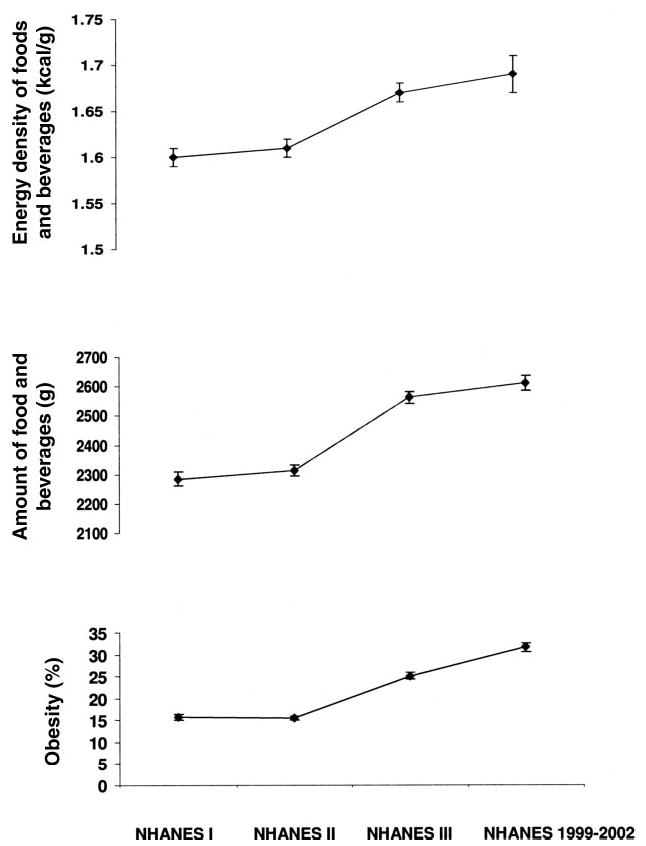
Results: The reported number of all eating episodes increased slightly in women from 4.90 in 1971-1975 to 5.04 in 1999-2002 (P for trend = 0.002). The amount (in g) of foods and beverages consumed, the energy density of foods, and energy intake per eating episode increased, but the mention of breakfast declined in both sexes (P for trend < 0.0001). The observed trends in mention of a snack (in men) and percentage of energy from evening food intake (in women) were downward. The amount (in g) of foods and their energy density were independent positive correlates of obesity in combined data from all surveys (P for trend < 0.0001).
Conclusions: Our results do not support large increases in eating frequency, snacking, or evening eating by the American population from 1971 to 2002. The quantity of foods and their energy density increased beginning in NHANES III (1988-1994) with trajectories roughly parallel to the rates of prevalence of obesity in the US population. However, we urge cautious interpretation of these results because of concurrent changes in dietary methods during this period.
Figures
References
-
- Flegal KM, Carroll MD, Ogden CL, Johnson CL. Prevalence and trends in obesity among US adults, 1999–2000. JAMA. 2002;288:1723–7. - PubMed
-
- Hedley AA, Ogden CL, Johnson CL, Carroll MD, Curtin LR, Flegal KM. Prevalence of overweight and obesity among US children, adolescents, and adults, 1999–2002. JAMA. 2004;291:2847–50. - PubMed
-
- Economic Research Service, US Department of Agriculture. America’s eating habits: changes and consequences. Washington, DC: USDA/Economic Research Service; 1999.
-
- Wright JD, Kennedy-Stephenson J, Wang CY, McDowell MA, Johnson CL. Trends in intake of energy and macronutrients–United States, 1971–2000. MMWR Morb Mortal Wkly Rep. 2004;53:80–2. - PubMed
-
- McCrory MA, Suen VMM, Roberts SB. Biobehavioral influences on energy intake and adult weight gain. J Nutr. 2002;132(suppl):3830–4S. - PubMed
Publication types
MeSH terms
Grants and funding
LinkOut - more resources
Full Text Sources
Medical
