. 2006 Nov 10;2(11):e169.
doi: 10.1371/journal.pgen.0020169. Epub 2006 Aug 28.

Harnessing a high cargo-capacity transposon for genetic applications in vertebrates

Affiliations

Harnessing a high cargo-capacity transposon for genetic applications in vertebrates

Darius Balciunas et al. PLoS Genet. .

Abstract

Viruses and transposons are efficient tools for permanently delivering foreign DNA into vertebrate genomes but exhibit diminished activity when cargo exceeds 8 kilobases (kb). This size restriction limits their molecular genetic and biotechnological utility, such as numerous therapeutically relevant genes that exceed 8 kb in size. Furthermore, a greater payload capacity vector would accommodate more sophisticated cis cargo designs to modulate the expression and mutagenic risk of these molecular therapeutics. We show that the Tol2 transposon can efficiently integrate DNA sequences larger than 10 kb into human cells. We characterize minimal sequences necessary for transposition (miniTol2) in vivo in zebrafish and in vitro in human cells. Both the 8.5-kb Tol2 transposon and 5.8-kb miniTol2 engineered elements readily function to revert the deficiency of fumarylacetoacetate hydrolase in an animal model of hereditary tyrosinemia type 1. Together, Tol2 provides a novel nonviral vector for the delivery of large genetic payloads for gene therapy and other transgenic applications.


Conflict of interest statement

Competing interests. We note that the University of Minnesota and PBH, RSM, DAL, and SCE are all founders of a gene therapy company called Discovery Genomics, Incorporated.

Figures
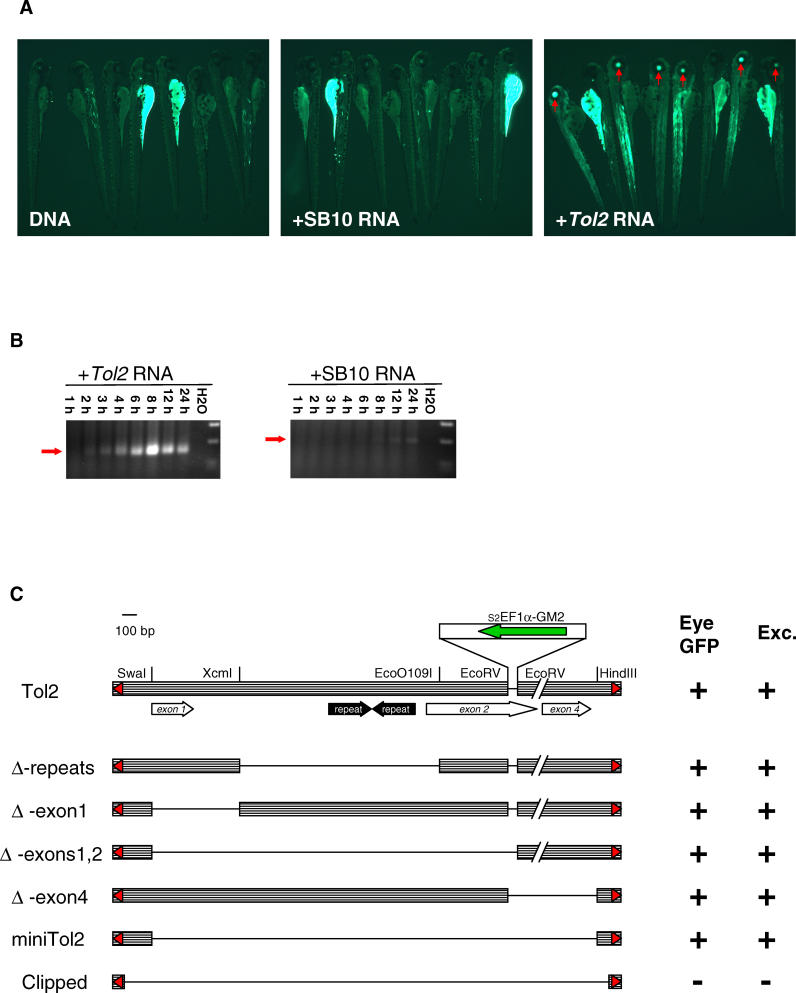
Figure 1
Figure 1. Functional Characterization of Tol2 Transposon Sequences Using a Somatic Transposition Assay in Zebrafish
(A) Visualization of Tol2-mediated somatic transposition in zebrafish (see somatic transposition assay in Materials and Methods). Left, Injection of transposon DNA alone results in a highly mosaic expression pattern with fewer than 5% of the animals displaying eye expression [13,50]. Middle, Injection of SB transposase RNA does not significantly alter this somatic gene transfer distribution [12]. Right, Injection of Tol2 transposase RNA results in gene transfer into the larval eye with over 75% of the injected embryos displaying gene transfer in this tissue at 3 dpf (red arrows). (B) Molecular evidence of rapid Tol2-transposase activity in injected zebrafish embryos. Time-course analysis of excision from injected plasmid DNA [14] was conducted on animals co-injected with a mixture of GFP-marked Tol2 (pTol2/S2EF1a-GM2) and SB (pT2/S2EF1a-GM2 [13] transposons with either Tol2 or SB RNA. Note the kinetic delay in activity maturation by the presumptive obligate tetrameric SB transposase compared to Tol2 (see text). Red arrows indicate the resulting transposase-dependent excision product. (C) Deletion analysis identifies minimal Tol2 sequences required for gene transfer and transposon excision in zebrafish. Zebrafish embryos were injected with depicted deletion constructs and transposase RNA and scored for GFP fluorescence at 3 d postfertilization (eye GFP column). Twenty GFP-positive embryos were used to prepare DNA for excision PCR (Exc. Column). Striped boxes represent Tol2 transposon sequences, with red triangles indicating terminal inverted repeats. Structural elements present in the commonly used Tol2 vector are depicted, with exons shown as open arrows and internal inverted repeats as solid arrows. Restriction enzyme sites are indicated above the transposon drawing.
Figure 2
Figure 2. Large Cargo-Capacity, Tol2-mediated Transposition in Human Cells
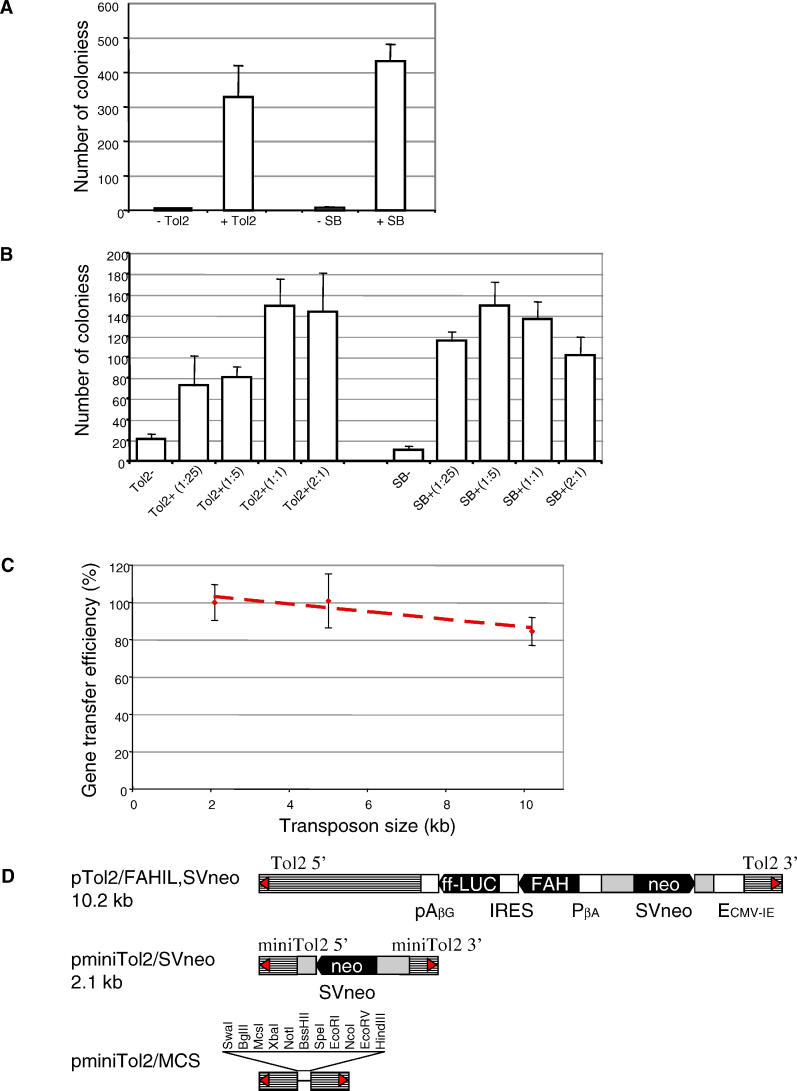
(A) Comparison of Tol2 and SB transposons in G418-resistant colony-forming assay in HeLa cells. SB (pT2/SVneo) and Tol2 (pTol2/SVneo) transposons with corresponding transposase-coding plasmids (pCMV-SB10 or pCMV-Tol2) were transfected into HeLa cells under conditions optimized for SB [8]. Transposon plasmid amounts were adjusted to be in equal molar ratio to 500 ng of pT2/SVNeo and the transposase construct amounts were based on 500 ng of pCMV-SB10. For negative control, a CMV-driven GFP plasmid (pGL-1) was used instead of transposase. Three independent preparations of each transposon plasmid were used in each experiment. (B) Tol2-mediated gene transfer activity is a positive function of Tol2 transposase activity. SB (pT2/SVneo [8]) and Tol2 (pTol2/SVneo depicted below the graph) transposons were transfected into HT1080 cells at various ratios of transposon to transposase (pCMV-SB10 [8] and pCMV-Tol2, respectively). For control experiments, pCMV-GFP plasmid was used. Total number of G418-resistant colonies per plate is plotted on the y-axis with error bars representing standard error of the mean of three transfection plates. In the transposon depiction below the graph, Tol2 sequences are shown as striped boxes with terminal inverted repeats indicated by red triangles. (C) Tol2 gene transfer efficiencies as a function of cargo-capacity. x-axis, transposon size in kilobases; y-axis, relative efficiency. Tol2 transposons of different sizes (2.1 kb, miniTol2/SVneo; 5.0 kb, Tol2/SVneo; 10.2 kb, Tol2/SVneo,FAHIL; two of them depicted below the graph) were transfected into HT1080 cells and selected for G418 resistance. The number of colonies obtained using each transposon was determined, and relative efficiency was calculated as percentage activity compared to miniTol2/SVneo ± standard error (n = 3). Red line represents a linear interpolation of activity as a function of Tol2 transposon size. (D) Tol2 transposon constructs. Top, pTol2/FAHIL,SVneo. ECMV-IE is CMV immediate-early enhancer (open box), PβG is the chicken beta globin promoter (open box), pAβG is rabbit beta globin polyA, and IRES is encephalomyocarditis virus internal ribosome entry site (open box). Middle, pminiTol2/SVneo. Bottom depiction, miniTol2 vector with multiple cloning site (MCS) designed to facilitate use of this vector by the genetics community.
Figure 3
Figure 3. Tol2-Mediated, Long-term Expression and Gene Correction of Murine Model of Tyrosinemia Type 1
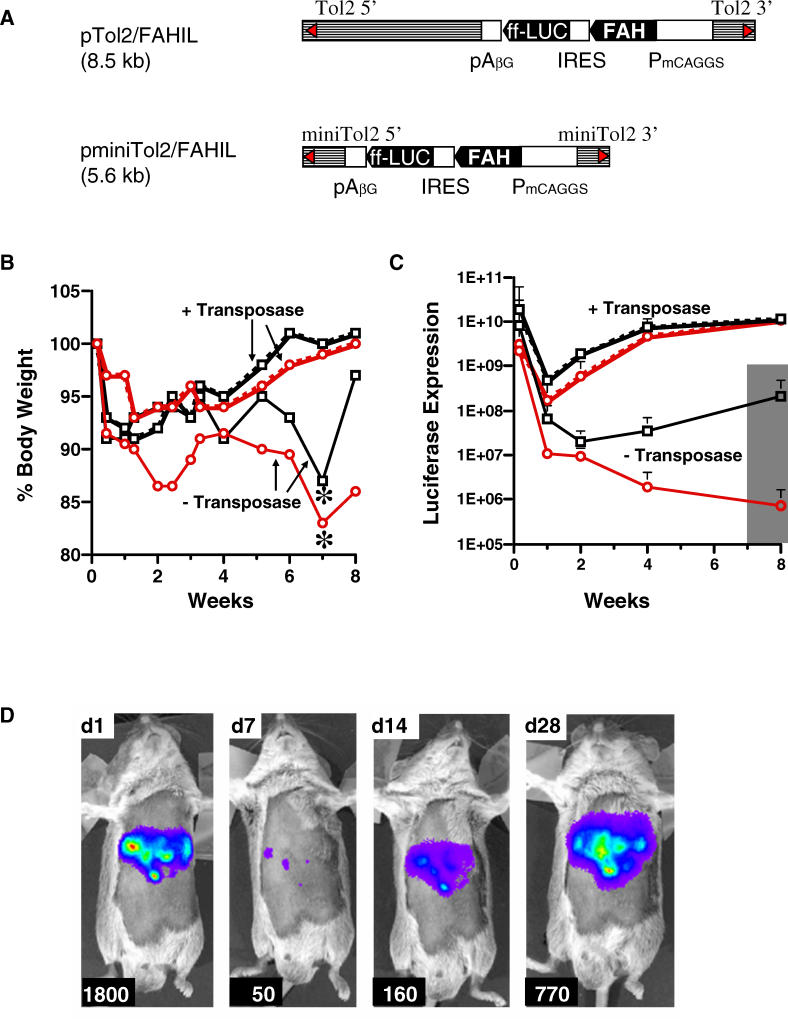
(A) Schematic diagram of Tol2 transposons used for injections of FAH-deficient mice. The full-length (pTol2/FAHIL) and minimal (pminiTol2/FAHIL) versions of the transposon provide expression of both FAH and luciferase as products of a single message; pCMV-GFP served as a co-delivered control plasmid while pCMV-Tol2 provided a source of transposase protein. PmCAGGS [51], minimal chimeric CMV enhancer/chicken beta-actin fusion promoter; pAβG, rabbit beta-globin poly(A); ff-LUC, firefly luciferase; FAH, mouse fumarylacetoactate hydrolase cDNA; IRES, encephalomyocarditis virus internal ribosome entry site. Then 10 mg of pTol2/FAHIL or pminiTol2/FAHIL transposon DNA plus pCMV-GFP or -Tol2 (10 mg each) was administered by rapid, high-volume tail vein injection into sedated FAH-deficient mice (n = 3 to 5 per group). (B) The mean percentage body weight for animals in each treatment group, to determine the progression of liver disease. An asterisk (*) indicates the time when NTBC was readministered in drinking water to prevent mortality of mice that did not receive Tol2 transposase. (C) In vivo luciferase activity levels, assayed at indicated time points by whole body imaging and recorded as photons emitted per second as described in Materials and MethodsMaterials and Methods. The time courses of changes in body weight or in vivo luciferase enzyme activity are shown for groups of animals co-infused with pTol2/FAHIL and GFP (squares) or Tol2 transposase (circles), or with pminiTol2/FAHIL plus GFP (triangles) or Tol2 transposase (plus sign). The mean percentage luciferase activity at any given time point is relative to that observed at 24 h for pminiTol2/FAHIL, which demonstrated the highest transient level of luciferase activity. The 8-wk measurement of no-transposase control animals is shaded because they required administration of NTBC for survival at 7 wk. (D) Images of mice infused with pminiTol2/FAHIL plus pCMV-Tol2 at indicated times (in days; upper left box), showing tissue regeneration as seen by increasing intensity of luciferase enzyme activity detected at a location corresponding to the liver. In vivo luciferase activity levels are reported at the bottom of each image (lower left box) as photons emitted per second (×106).

References

    1. Koga A, Hori H. The Tol2 transposable element of the medaka fish: An active DNA-based element naturally occurring in a vertebrate genome. Genes Genet Syst. 2001;76:1–8. - PubMed
    1. Koga A, Suzuki M, Inagaki H, Bessho Y, Hori H. Transposable element in fish. Nature. 1996;383:30. - PubMed
    1. Kawakami K, Koga A, Hori H, Shima A. Excision of the tol2 transposable element of the medaka fish, Oryzias latipes, in zebrafish, Danio rerio . Gene. 1998;225:17–22. - PubMed
    1. Ivics Z, Hackett PB, Plasterk RH, Izsvak Z. Molecular reconstruction of Sleeping Beauty, a Tc1-like transposon from fish, and its transposition in human cells. Cell. 1997;91:501–510. - PubMed
    1. Miskey C, Izsvak Z, Plasterk RH, Ivics Z. The Frog Prince: A reconstructed transposon from Rana pipiens with high transpositional activity in vertebrate cells. Nucleic Acids Res. 2003;31:6873–6881. - PMC - PubMed

Publication types

Substances