. 2006 Dec 29;351(4):883-9.
doi: 10.1016/j.bbrc.2006.10.102. Epub 2006 Oct 30.

Nrf2-dependent protection from LPS induced inflammatory response and mortality by CDDO-Imidazolide

Affiliations

Nrf2-dependent protection from LPS induced inflammatory response and mortality by CDDO-Imidazolide

Rajesh K Thimmulappa et al. Biochem Biophys Res Commun. .

Abstract

Sepsis induced lethality is characterized by amplified host innate immune response. Nrf2, a bZIP transcription factor, regulates a battery of cellular antioxidative genes and maintains cellular redox homeostasis. This study demonstrates that increasing Nrf2 activity by a potent small molecule activator, CDDO-Im (1-[2-cyano-3-,12-dioxooleana-1,9(11)-dien-28-oyl]imidazole), protects from deregulation of lipopolysaccharide (LPS) induced innate immune response. In response to LPS stimuli, nrf2-deficient (nrf2 -/-) peritoneal neutrophils showed increased NADPH oxidase-dependent ROS generation, proinflammatory cytokines (Tnf-alpha and Il-6) and chemokines (Mip2 and Mcp-1) relative to wild-type (nrf2 +/+) cells. Pretreatment of peritoneal neutrophils with CDDO-Im induced antioxidative genes (Ho-1, Gclc, Gclm, and Nqo1) and attenuated LPS induced ROS generation as well as expression of proinflammatory cytokines exclusively in nrf2 +/+ neutrophils but not in nrf2 -/- cells. In corroboration with in vitro studies, pretreatment with CDDO-Im induced Nrf2-dependent antioxidative genes, attenuated LPS induced proinflammatory cytokine expression, and decreased mortality specifically in the nrf2 +/+ mice. In conclusion, the results suggest that Nrf2 is associated with oxidative regulation of LPS induced innate immune response in neutrophils. Activation of Nrf2-dependent compensatory antioxidative pathways by CDDO-Im protects from LPS induced inflammatory response and mortality.


Figures
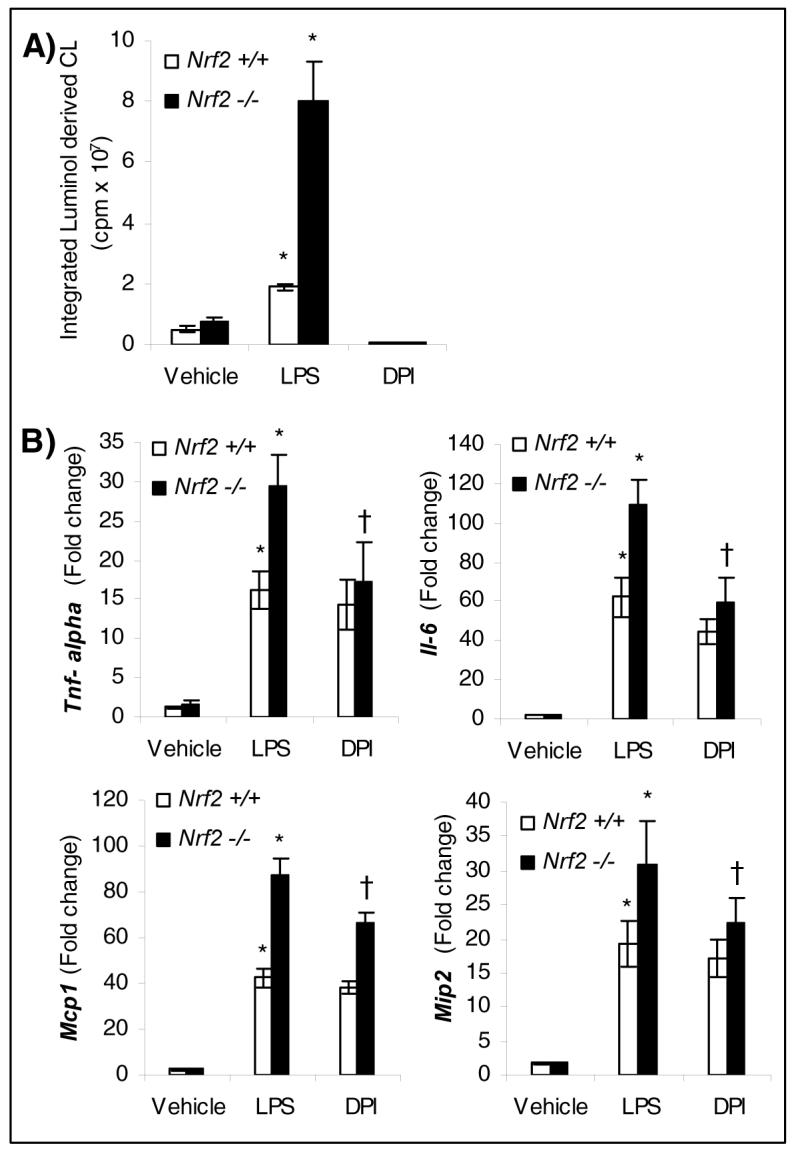
Fig.1
Fig.1
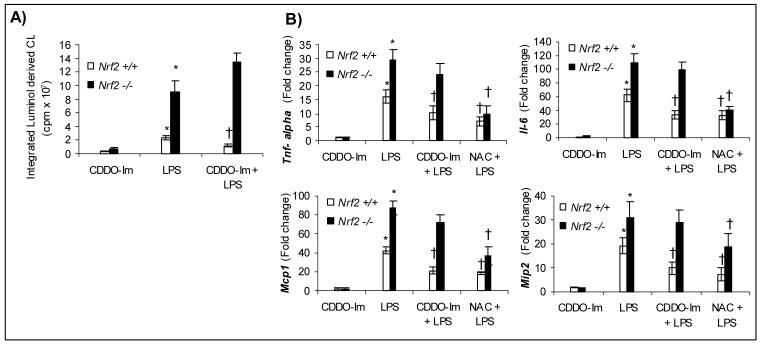
Elevated levels of ROS and proinflammatory cytokines and chemokines in nrf2-deficient neutrophils in response to LPS stimulus. A) ROS levels in nrf2 +/+ and nrf2 −/− neutrophils stimulated either with vehicle or LPS (100 ng/ml) for 1 h. Each bar is the mean ± SD (n=3) of values presenting the integration of the area under curve expressed in counts. The luminol-dependent chemiluminescence of untreated cells is at the level of the instrument background. B) mRNA expression by QPCR of cytokines (Tnf-α and Il-6) and chemokines (Mcp-1 and Mip2) in nrf2 +/+ and nrf2 −/− neutrophils 3 h after LPS stimulation (100 ng/ml). For inhibiting NADPH oxidase, cells were pretreated with DPI (10 μM) for 20 min, before stimulating with LPS. Data represented are mean fold change ± SD, n=3. * Differs from vehicle control of the same genotype; †differs from LPS treated of the same genotype.
Fig 2
Fig 2
CDDO-Im pretreatment attenuates LPS induced ROS levels as well as expression of cytokines (Tnf-α, Il-6) and chemokines (Mcp1, Mip2) exclusively in nrf2 +/+neutrophils. A) LPS induced ROS levels in nrf2 +/+ and nrf2 −/− peritoneal neutrophils pretreated with CDDO-Im. Peritoneal neutrophils were pretreated with CDDO-Im for 12 h and then stimulated either with vehicle or LPS (100 ng/ml). Each bar is the mean ± SD (n=3) of values presenting the integration of the area under curve for 60 min expressed in counts. B) LPS induced cytokines and chemokines expression in nrf2 +/+ and nrf2 −/− peritoneal neutrophils pretreated with CDDO-Im and or NAC. Peritoneal neutrophils were pretreated either with CDDO-Im or NAC for 12 h then stimulated either with vehicle and or LPS (100 ng/ml) for 3 h. Data presented are mean fold change ± SD (n=3). * Differs from vehicle control of the same genotype; †, differs from LPS treated of the same genotype (P<0.05).
Fig. 3
Fig. 3
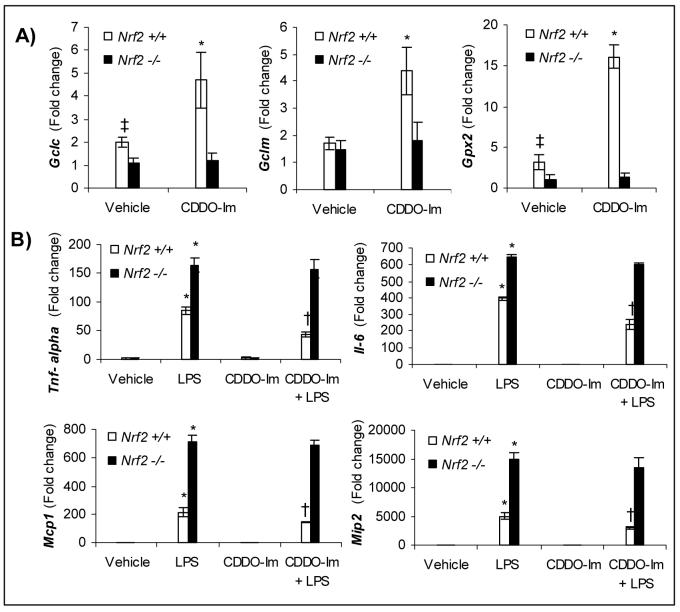
CDDO-Im pretreatment attenuates LPS shock induced expression of cytokines and chemokines by up-regulating antioxidative genes specifically in the lungs of nrf2 +/+, but not nrf2 −/− mice A) mRNA levels of Gclc, Gclm, and Gpx2 in the lungs of nrf2 +/+ and nrf2 −/− mice after treatment with CDDO-Im. Mice were treated with 3 doses of CDDO-Im (3 μmol/kg bodyweight) 24 h apart by intraperitoneal injection. Lungs were isolated 6 h after the last dose of CDDO-Im. The fold change was calculated using the formula described in methods. Data presented is mean fold change ± SD (n=3). B) LPS induced mRNA expression of cytokines (Tnf-α and Il-6) and chemokines (Mcp1 and Mip2) in the lung of nrf2 +/+ and nrf2 −/− mice pretreated with 3 doses of CDDO-Im. Mice were treated with 3 doses of CDDO-Im (3 μmol/kg bodyweight) 24 h apart by intraperitoneal injection. A lethal dose of LPS (50 mg/kg bodyweight) was administered peritoneally 6 h after the last dose of CDDO-Im. Lungs were isolated for measuring cytokine expression 1 h after LPS treatment. Data represented are mean fold change ± SD (n=3). * Differs from vehicle control of the same genotype; †, differs from LPS treated of the same genotype (P<0.05).
Fig. 4
Fig. 4
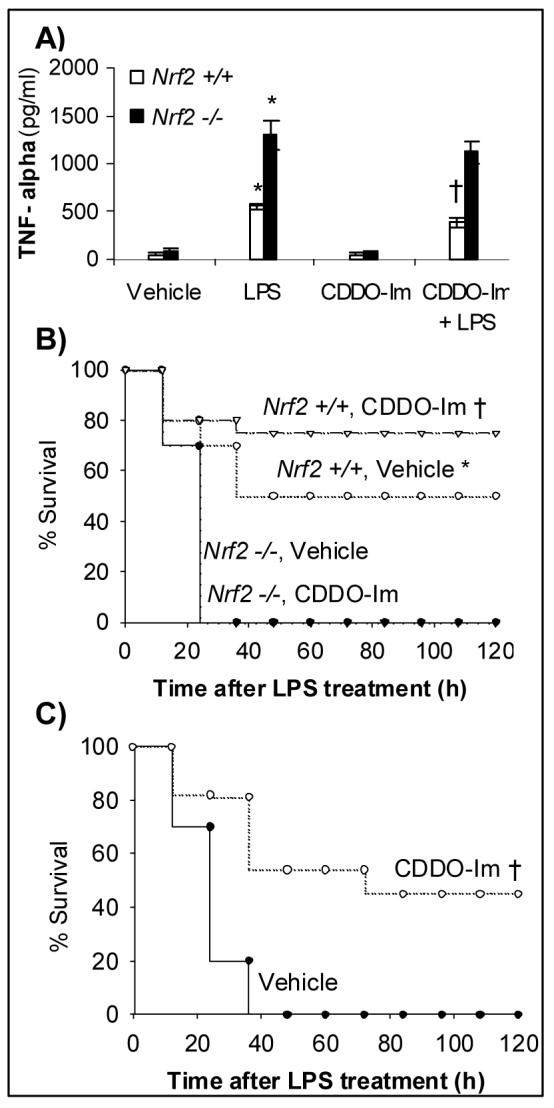
CDDO-Im pretreatment protects nrf2 +/+ mice mortality from LPS induced septic shock mortality. A) Serum TNF-α levels in CDDO-Im pretreated nrf2 +/+ and nrf2 −/− mice after 1 h of LPS challenge. Data represented are mean ± SD, n=5. B) Mortality after LPS administration in nrf2 +/+ and nrf2 −/− mice. Age-matched male nrf2 +/+ (n=10) and nrf2 −/− mice (n=10) were either pretreated with 3 doses of vehicle or CDDO-Im (3 μmol/kg bodyweight) 24 h apart followed by single intraperitoneal injection of LPS at a dose of 50 mg/kg bodyweight. C) Protection of nrf2 +/+ mice pretreated with CDDO-Im after a higher dose of LPS administration. Nrf2 +/+ (n=10) were either pretreated with 3 doses of vehicle or CDDO-Im (3 μmol/kg bodyweight) 24 h apart followed by single intraperitoneal injection of LPS at a dose of 60 mg/kg bodyweight. Mortality was monitored every 12 h for 5 days.*, Nrf2 +/+ mice had improved survival compared to nrf2 −/− mice †, Nrf2 +/+ mice pretreated with CDDO-Im had improved survival compared to vehicle pretreated mice (P<0.05).

References

    1. Cohen J. The immunopathogenesis of sepsis. Nature. 2002;420:885–891. - PubMed
    1. DeLeo FR, Renee J, McCormick S, Nakamura M, Apicella M, Weiss JP, Nauseef WM. Neutrophils exposed to bacterial lipopolysaccharide upregulate NADPH oxidase assembly. J Clin Invest. 1998;101:455–463. - PMC - PubMed
    1. Matsuzawa A, Saegusa K, Noguchi T, Sadamitsu C, Nishitoh H, Nagai S, Koyasu S, Matsumoto K, Takeda K, Ichijo H. ROS-dependent activation of the TRAF6-ASK1-p38 pathway is selectively required for TLR4-mediated innate immunity. Nat Immunol. 2005;6:587–592. - PubMed
    1. Nakahira K, Kim HP, Geng XH, Nakao A, Wang X, Murase N, Drain PF, Sasidhar M, Nabel EG, Takahashi T, Lukacs NW, Ryter SW, Morita K, Choi AM. Carbon monoxide differentially inhibits TLR signaling pathways by regulating ROS-induced trafficking of TLRs to lipid rafts. J Exp Med. 2006;203:2377–2389. - PMC - PubMed
    1. Powers KA, Szaszi K, Khadaroo RG, Tawadros PS, Marshall JC, Kapus A, Rotstein OD. Oxidative stress generated by hemorrhagic shock recruits Toll-like receptor 4 to the plasma membrane in macrophages. J Exp Med. 2006;203:1951–1961. - PMC - PubMed

Publication types

MeSH terms