. 2007 Feb;189(3):860-71.
doi: 10.1128/JB.01394-06. Epub 2006 Nov 10.

Functional analysis of luxS in the probiotic strain Lactobacillus rhamnosus GG reveals a central metabolic role important for growth and biofilm formation

Affiliations

Functional analysis of luxS in the probiotic strain Lactobacillus rhamnosus GG reveals a central metabolic role important for growth and biofilm formation

Sarah Lebeer et al. J Bacteriol. 2007 Feb.

Abstract

Quorum sensing is involved in the regulation of multicellular behavior through communication via small molecules. Given the high number and diversity of the gastrointestinal microbiota, it is postulated that members of this community communicate to coordinate a variety of adaptive processes. AI-2 is suggested to be a universal bacterial signaling molecule synthesized by the LuxS enzyme, which forms an integral part of the activated methyl cycle. We have previously reported that the well-documented probiotic strain Lactobacillus rhamnosus GG, a human isolate, produces AI-2-like molecules. In this study, we identified the luxS homologue of L. rhamnosus GG. luxS seems to be located in an operon with a yxjH gene encoding a putative cobalamin-independent methionine synthase. In silico analysis revealed a methionine-specific T box in the leader sequence of the putative yxjH-luxS operon. However, transcriptional analysis showed that luxS is expressed mainly as a monocistronic transcript. Construction of a luxS knockout mutant confirmed that the luxS gene is responsible for AI-2 production in L. rhamnosus GG. However, this mutation also resulted in pleiotropic effects on the growth of this fastidious strain. Cysteine, pantothenate, folic acid, and biotin could partially complement growth, suggesting a central metabolic role for luxS in L. rhamnosus GG. Interestingly, the luxS mutant also showed a defect in monospecies biofilm formation. Experiments with chemically synthesized (S)-4,5-dihydroxy-2,3-pentanedione, coculture with the wild type, and nutritional complementation suggested that the main cause of this defect has a metabolic nature. Moreover, our data indicate that suppressor mutations are likely to occur in luxS mutants of L. rhamnosus GG. Therefore, results of luxS-related studies should be carefully interpreted.


Figures
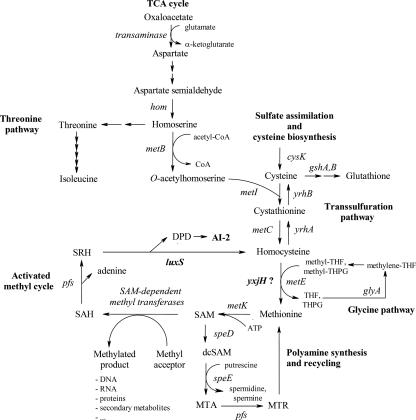
FIG. 1.
FIG. 1.
The activated methyl cycle, biosynthesis of AI-2, and directly coupled metabolic pathways in gram-positive bacteria. AI-2 is produced from SAM, which is essential for a large number of methylation processes and is used for polyamine synthesis, in three enzymatic steps. During various methyltransferase reactions, SAM is converted to SAH. SAH is detoxified by the Pfs enzyme to yield adenine and SRH. LuxS then catalyzes the conversion of SRH, yielding DPD and homocysteine. DPD undergoes spontaneous rearrangements to form AI-2. Homocysteine is used to recycle methionine. Methionine synthase is required by all organisms to ensure the regeneration of the methyl group of SAM. Most gram-positive bacteria contain a cobalamin-independent methionine synthase, MetE, and a YxjH enzyme, which is suggested to be an alternative cobalamin-independent methionine synthase that is mainly involved in the SAM recycling pathway. Methionine is then converted to SAM in a reaction catalyzed by SAM synthetase (MetK). Homocysteine can also be synthesized de novo from oxaloacetate in seven steps as part of the aspartate family. Notably, some organisms, such as L. plantarum and L. salivarius, can synthesize homocysteine from cysteine by direct sulfhydrylation involving the CysK enzyme. Homocysteine can also be converted to cysteine via the reverse transsulfuration pathway. The enzymes cystathionine β-lyase and cystathionine γ-synthase (encoded by metI and metC homologues) require pyridoxal-phosphate as cofactor. These complex branching pathways are coordinated by a variety of regulatory mechanisms, including multivalent feedback inhibition of enzyme activity by more than one end product, “metabolite-sensing” controllers of gene expression such as riboswitches and amino-acid-specific T boxes, and regulatory proteins. Moreover, the scheme presented here is simplified. For example, some gram-positive organisms can use alternative organic and inorganic sulfur sources, and some bacteria use O-succinylhomoserine instead of O-acetylhomoserine in the MetB-catalyzed reaction. Additionally, not all gram-positive bacteria contain the complete set of pathways. The common gene names for B. subtilis and E. coli are used. The pathway was constructed based on previously described data (13, 44), the KEGG PATHWAY website (http://www.genome.jp/kegg/pathway/map/map00271.html), and the LacplantCyc pathway genome database (53). TCA, tricarboxylic acid; MTA, methylthioadenosine; MTR, methylthioribose; THF, tetrahydrofolate; THPG, tetrahydropteroyltriglutamate; dcSAM, decarboxylated SAM.
FIG. 2.
FIG. 2.
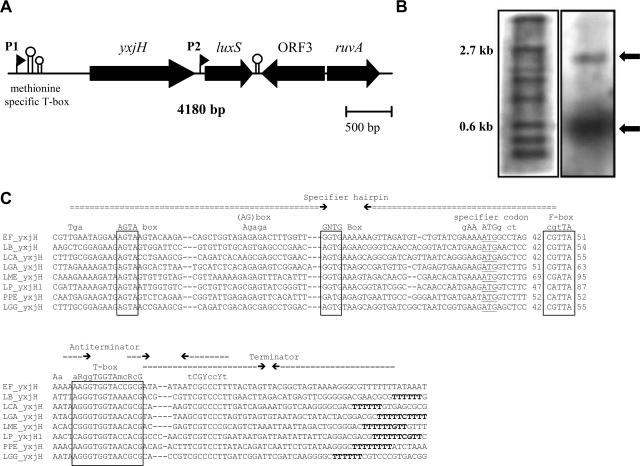
Genomic organization of the L. rhamnosus GG luxS gene. (A) Schematic representation of the relative orientations of the different ORFs within the luxS chromosomal region (4.2 kb) of L. rhamnosus GG as revealed by sequencing and BLAST analysis. The respective gene names are indicated in the figure. ORF3 encodes for a conserved hypothetical protein with unknown function in lactobacilli (see the text). The putative promoters (shown by flags) P1, corresponding to yxjH-luxS cotranscription, and P2, corresponding to luxS expression, were determined based on the Northern blot analysis shown in B. The methionine-specific T box is shown by two consecutive stem-loop structures representing the specifier hairpin and the mutually exclusive terminator-antiterminator hairpin as further explained below (C). The other stem-loop represents the putative rho-independent terminator of the luxS gene. The nucleotide sequence for this genomic region of L. rhamnosus GG has been deposited in the NCBI database (GenBank accession number DQ335218). (B) Transcriptional analysis of the luxSLGG gene. L. rhamnosus GG was grown in MRS medium, and total RNA was prepared from liquid cultures in exponential and stationary phases. Total RNA was then subjected to Northern blotting and hybridization using a DIG-labeled luxS-specific probe. The first lane of the nylon membrane (lane 1) contains a DIG-labeled RNA marker (Roche), and relevant sizes are indicated on the left side of this lane. The second lane (lane 2) contains total RNA of L. rhamnosus GG hybridized with the luxS-specific probe. The arrows mark the sizes of the luxSLGG mRNA transcripts under this condition. (C) Alignment of methionine-specific T boxes present in the leader sequence of yxjH genes of L. rhamnosus GG and related organisms. The complementary stems of the RNA secondary structure and positions of the hairpins and conserved boxes are shown in the upper lines. The names of the boxes and conserved structural elements crucial for the regulations are based upon data reported previously (24, 44). The first hairpin structure is the “specifier hairpin.” The specifier codon ATG for methionine is underlined. The other hairpin structures are the mutually exclusive antiterminator-terminator loops. The antiterminator contains the T-box sequence, which is the most highly conserved leader element. The effector molecule that signals limitation for the specific amino acid is the cognate uncharged tRNA, which can interact directly with the leader by making at least two contacts. The first is a codon-anticodon interaction with the specifier codon. The second occurs by base pairing between 5′-UGGN-3′ of the T box in the antiterminator side bulge and the 5′-NCCA-3′ acceptor end of uncharged tRNA, which stabilizes the antiterminator and prevents the formation of the competitive terminator helix (24). The binding of uncharged tRNA to the methionine-specific T-box sequence therefore promotes the formation of the antiterminator and results in the transcription of the yxjH-luxS operon of L. rhamnosus GG under methionine-limited conditions.
FIG. 3.
FIG. 3.
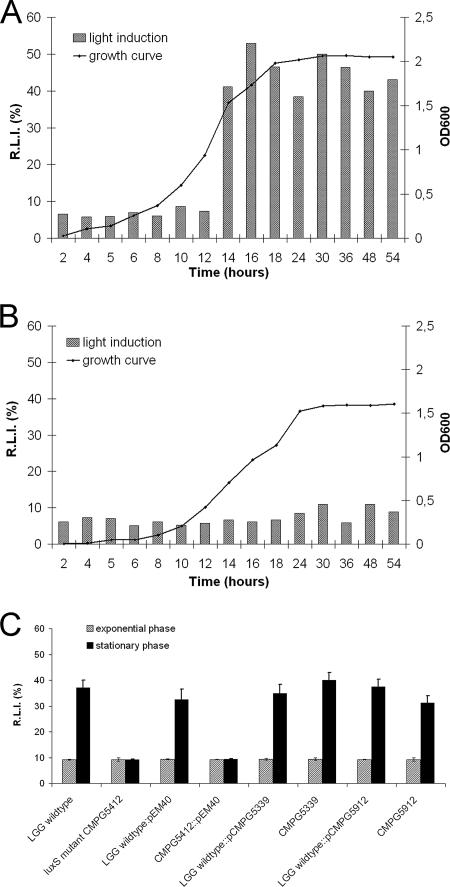
Detection of AI-2 activity in cell-free supernatant of L. rhamnosus GG strains by induction of V. harveyi BB170 luminescence. (A) Time course analysis of AI-2 activity in cell-free culture supernatant of wild-type L. rhamnosus GG (LGG) grown in modified MRS medium. For the detection of AI-2 activity, aliquots were removed for optical density measurements (line) and determinations of the capacity of conditioned medium to induce luminescence in V. harveyi BB170 at different time points (bars). The luminescence data are represented as relative light induction (R.L.I.) in percentages of induction by the positive control. The background level of luminescence was around 8% ± 2%. Time axes are not drawn to scale. (B) Lack of AI-2 activity in cell-free supernatant of luxS mutant CMPG5412. AI-2 activity was assessed as described above for the wild type. (C) Complementation of AI-2 production in the luxS mutant CMPG5412 with plasmid pCMPG5339 (P2-luxS) and pCMPG5912 (P1-yxjH-luxS). Strains with the empty cloning vector pEM40 served as a negative control. Conditioned medium was prepared from the exponential (OD600 of 0.3 to 0.4) and stationary (OD600 of 1.8 to 2) growth phases.
FIG. 4.
FIG. 4.
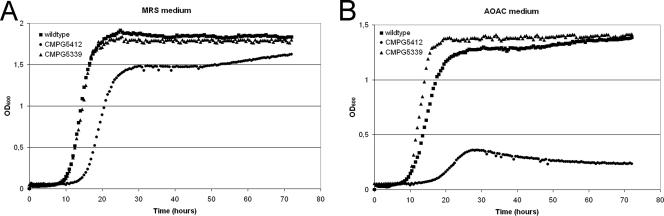
Role of luxS in optimal growth of L. rhamnosus GG. Growth of wild-type L. rhamnosus GG (square), its isogenic luxS mutant strain CMPG5412 (closed circle), and the complemented strains CMPG5339 (triangle) and CMPG5912 (data not shown) was assessed by measuring the OD600 every half hour for three consecutive days in MRS medium (A) and Lactobacilli AOAC medium (B). The complemented strain CMPG5912 showed the same growth characteristics as strain CMPG5339 (data not shown).
FIG. 5.
FIG. 5.
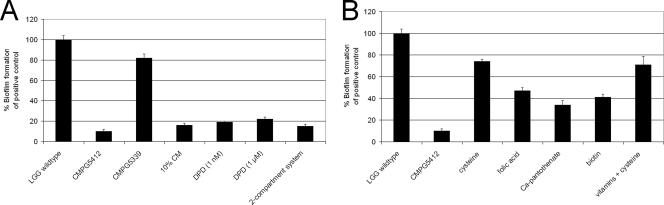
Role of AI-2 and luxS in monospecies biofilm formation by L. rhamnosus GG. (A) Biofilm formation capacities of wild-type L. rhamnosus GG (LGG) and luxS mutant strain CMPG5412 were compared. Biofilm formation of wild-type L. rhamnosus GG in AOAC medium served as a positive control in all the experiments and was set to 100%. The error bars represent standard deviations. Intracellular genetic complementation of biofilm formation of the luxS mutant could be achieved with the constructs pCMPG5339 (P2-luxS) (shown) and pCMPG5912 (P1-yxjH-luxS). Additionally, the role of AI-2 in the monospecies biofilm of L. rhamnosus GG was investigated using different extracellular complementation experiments to recover biofilm growth of luxS mutant strain CMPG5412, namely, 10% conditioned medium (CM), chemically synthesized DPD in different concentrations, and coculture with the wild type in a two-compartment system (0.22 μm). As a control, these conditions were also tested for wild-type L. rhamnosus GG, but no influence on biofilm formation was observed (data not shown). (B) Nutritional complementation experiments to investigate the metabolic cause of the defective biofilm formation of L. rhamnosus GG luxS mutant strain CMPG5412. SAM (1 mM) (data not shown), methionine (100 μM) (data not shown), cysteine (2 mM), folic acid (0.01 μg/ml), biotin (5 μg/ml), and pantothenic acid (10 μg/ml) were added to AOAC medium, and biofilm formation of wild-type L. rhamnosus GG (control) (not shown) and luxS mutant strain CMPG5412 (shown) was assessed. Additionally, the addition of the vitamin mix combined with cysteine (as described in Table 3) was investigated.

References

    1. Altermann, E., W. M. Russell, M. A. Azcarate-Peril, R. Barrangou, B. L. Buck, O. McAuliffe, N. Souther, A. Dobson, T. Duong, M. Callanan, S. Lick, A. Hamrick, R. Cano, and T. R. Klaenhammer. 2005. Complete genome sequence of the probiotic lactic acid bacterium Lactobacillus acidophilus NCFM. Proc. Natl. Acad. Sci. USA 102:3906-3912. - PMC - PubMed
    1. Alvarez, M. A., M. Herrero, and J. E. Suarez. 1998. The site-specific recombination system of the Lactobacillus species bacteriophage A2 integrates in gram-positive and gram-negative bacteria. Virology 250:185-193. - PubMed
    1. Bassler, B. L., E. P. Greenberg, and A. M. Stevens. 1997. Cross-species induction of luminescence in the quorum-sensing bacterium Vibrio harveyi. J. Bacteriol. 179:4043-4045. - PMC - PubMed
    1. Bassler, B. L., M. Wright, R. E. Showalter, and M. R. Silverman. 1993. Intercellular signalling in Vibrio harveyi: sequence and function of genes regulating expression of luminescence. Mol. Microbiol. 9:773-786. - PubMed
    1. Beeston, A. L., and M. G. Surette. 2002. pfs-dependent regulation of autoinducer 2 production in Salmonella enterica serovar Typhimurium. J. Bacteriol. 184:3450-3456. - PMC - PubMed

Publication types

MeSH terms

Associated data

LinkOut - more resources