


Community structure of ammonia-oxidizing bacteria under long-term application of mineral fertilizer and organic manure in a sandy loam soil
- PMID: 17098920
- PMCID: PMC1796994
- DOI: 10.1128/AEM.01536-06
Community structure of ammonia-oxidizing bacteria under long-term application of mineral fertilizer and organic manure in a sandy loam soil
Abstract
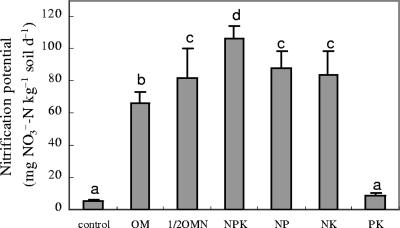
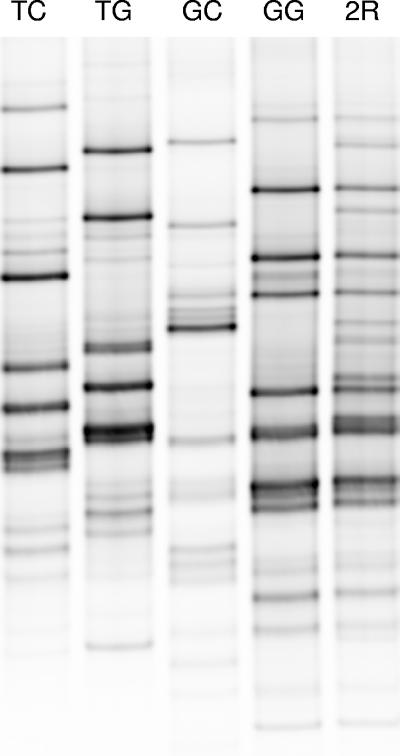
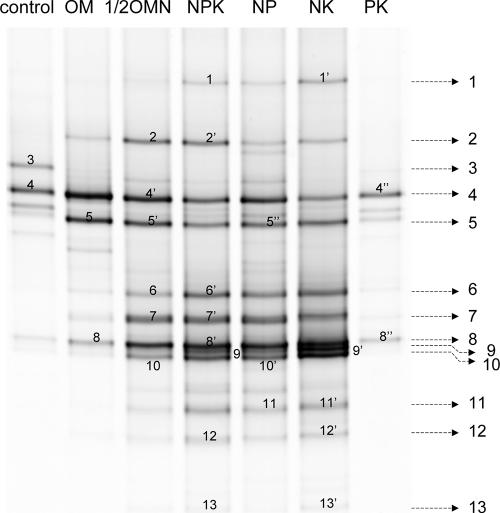
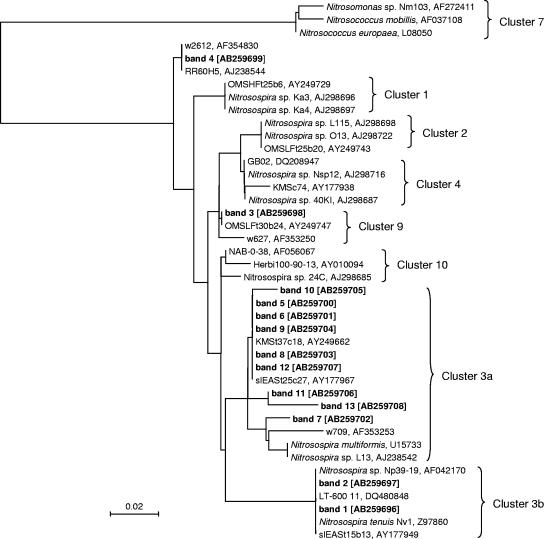
The effects of mineral fertilizer (NPK) and organic manure on the community structure of soil ammonia-oxidizing bacteria (AOB) was investigated in a long-term (16-year) fertilizer experiment. The experiment included seven treatments: organic manure, half organic manure N plus half fertilizer N, fertilizer NPK, fertilizer NP, fertilizer NK, fertilizer PK, and the control (without fertilization). N fertilization greatly increased soil nitrification potential, and mineral N fertilizer had a greater impact than organic manure, while N deficiency treatment (PK) had no significant effect. AOB community structure was analyzed by PCR-denaturing gradient gel electrophoresis (PCR-DGGE) of the amoA gene, which encodes the alpha subunit of ammonia monooxygenase. DGGE profiles showed that the AOB community was more diverse in N-fertilized treatments than in the PK-fertilized treatment or the control, while one dominant band observed in the control could not be detected in any of the fertilized treatments. Phylogenetic analysis showed that the DGGE bands derived from N-fertilized treatments belonged to Nitrosospira cluster 3, indicating that N fertilization resulted in the dominance of Nitrosospira cluster 3 in soil. These results demonstrate that long-term application of N fertilizers could result in increased soil nitrification potential and the AOB community shifts in soil. Our results also showed the different effects of mineral fertilizer N versus organic manure N; the effects of P and K on the soil AOB community; and the importance of balanced fertilization with N, P, and K in promoting nitrification functions in arable soils.
Figures
References
-
- Aakra, A., J. B. Utaker, and I. F. Nes. 1999. RFLP of rRNA genes and sequencing of the 16S-23S rDNA intergenic spacer region of ammonia-oxidizing bacteria: a phylogenetic approach. Int. J. Syst. Bacteriol. 49:123-130. - PubMed
-
- Aakra, A., J. B. Utaker, and I. F. Nes. 2001. Comparative phylogeny of the ammonia monooxygenase subunit A and 16S rRNA genes of ammonia-oxidizing bacteria. FEMS Microbiol. Lett. 205:237-242. - PubMed
-
- Avrahami, S., W. Liesack, and R. Conrad. 2003. Effects of temperature and fertilizer on activity and community structure of soil ammonia oxidizers. Environ. Microbiol. 5:691-705. - PubMed
-
- Avrahami, S., and R. Conrad. 2005. Cold-temperature climate: a factor for selection of ammonia oxidizers in upland soils? Can. J. Microbiol. 51:709-714. - PubMed
Publication types
MeSH terms
Substances
Associated data
- Actions
- Actions
- Actions
- Actions
- Actions
- Actions
- Actions
- Actions
- Actions
- Actions
- Actions
- Actions
- Actions
LinkOut - more resources
Full Text Sources
Medical
Miscellaneous
